
News
Do American citizens need a visa for France? Short stays, ETIAS and the student long-stay visa

The figures below are fixed by French and EU regulation and published on official sources. Short-stay travel is capped at 90 days in any 180-day window [france-visas.gouv.fr, 2026]. The student long-stay visa requires proof of at least €877.50 per month [service-public.fr, F2231, 2026], carries a €50 consular fee for applicants going through Campus France [france-visas.gouv.fr/etudiant, 2026], and must be validated online within three months of arrival, with a tax of €100 since 1 May 2026 [service-public.gouv.fr, A18881, 2026]. ETIAS, the travel authorisation due for visa-exempt nationals, is not yet required and carries no fee today [travel.state.gov, 2026].
Quick answer: do American citizens need a visa for France?
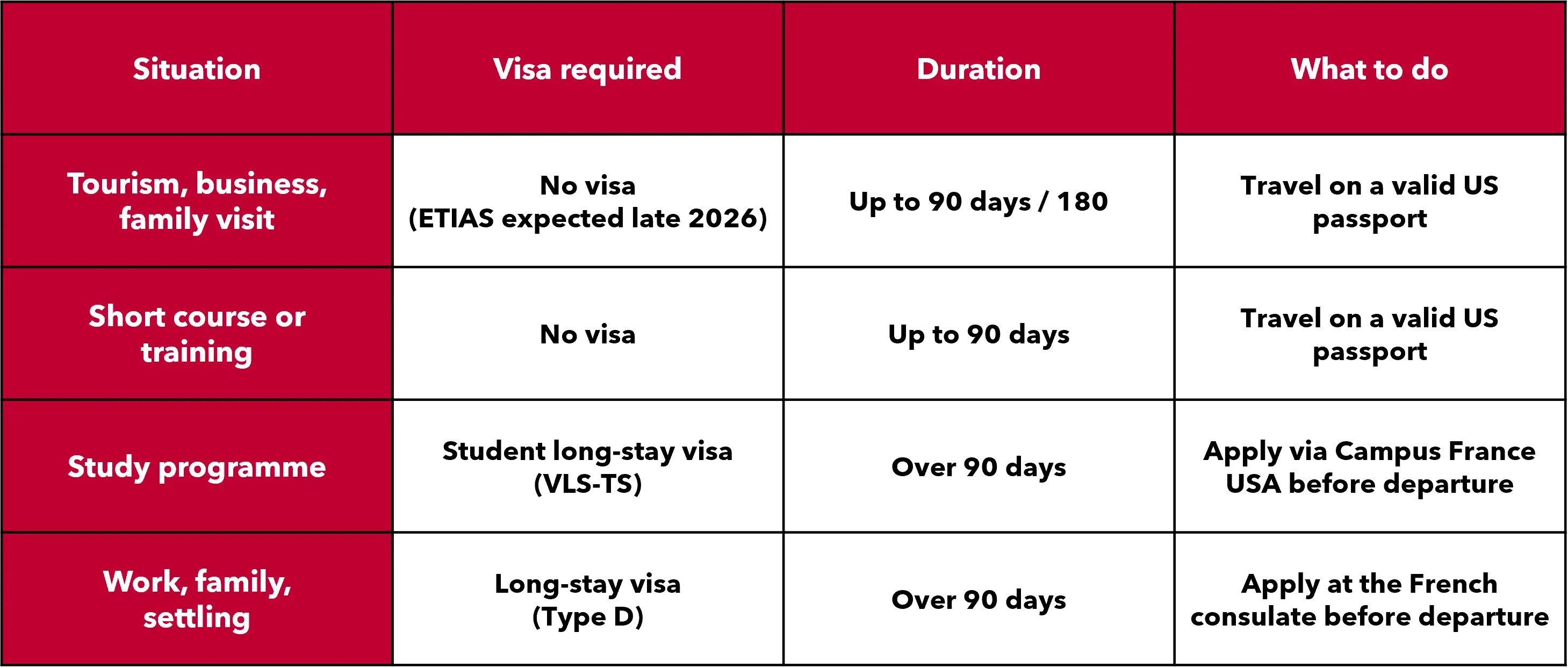
For a short stay, no. US citizens are exempt from a short-stay visa for visits of up to 90 days in any 180-day period, for tourism, business, family visits and short courses [travel.state.gov, 2026]. For a long stay, yes. Any stay above 90 days requires a long-stay visa applied for at a French consulate before departure, whatever the purpose.
-
A US citizen may enter France and the wider Schengen Area without a visa for up to 90 days in any 180-day period, for tourism, business meetings, family visits, short training and transit [fr.usembassy.gov, 2026]. The exemption is automatic for American passport holders and needs no advance application, though it does not waive the entry checks set out below.
-
The 90-day ceiling is the dividing line. A stay above 90 days requires a long-stay visa, regardless of the reason: study, salaried work, family reunification or settling in France. There is no way to regularise a long stay from inside France, so the application has to be filed and approved in the United States before departure.
-
ETIAS, the European Travel Information and Authorisation System, is a pre-travel screening for visa-exempt nationals, not a visa and not a replacement for the long-stay visa. It is not in force yet, and US citizens should not pay any "ETIAS fee" before the system opens [travel.state.gov, 2026]. Its expected schedule is covered below.
Entry rules for US passport holders
A valid passport and a stay within the 90-day limit are the two conditions that govern visa-free entry. Both are checked at the external Schengen border, where the exemption from a visa does not remove the duty to justify the trip.
Visa-free short stays and the 90/180-day rule
The Schengen area is the group of European countries that have abolished checks at their shared internal borders, which means that France shares a single external border and a single short-stay clock with the other member states. Time counts across the whole area, so days spent in Italy or Spain reduce the days still available in France.
The 90/180-day rule means that a US citizen may spend at most 90 days inside the Schengen Area within any rolling 180-day period. The count is checked backwards at each entry, and an overstay leads to penalties and a possible re-entry ban. The rule covers tourism and business but never study or work beyond the 90 days.
Passport validity and what to carry at the border
A US passport must have been issued within the previous ten years and remain valid for at least three months beyond the planned date of departure from the Schengen Area [france-visas.gouv.fr, 2026]. Some online sources quote a "six-month" rule; the official French requirement is three months beyond departure.
Even without a visa, border officers may ask a traveller to show the purpose and conditions of the stay: a return or onward ticket, confirmed accommodation, travel-medical insurance of at least €30,000 covering emergency care and repatriation, and sufficient means of subsistence [france-visas.gouv.fr, 2026]. The daily reference amount depends on the lodging: about €65 a day with a confirmed hotel booking, €32.50 a day when staying with a host who has a validated attestation d'accueil, and €120 a day when no accommodation is proven [france-visas.gouv.fr, 2026].
Entering France is not the same as studying or working there
Visa-free entry covers a short visit only. It does not authorise a stay beyond 90 days, enrolment in a programme that runs longer than three months, or paid work. A US student who plans a full academic year on a French campus therefore falls outside the exemption and into the long-stay regime described later in this guide.
Border modernisation for 2026: EES and ETIAS
The European Union has modernised its external border with two separate electronic systems. They change how short stays are recorded and authorised, and they matter to US travellers because American citizens are visa-exempt.
The Entry/Exit System (EES) for US travellers
The Entry/Exit System (EES) is a digital register that replaces the manual passport stamp with a biometric record of each entry and exit. It began a phased roll-out on 12 October 2025 and became fully operational across the 29 participating countries on 10 April 2026 [diplomatie.gouv.fr, 2026; home-affairs.ec.europa.eu, 2026]. On arrival, a visa-exempt traveller gives four fingerprints and a facial image, with children under 12 exempt from fingerprints. The system records short-stay travellers only and does not apply to holders of a long-stay visa such as the VLS-TS.
How ETIAS will work for American citizens
ETIAS is an electronic travel authorisation that visa-exempt nationals, US citizens included, will need before travelling to the participating European countries for a short stay. It is scheduled to launch in the final quarter of 2026 [travel-europe.europa.eu, 2026]. A transition period runs from October 2026 to April 2027, during which travellers can apply but may still enter without an active authorisation; registration becomes progressively mandatory from April 2027 and fully mandatory by October 2027. The application costs €20, with applicants under 18 or over 70 exempt, and an approved authorisation lasts three years or until the passport expires, allowing multiple short stays within the 90/180 limit. Most decisions arrive within minutes, though a manual review can take up to 96 hours.
Long-stay visa holders do not need ETIAS
ETIAS covers short, visa-free travel only. A US student holding a VLS-TS étudiant does not need it, because the long-stay visa already authorises the stay. The same applies to anyone holding a French residence permit.
When American citizens need a long-stay visa
Any stay over 90 days requires a long-stay visa, and the rule holds whatever the reason for the move. The popular answer that Americans need no visa for France applies only up to this 90-day ceiling.
The rule: over 90 days means a long-stay visa
A US citizen who intends to study, work, join family or settle in France for more than three months must obtain a long-stay visa (visa de long séjour, Type D) before leaving the United States. The category depends on the purpose, and the supporting file differs accordingly, but the principle is constant: entry is arranged from the United States, in advance, never from inside France.
Common reasons: study, work, family
Study is the most common long-stay reason for young Americans, and it follows its own track through Campus France, set out below. Salaried work requires an employer and a work authorisation, family reunification rests on a qualifying relative, and settling without working calls for a visitor visa with proof of resources. Each route ends in a residence document once the holder is in France.
The long-stay visa and the VLS-TS that doubles as a residence permit
Entering France and residing there are two different permissions. The standard student form, the VLS-TS, settles both at once: it is the entry visa and, once validated online, the residence permit for the first academic year. That dual function is why a US student validates the visa through a French portal soon after arrival rather than applying for a separate card.
Studying in France as an American citizen: the student visa
The student long-stay visa (VLS-TS étudiant) is the document a US citizen needs to study in France for more than 90 days. It applies to any course above that length, at a public university or a private grande école such as SKEMA, and it is obtained through a fixed sequence that starts with Campus France USA.
-
A US citizen admitted to a French programme that runs longer than three months needs the VLS-TS étudiant. American students who begin at SKEMA's Raleigh campus in North Carolina and then continue their studies on a French campus move into this regime for the French part of their course, since the visa covers the time physically spent studying in France.
-
A study trip of 90 days or less, such as a short exchange or a summer programme, does not require a student visa or the Campus France procedure for a US citizen [usa.campusfrance.org, 2026]. It falls under the same short-stay exemption as tourism, within the 90/180 limit.
-
For a course above 90 days, the application begins with the Études en France platform run by Campus France USA, the mandatory pre-consular step for students resident in the United States. The student opens a file, uploads the acceptance letter and transcripts, pays the service fee and attends an interview, which produces the certificate that unlocks the visa application. The regulatory threshold for proof of funds is €877.50 per month over the duration of the studies, with €1,000 or more advisable for Paris [service-public.fr, F2231, 2026], and a SKEMA scholarship can count towards that proof. Every student also pays the CVEC student-life contribution, set at €105 for 2025-2026, before enrolling. A US student admitted to a programme taught in France, whether the Master in Management delivered on the French campuses or a specialised MSc taught in France, follows this route in full.
How an American applies for a French student visa, step by step
From admission to arrival, the steps run in a set order, shared between the student, Campus France USA, the consulate and, after arrival, the ANEF portal. The chain is specific to applicants based in the United States.
- Secure admission and the acceptance letter. The file cannot start without a formal offer from a French institution; an admission to a French programme generates the letter that opens the procedure, which is the point at which a candidate can start a SKEMA application for a programme based in France.
- Complete the Campus France USA "Études en France" procedure, pay the service fee and obtain the certificate.
- Apply on the France-Visas portal, then book the in-person appointment at the visa application centre, operated in the United States by TLScontact.
- Attend the appointment with originals and biometrics. The Consulate General of France in Washington, D.C. is the sole authority that examines and decides US visa applications [france-visas.gouv.fr, 2026].
- Travel to France, then validate the VLS-TS online through the ANEF portal within three months of arrival.
The French consulate's external service provider in the United States changed from VFS Global to TLScontact on 18 April 2025, with ten application centres in Washington D.C., New York, Los Angeles, San Francisco, Chicago, Boston, Houston, Miami, Atlanta and Seattle [Consulate General of France in the United States, 2025]. For the full procedural detail of the student visa, from the Campus France file to the ANEF validation, the dedicated France student visa guide sets out each document and step.
Costs and processing times for a US student visa
The total cost combines the Campus France service fee, the consular visa fee, the application-centre fee, the post-arrival validation tax and the CVEC. The amounts below are the 2026 baseline for a US applicant.
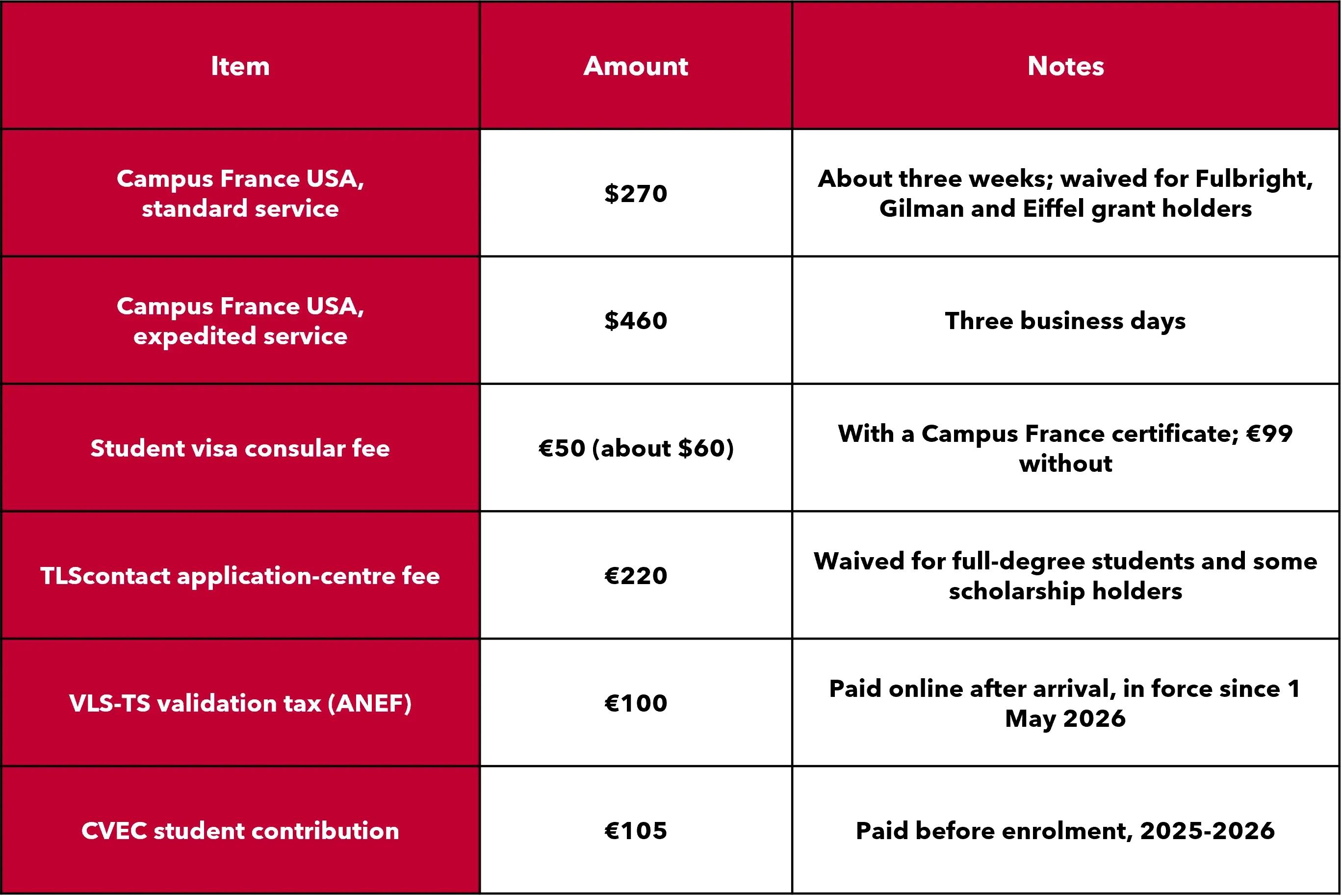
Sources for these amounts are usa.campusfrance.org, france-visas.gouv.fr/etudiant and service-public.gouv.fr (A18881), all 2026. Consular processing usually runs from two to eight weeks and lengthens during the summer peak, so the recommended start is four to five months before the programme begins. An application cannot be filed more than three months before departure.
Documents an American citizen needs
Consular services require a complete file, in original and digital form, and a single missing item halts the review. The documents fall into three groups.
Identity and admission. A US passport meeting the issuance and validity standards above, recent identity photographs, the official acceptance letter from the French institution, and the Études en France certificate from Campus France.
Means and lodging. Proof of at least €615 per month for the year, through bank statements, a scholarship award or a guarantor's commitment, and confirmed accommodation for at least the first three months. SKEMA's housing service for admitted students helps document this in a tight rental market, particularly in Paris.
Health and exit. A travel-medical insurance certificate covering emergency care, hospitalisation and repatriation up to at least €30,000, and a return ticket or proof of the means to leave the Schengen Area [france-visas.gouv.fr, 2026].
Working during and after your studies
A US student visa allows paid work alongside the course. A VLS-TS holder may work up to 964 hours a year, about 60% of full-time and roughly 20 hours a week, without a separate work permit [service-public.fr, F35796, 2026]. Mandatory internships under a convention de stage do not count towards that limit, and an internship longer than two months carries a minimum gratuity.
After graduation, a US citizen who completes an eligible French degree such as a master's can apply for the RECE permit (recherche d'emploi ou création d'entreprise) to stay and look for work or start a business [service-public.fr, F17319, 2026]. It runs for twelve months, is not renewable, and allows full-time work during that year. A graduate who returns to the United States can still apply for it from abroad up to four years after the degree, provided they held a student residence permit when it was awarded.
After you arrive in France
The first administrative task is to validate the visa. A US student validates the VLS-TS online through the ANEF portal within three months of arrival, using the visa details, the date of entry, the French address and a tax payment of €100 [service-public.gouv.fr, A18881, 2026]. Missing the deadline ends the holder's legal residence and, in practice, bars re-entry to the Schengen Area after leaving France.
Health cover and housing follow. Affiliation to the French health system (l'Assurance Maladie) is free and compulsory and is done at etudiant-etranger.ameli.fr after enrolment; the state scheme reimburses about 70% of standard costs, so a complementary policy (mutuelle) covers the rest [ameli.fr, 2026]. SKEMA's international student services guide admitted students through these formalities, and the school's student health service supports them through the year.
Travel scenarios for American citizens
The same rules produce different answers depending on the trip.
Tourist staying under 90 days. No visa, a valid US passport, and an eye on the 90/180 count. From late 2026, an ETIAS authorisation will be needed before departure.
Student staying several months. A VLS-TS étudiant obtained through Campus France USA before leaving, then validated on arrival. This is the route for an American admitted to a SKEMA programme on the Paris campus, in Lille or at Sophia Antipolis.
Business traveller. No visa for meetings, negotiations or short assignments within 90 days, on the same terms as tourism.
Moving to France long term. A long-stay visa matched to the purpose, applied for at the consulate before departure, then a residence permit once settled.
FAQ
-
Not for a short stay. US citizens can visit France for up to 90 days in any 180-day period without a visa, for tourism or business [travel.state.gov, 2026]. A visa is required for any stay over 90 days, including study, and from late 2026 short-stay travellers will also need an ETIAS authorisation.
-
Up to 90 days in any rolling 180-day period across the whole Schengen Area, not France alone. Days spent in other Schengen countries count towards the same limit. Staying beyond 90 days without a long-stay visa is an overstay and can lead to penalties and a re-entry ban.
-
Not yet. ETIAS is scheduled to launch in the final quarter of 2026, with a transition period into 2027 [travel-europe.europa.eu, 2026]. When it applies, US citizens will need it for short, visa-free stays. It costs €20, lasts three years, and is a travel authorisation, not a visa. Holders of a long-stay visa do not need it.
-
For a course longer than 90 days, yes: the student long-stay visa (VLS-TS étudiant), obtained through Campus France USA before departure. A short exchange or summer programme of 90 days or less does not require a student visa [usa.campusfrance.org, 2026].
-
Yes, up to 964 hours a year, about 60% of full-time, without a separate work permit [service-public.fr, F35796, 2026]. Study must remain the main purpose of the stay. Mandatory internships under a formal agreement do not count towards that annual limit.
-
The application goes through the France-Visas portal and an in-person appointment at a TLScontact centre in the United States, in one of ten cities. The Consulate General of France in Washington, D.C. is the only authority that decides US visa applications [france-visas.gouv.fr, 2026].
-
For a short stay, a US passport issued within the last ten years and valid for at least three months beyond departure is enough, though border officers may also ask for proof of accommodation, funds and onward travel [france-visas.gouv.fr, 2026]. For a stay over 90 days, the passport must carry a long-stay visa.
Official sources and a pre-travel checklist
The rules change by date, so the safest check before travelling is the official source for each point: travel.state.gov and fr.usembassy.gov for the US-side short-stay position, france-visas.gouv.fr and service-public.gouv.fr for visa rules and fees, usa.campusfrance.org for the student procedure, travel-europe.europa.eu for EES and ETIAS, and ameli.fr for health cover.
Before departure, a US citizen should confirm a valid passport, the right status for the length of stay (no visa under 90 days, a long-stay visa above it), any ETIAS authorisation once the system is live, the supporting documents that border officers may request, and, for a VLS-TS holder, the three-month deadline to validate the visa on arrival. For an admitted student, the file flows from the acceptance letter onward, and SKEMA's international, financial and housing services support each stage of the move to a French campus.