
News
How to build an employer branding strategy that attracts and retains talent

What is an employer branding strategy?
An employer branding strategy is the deliberate, long-term approach a company takes to define, communicate and protect its reputation as an employer. It is easy to confuse four terms that sit close together, so it helps to separate them.
Your employer brand is the perception people already hold of you as a place to work, which can be positive, neutral or negative whether or not you manage it. Your employer value proposition, or EVP, is the promise you want to make: the unique set of offerings, associations and values you give employees in return for their contribution, spanning culture, career development, pay and work-life balance. Employer branding is the process and the activities that communicate the EVP and shape the employer brand over time. Recruitment marketing is narrower again: the campaigns and channels you use to fill specific roles. The strategy is the layer above all of these, the plan that makes them consistent.
The distinction matters because most reputational problems come from a gap between the three. A company can run polished recruitment campaigns on an EVP its own employees would not recognise, and the market notices.
Why employer branding matters now
The business case rests on a simple shift: pay alone no longer secures talent. The CIPD finds that candidates increasingly weigh career development, clear organisational values and flexible working alongside salary, and that 68% of employers offering hybrid or remote working say it has helped them attract and retain people. Retention is under the same pressure, with 56% of UK employers in the 2024 survey finding it harder to keep talent than the year before.
What employees want is now well documented. Randstad's 2025 Employer Brand Research, which covers 34 markets and more than three-quarters of the global economy, ranks the top five drivers of employer attractiveness as salary and benefits, work-life balance, long-term job security, a pleasant working atmosphere, and equity, which entered the top five for the first time. The weighting shifts by demographic: the importance of pay rises with age and is lowest among Gen Z, while women and younger workers place more value on equity. An employer branding strategy is how you decide which of these promises you can credibly own, and which you cannot.
There is also a timing argument. The CIPD's Winter 2025/26 Labour Market Outlook notes that as hiring pressure eases, falling vacancy levels create space to strengthen the employer brand, and advises employers to focus on job quality, inclusion and realistic role design. The quieter moment is the one to invest in reputation, before the next squeeze.
The building blocks of a strong employer brand
A strong employer brand rests on four pillars.
- Employer value proposition. The core promise, expressed in a way that is true, credible, relevant, distinctive and aspirational. Everything else flows from it.
- Culture and lived values. Not the values on the wall, but the ones employees experience day to day, which is what review sites and referrals expose.
- Candidate and employee experience. Every touchpoint from a job advert to onboarding either confirms or contradicts the promise.
- Communication and proof. The channels and, crucially, the evidence: stories, data and employee voices that make the promise believable.
A useful shorthand, the four P's of employer branding, maps onto these pillars. Promise is what you offer employees. People are those who bring the brand to life and prove it is real. Proof is the evidence behind the EVP. Promotion is how you communicate it across channels. If any of the four is missing, the brand wobbles: promotion without proof reads as spin, and a promise without people behind it does not survive contact with Glassdoor.
How to build an employer branding strategy, step by step
Building the strategy follows a sequence. Seven steps take you from the first audit through to ongoing optimisation.
- Audit your current employer brand. Gather employee and candidate feedback, read your review-site sentiment, and look honestly at your careers site, job adverts and social presence. The aim is to find the gap between how you see yourself and how the market sees you.
- Define or refine your EVP. A reliable method is to audit what employees actually value through surveys, focus groups and interviews, benchmark against comparable employers, align the result with business strategy, then define EVP pillars that are true, credible, relevant, distinctive and aspirational, and test them with employees before launch.
- Segment your talent personas. Early-career engineers and senior commercial leaders do not respond to the same message. Segment by role, seniority and geography so the EVP can be expressed, not diluted.
- Align stakeholders. Employer branding fails when HR, talent acquisition, marketing, leadership and hiring managers each tell a different story. Agree who owns the brand and how decisions are made before any content goes out.
- Build a messaging matrix. Map each EVP theme to its proof points, its audience and the channels where it lands, so every team works from the same source.
- Activate across content and campaigns. Turn the matrix into a content plan: careers-site pages, employee stories, recruiter outreach and paid campaigns, sequenced rather than scattered.
- Measure and optimise. Track the metrics that matter, review them on a fixed cadence, and feed what you learn back into the EVP and the content.
Employer branding across channels
Channels carry the EVP, and each plays a different role.
- The careers site is the conversion hub, the one channel you fully control. It should make the EVP explicit, show proof, and remove friction from the application itself.
- LinkedIn carries thought leadership, culture and roles, and is where senior and passive candidates form their first impression.
- Short-form social suits culture content and employee voices, where authenticity outperforms production value.
- Employee advocacy and employee-generated content can add credibility because they show the employee experience in a more direct, personal way than corporate messaging. Give employees space to share authentic perspectives on their work, while providing clear guidance on confidentiality and brand standards.
- Job descriptions are an underused branding surface: aligning role messaging with the EVP turns a transactional advert into a brand touchpoint.
- Review sites are not optional. Responding to reviews, learning from them and acting on the patterns shapes perception more than any campaign.
How to measure employer branding performance
Employer branding earns its budget only when it is measured against hiring and retention outcomes, not vanity metrics. A simple framework tracks four levels.
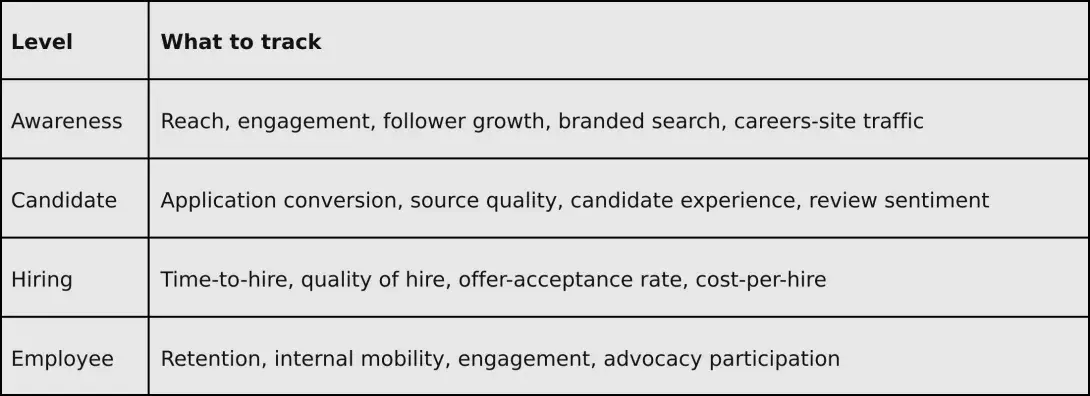
The practical tool is a scorecard that, for each metric, records a baseline, a target, an owner and a review frequency. Awareness metrics show whether the brand is reaching people; hiring and employee metrics show whether it is changing behaviour. A strategy that lifts engagement but never moves offer-acceptance or attrition is measuring the wrong thing.
Trends reshaping employer branding in 2026
Four shifts are changing how the strategy is run.
Artificial intelligence is moving into talent attraction, from drafting job descriptions to analysing candidate sentiment and personalising outreach. The value is in speed and scale, but the limit is trust: AI can draft a message, yet authenticity, judgement and the human story behind the brand cannot be automated. The questions this raises, about where algorithmic help ends and human responsibility begins, are exactly the ones SKEMA's Centre for Artificial Intelligence studies through the lens of human-centric, responsible AI.
Skills-based hiring is reshaping the EVP. The World Economic Forum's 2025 Future of Jobs report names analytical thinking the most sought-after core skill, with seven employers in ten calling it essential, and puts AI and big data at the top of the fastest-growing skills. Employers that can credibly promise to build these skills, not just hire them, hold an attraction advantage.
Early-career expectations are specific and well evidenced. SKEMA's 2025 Talent Barometer, a survey of young professionals, finds that 96% want clear opportunities to progress and 48% expect strong pay, alongside genuine commitments to inclusion and sustainability. Employers that want to reach this cohort increasingly build relationships with the institutions that train them, for example by recruiting emerging talent directly through campus partnerships.
Authenticity and flexibility underpin all of it. Employee-generated content keeps gaining ground over corporate messaging, and flexible working has shifted from a perk to a baseline expectation that shapes whether candidates apply at all.
Common employer branding mistakes to avoid
Most failures repeat a short list of errors.
- Promising a culture employees do not live. New hires spot the gap quickly, and some turn into detractors.
- Generic messaging. A promise that could describe any employer attracts no one.
- Ignoring review sites and candidate feedback, which leaves the loudest version of your brand unmanaged.
- No stakeholder alignment, so leadership, HR and hiring managers each tell a different story.
- Vanity metrics. Likes and reach look healthy while hiring and retention outcomes go untracked.
- Forgetting current employees, who are the proof the whole strategy depends on.
Conclusion and next steps
An employer branding strategy is an operating discipline, not a one-off campaign. You define a credible EVP, prove it through your employees and your channels, then measure it against hiring and retention. The organisations that do this well treat it as a leadership capability that shapes culture, governance and the way managers behave, which is why it rarely works as a marketing task alone. Building that capability inside an HR and leadership team is where structured executive learning pays off, through SKEMA's customised programmes for companies and its wider executive education portfolio, designed to help organisations develop the people who will lead the transition.
Frequently asked questions
-
The four pillars are the employer value proposition, culture and lived values, candidate and employee experience, and communication backed by proof. Together they ensure the promise you make is distinctive, true and visible across every touchpoint.
-
Promise, People, Proof and Promotion. Promise is what you offer employees, People are those who embody it, Proof is the evidence behind the promise, and Promotion is how you communicate it across channels. A brand weakens when any of the four is missing.
-
Ownership is shared but must be coordinated. HR and talent acquisition usually lead, with marketing, leadership and hiring managers all contributing. The strategy works only when one team is accountable for keeping the message consistent across functions.
-
Activation can begin within a few months, but shifting market perception is a multi-year effort because reputation lags reality. A realistic plan sets early milestones, such as a defined EVP and an audited careers site, while tracking awareness and hiring metrics over a longer horizon.
-
Track outcomes, not vanity metrics: time-to-hire, quality of hire, offer-acceptance rate, cost-per-hire, and retention, set against a baseline. Pair these with awareness and candidate measures so you can see both whether the brand is reaching people and whether it is changing hiring results.