News
Student visa for the USA: requirements, costs and how to apply
This guide sets out the federal rules in force in 2026, with the dollar amounts and timing windows that govern each step, for prospective international students preparing for a programme in the United States, including those targeting the SKEMA Business School campus in Raleigh, North Carolina.
The cost stack is fixed and non-refundable: $350 for the SEVIS I-901 fee, $185 for the DS-160 / MRV visa fee, plus a country-dependent reciprocity fee. The calendar is equally strict: the visa can be issued up to 365 days before the programme start date, but CBP will refuse admission more than 30 days before that date. Every figure below is sourced to the relevant US federal authority (Department of State, ICE, USCIS, DHS Study in the States) and reflects the framework in force in 2026.
F-1, M-1 and J-1: which student visa do you need?
The US Department of State classifies non-immigrant visas by the primary purpose of entry. Three categories cover educational mobility, with different documents, schools and post-study options.
The operational differences between the three categories matter for what students can actually do once in the country:
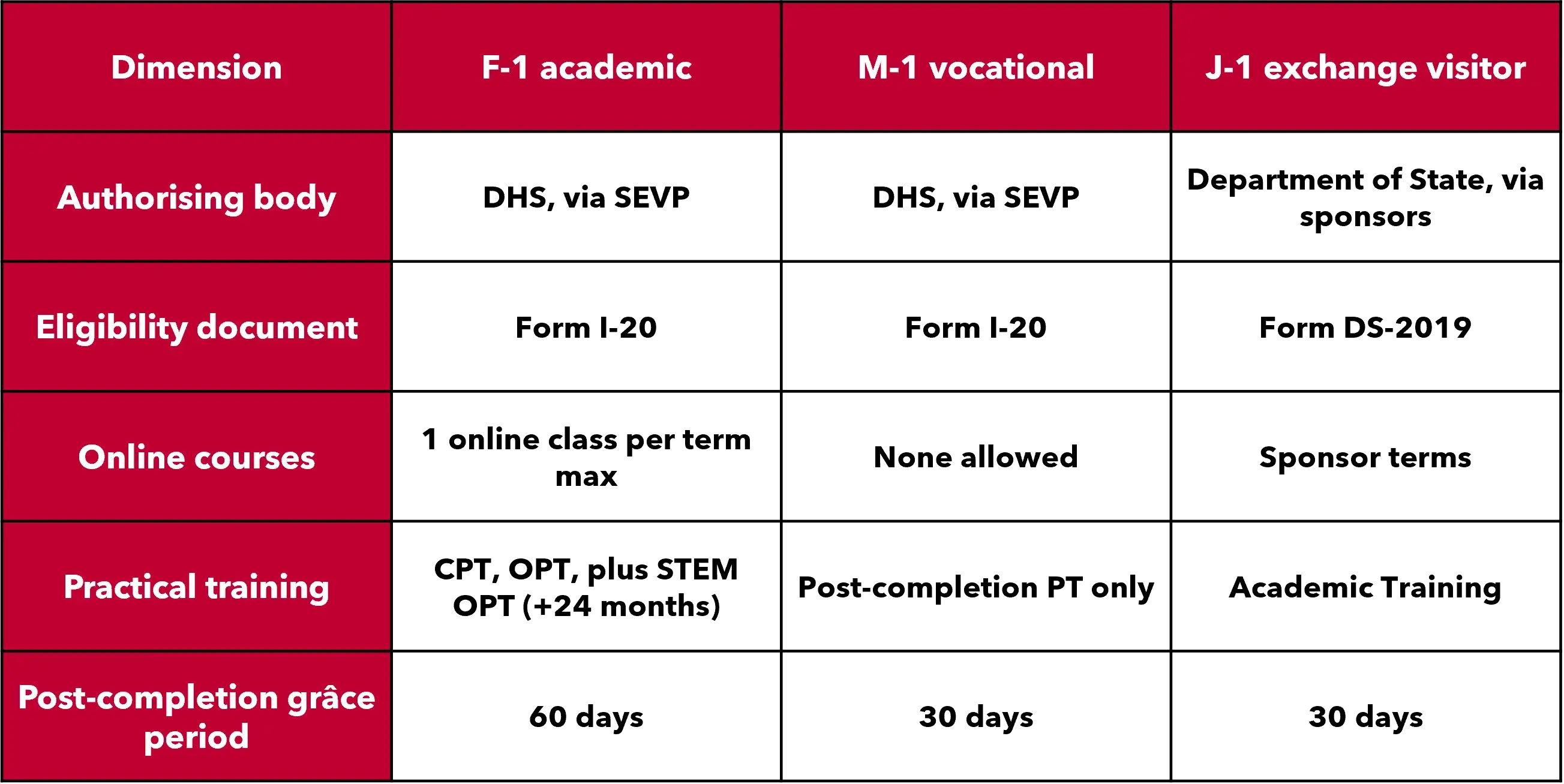
[Source : travel.state.gov, studyinthestates.dhs.gov, 2026]
Spouses and unmarried children under 21 may accompany F-1 and M-1 students under the F-2 or M-2 dependent status. Dependents are exempt from the SEVIS fee but cannot work in the United States.
Eligibility requirements for a US student visa
Securing an F-1 or M-1 visa rests on three pillars set by the Department of Homeland Security and the Department of State.
-
Only schools certified under federal regulations may register students in the Student and Exchange Visitor Information System (SEVIS) and issue the Form I-20. The I-20 is a legally binding record listing programme start and end dates, school codes, estimated tuition and living costs, and the student's unique SEVIS ID. Both the school's Designated School Official (DSO) and the student must sign the document to activate it. Multi-campus business programmes such as SKEMA's BBA in International Business, which includes a track delivered on the SEVP-certified Raleigh campus, fall within this regime.
-
Applicants must show objective, verifiable evidence that they can cover tuition, living and travel costs for the duration of the programme. Consular officers expect original bank statements, sponsor affidavits or formal scholarship awards, with the assets liquid and traceable. Non-liquid wealth (real estate, future business revenues) does not meet the test.
-
Section 214(b) of the Immigration and Nationality Act (INA) presumes every non-immigrant visa applicant to be an intending immigrant. The legal burden of proof rests on the applicant, who must show "strong ties" to their country of residence (family connections, employment contracts, property) that will compel them to leave the United States at the end of their authorised stay [Source : travel.state.gov, INA §214(b), 2026].
How to apply for a US student visa, step by step
The path from admission to arrival is a chronological sequence shared between the school, the student and US consular services. Missing or reversing a step delays everything downstream.
-
The student applies to an SEVP-certified institution and receives a formal offer of admission. The school's DSO then registers the student's biographic and academic details in SEVIS and issues the signed Form I-20 directly to the student.
-
Once the I-20 is in hand, the student pays the SEVIS I-901 fee ($350 for F-1 and M-1 applicants) through the fmjfee.com portal [ICE, ice.gov/sevis/i901, in force since 24 June 2019]. The student then completes the Form DS-160 online and pays the $185 MRV visa application fee to the Department of State [travel.state.gov, in force since 30 May 2023].
-
The student schedules a visa interview at the US Embassy or Consulate with jurisdiction over their place of residence, attends in person with the required documents, and undergoes digital fingerprint scans. If approved, the embassy issues the visa stamp in the passport.
-
The student travels to the United States and presents passport, valid visa and original Form I-20 to a CBP officer at the port of entry. Admission is at the officer's discretion and is recorded under "Duration of Status" (D/S).
The student is the responsible party for steps 2 to 4; the school owns step 1 and continues to act through the DSO throughout the entire programme.
How much does a US student visa cost?
The fee structure is set by federal regulation, paid to distinct agencies and entirely non-refundable, including on refusal.
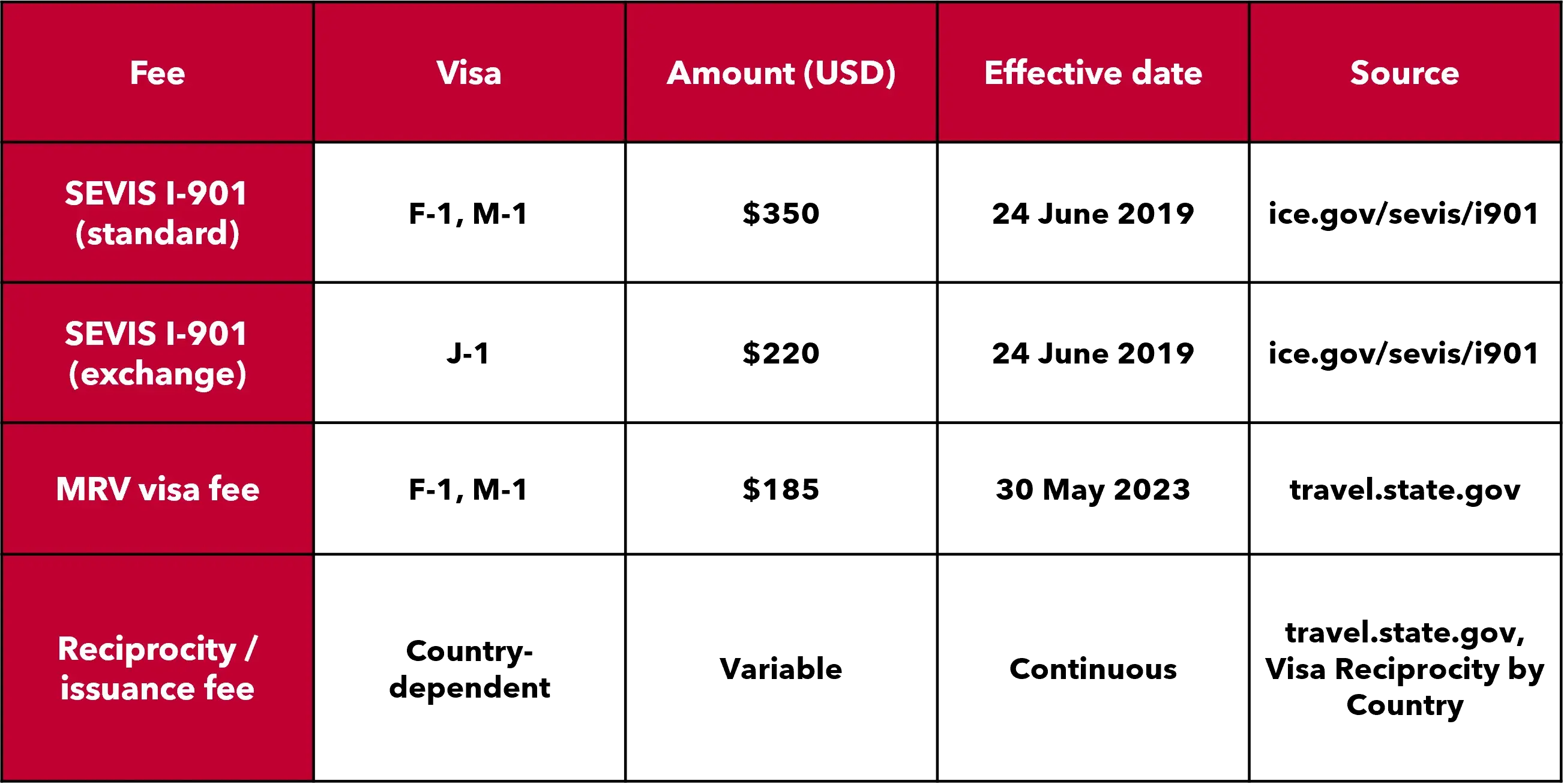
The reciprocity fee, paid to the US consular post after approval and before passport printing, varies according to bilateral treaties; applicants should check the Visa Reciprocity table for their country of nationality before budgeting. None of these fees are refunded if the visa is refused, postponed or abandoned.
Timeline: when should you apply?
The student visa process operates inside three federal windows. Missing any of them costs time, money or both.
Visa issuance window: 365 days before the programme start date. Consular officers may issue F-1 and M-1 visas up to one year before the start date on the Form I-20 [travel.state.gov, 2026].
Pre-arrival window: 30 days before the programme start date. Students are strictly prohibited from entering the United States more than 30 days before the start date on the I-20; attempting earlier entry results in CBP denial at the port of entry [studyinthestates.dhs.gov, 2023 guidance in force in 2026].
SEVIS fee validity: 12 months from the date of payment. The fee must be active and valid at both the consular interview and the port of entry. If the programme is deferred beyond that window, the fee has to be paid again [ICE, ice.gov/sevis/i901, 2026].
Consular processing times vary by post and season. Routine approvals are issued within days of the interview, but cases flagged for administrative processing under INA §221(g) can be delayed by several weeks or months [travel.state.gov]. A defensible plan is to secure the Form I-20 and file the DS-160 three to four months before the intended travel date.
The visa interview: what to bring and what officers assess
The consular interview is the gatekeeping moment of the process. It is conducted in person at the US Embassy or Consulate with jurisdiction over the applicant's place of residence.
Mandatory documents at the window:
- A passport valid for travel to the United States, with at least 6 months of validity beyond the intended stay.
- The Form DS-160 barcode confirmation page.
- The MRV fee payment receipt.
- A photograph meeting US visa specifications, if the digital upload during the DS-160 failed.
- The original, signed Form I-20 (printed copies are accepted only in very limited consular circumstances).
- The SEVIS I-901 payment confirmation receipt.
Documents to have available, even when not requested:
- Financial documentation showing liquid capital, sponsor support or institutional funding sufficient to cover at least the first year of tuition and living costs listed on the I-20.
- Academic credentials: transcripts, diplomas, standardised test scores (TOEFL, SAT, GMAT) and the formal acceptance letter.
- Objective evidence of ties to the home country (employment records, family registries, proof of property).
During the brief interaction, the consular officer evaluates three legal requirements: academic authenticity (the student has the language and scholastic capability to undertake the programme), financial integrity (funds are liquid, traceable and sufficient to remove any pressure to work illegally), and non-immigrant intent (a credible plan to return home, backed by verifiable ties that overcome the §214(b) presumption).
After you arrive: maintaining status and working in the USA
Admission by CBP places the student in Duration of Status (D/S), valid as long as the student maintains enrolment and complies with federal regulations.
-
F-1 students at undergraduate level must register for at least 12 credit hours per term [studyinthestates.dhs.gov]. Graduate students must take a full course load as certified by the institution. Address changes must be reported to the DSO within 10 days. Students are subject to US federal taxation on US-sourced wages, taxable scholarships and similar income.
-
F-1 students may work on campus up to 20 hours per week while school is in session, and up to 40 hours per week during official school breaks, provided they are enrolled for the following term [studyinthestates.dhs.gov].
-
Off-campus employment or internship that forms an integral, required part of the curriculum, directly tied to the major field of study. CPT can be part-time or full-time, but a cumulative 12 months or more of full-time CPT permanently disqualifies the student from post-completion OPT [studyinthestates.dhs.gov].
-
Up to 12 months of off-campus work authorisation per higher education level (bachelor's, master's, doctorate), relevant to the major field of study. The Form I-765 must be filed with USCIS up to 90 days before the programme end date and no later than 60 days after it, and within 30 days of the DSO entering the OPT recommendation in SEVIS. The student is restricted to 90 days of cumulative unemployment during post-completion OPT [studyinthestates.dhs.gov, uscis.gov, 2026].
-
Graduates of eligible STEM degrees on the DHS STEM Designated Degree Program List may apply for an additional 24-month extension of OPT, for a potential total of 36 months. The employer must be registered in E-Verify and must sign a Form I-983 training plan. STEM OPT extends the cumulative unemployment cap from 90 to 150 days. A student is limited to 2 STEM extensions in a lifetime [USCIS, 2026].
-
F-1 students have 60 days from the programme or OPT end date to depart, change educational level or request a SEVIS transfer; M-1 students have 30 days. Departing the United States during the grace period immediately invalidates the remaining days, and travel re-entry during that window is prohibited. For ordinary international travel during the programme, students must present a valid passport, valid visa and a current Form I-20 endorsed with a DSO travel signature.
The international structure of the SKEMA MSc in International Business, which includes a Raleigh track among its multi-campus options, illustrates how OPT and STEM OPT eligibility shapes the post-graduation calendar for students targeting the US labour market.
Common reasons for visa refusal
Refusals concentrate in a small number of recurring patterns, almost all of which are documentary or evidential rather than discretionary.
- INA §214(b), insufficient strong ties. The applicant cannot articulate verifiable ties to their home country that justify departure after graduation.
- INA §214(b), incoherent academic pathway. The chosen US programme does not credibly align with the applicant's past studies or stated career plans.
- INA §221(g), incomplete documentation. Missing originals (signed I-20, valid financial statements), triggering refusal or a consular hold. Unresolved §221(g) cases are terminated after 12 months and the fees are forfeited [travel.state.gov].
- Financial deficiencies. Non-liquid or untraceable assets presented in place of bank-grade evidence covering the I-20 cost estimate.
- Status violations. Unauthorised off-campus work, exceeding the OPT or STEM OPT unemployment caps, or attempting to enter the United States more than 30 days before the I-20 start date. Any of these can result in immediate SEVIS termination, loss of benefits and removal proceedings.
FAQ
-
For full-time academic study at a SEVP-certified college, university or language school, the F-1 visa applies. For vocational or technical programmes excluding language training, the M-1 visa applies. Government and sponsor-funded exchange programmes use the J-1 visa.
-
The Form I-20 is the Certificate of Eligibility for Nonimmigrant Student Status issued by an SEVP-certified school after admission. It lists the programme dates, school codes, estimated costs and the student's SEVIS ID, and must be signed by both the DSO and the student. It is the prerequisite to paying the SEVIS fee, filing the DS-160 and attending the visa interview.
-
The mandatory federal fees are $350 for the SEVIS I-901 (F-1 / M-1) and $185 for the DS-160 / MRV visa fee, plus a country-dependent reciprocity fee paid after approval. All fees are non-refundable. Country-specific reciprocity amounts are published on travel.state.gov.
-
A maximum of 30 days before the programme start date listed on the Form I-20. Earlier arrival will be refused by CBP at the port of entry. The visa itself can be issued up to 365 days before the start date.
-
F-1 students may work on campus up to 20 hours per week during term and 40 hours per week during official school breaks. Off-campus work requires prior authorisation through CPT (curricular) or OPT (12 months, with up to 24 additional months for eligible STEM graduates). Any unauthorised employment is a severe status violation. M-1 students may not work on campus and have only a limited post-completion practical training option.
-
F-1 is academic (universities, colleges, language schools) and gives access to CPT, OPT and STEM OPT, with a 60-day post-completion grace period. M-1 is vocational (technical and trade programmes, excluding language training), with no online classes allowed, no annual vacation eligibility, post-completion practical training only and a 30-day grace period.
Glossary
F-1 is the non-immigrant visa category for full-time academic and language studies at SEVP-certified institutions.
M-1 is the non-immigrant visa category for vocational and technical programmes, excluding language training.
SEVIS (Student and Exchange Visitor Information System) is the federal database the Department of Homeland Security uses to track and verify international student records.
SEVP (Student and Exchange Visitor Program) is the DHS programme that certifies schools to host international students and authorises the issuance of Form I-20.
I-20 is the Certificate of Eligibility for Nonimmigrant Student Status issued by SEVP-certified schools.
DS-160 is the online non-immigrant visa application required by the Department of State for any temporary visa.
CPT (Curricular Practical Training) is authorised off-campus employment that forms an integral, required part of an F-1 student's academic curriculum.
OPT (Optional Practical Training) is temporary off-campus employment authorisation directly related to an F-1 student's major field of study, available before or after completion of the programme.
Planning your US study path
The federal sequence is procedural rather than discretionary: admission to an SEVP-certified school, issuance of a signed Form I-20, payment of the $350 SEVIS I-901 fee, completion of the $185 DS-160 application, a consular interview that turns on academic, financial and non-immigrant intent, and CBP inspection no earlier than 30 days before the programme start date. Reading the federal sources directly (travel.state.gov, ice.gov, uscis.gov, studyinthestates.dhs.gov) before each step removes most of the operational risk, particularly when fees and policies are updated.
For international students who have validated their academic plan and financial capacity, programmes such as the SKEMA Global MBA with an international triple-degree structure include a US mobility component, while undergraduate and master-level tracks run on the Raleigh campus. The next operational step is to apply directly online for an admission decision and start the I-20 sequence with the admissions team.
Official sources
Every fee, window and status rule above is set by US federal authorities, which are the only authority on the current position. The U.S. Department of State, Bureau of Consular Affairs (travel.state.gov) defines the visa categories, the DS-160 and MRV fee, the reciprocity fees, the consular interview and the §214(b) and §221(g) grounds. The SEVIS I-901 fee is set and collected by U.S. Immigration and Customs Enforcement through the Student and Exchange Visitor Program (ice.gov/sevis, paid at fmjfee.com). The DHS "Study in the States" portal (studyinthestates.dhs.gov) covers F-1 status, on-campus work, CPT and the 30-day entry window. U.S. Citizenship and Immigration Services (uscis.gov) handles OPT, the STEM OPT extension and Forms I-765 and I-983. Admission at the port of entry rests with U.S. Customs and Border Protection (cbp.gov). Fees and policies are revised periodically, so confirm the value in force on the relevant federal source before you act.