
News
The complete study abroad checklist for students

A quick-start study abroad checklist
The full version is below. This is the scannable summary, in the order things actually need doing.
Before you leave
- Confirm your admission, intake dates and the campus or exchange you are enrolled on.
- Check passport validity and apply for your student visa as soon as your acceptance is confirmed.
- Assemble your document file: acceptance letter, enrolment proof, visa papers, insurance certificate, emergency contacts.
- Open or prepare a bank account and a backup payment method that works abroad.
- Sort health cover (national scheme registration, EHIC or GHIC, top-up insurance) and a supply of prescription medication.
- Book accommodation and confirm the deposit and guarantor before you fly.
What to pack and bring
- Originals and certified copies of your key documents, plus digital scans in the cloud.
- Two universal travel adapters and dual-voltage chargers for your destination.
- Around 90 days of prescription medication with a doctor's letter using international drug names.
- At least ten passport photos on a white background for local administrative files.
- Clothing matched to the local climate, and only the essentials you cannot buy more cheaply on arrival.
On travel day and after you arrive
- Keep passport, visa, acceptance letter, insurance papers and valuables in your carry-on.
- On arrival, validate your visa or residence permit within the legal window.
- Set up a local phone number or eSIM, transport pass and the bank account you prepared.
- Register with your school and complete enrolment in person.
Before you go: confirm your programme, dates and requirements
Everything downstream depends on knowing exactly what you have been admitted to. The visa category, the proof of funds threshold and the length of your stay all follow from the programme.
Acceptance and enrolment proof are the first documents a consulate, a landlord and a bank will ask for. Keep the official acceptance letter and your enrolment certificate in both print and digital form, and note the term start and end dates listed on them, because visa windows and accommodation bookings are calculated from those dates. On a multi-campus structure such as SKEMA's, degree and exchange programmes carry different start dates and mobility periods, so confirm the specific track before you book anything.
Check your destination's entry rules, climate and academic expectations early. A full degree abroad and a one-semester exchange produce different checklists: an exchange student transfers credits back and rarely needs a long-stay residence permit, while a full-degree student manages the complete immigration sequence and often a local bank account, tax number and housing contract. Build the list that fits your case rather than copying a generic one.
If you are on a European exchange, note the credit framework. A semester abroad is normally worth 15 to 30 ECTS, and grading scales differ: France marks out of 20, with 10 as the pass mark, against a 0 to 4.0 GPA in the United States [Source : SKEMA Fact Sheet 2025-2026]. Confirm in writing how your credits will transfer before you leave.
Essential documents: passport, visa and backup copies
This is the block that causes the most delays, so treat it as the priority once your place is confirmed.
A passport is the document every other step hangs on. For the Schengen Area, it must be valid for at least three months beyond your intended departure date, issued within the last ten years, and carry at least one blank page [Source : France consular requirements, 2026]. Countries outside Schengen are often stricter: the United States expects a passport valid for six months beyond the end of your programme. Check the rule for your destination and renew early if you are close to either limit.
A student visa is the authorisation to enter and stay for study. For France, the long-stay student visa is the VLS-TS, which doubles as a residence permit for the first year. The consular fee is 99 euros, and once you arrive you validate it online through the ANEF platform within three months, with a 100 euro electronic tax stamp [Source : france-visas.gouv.fr, 2026]. Missing that three-month validation invalidates the visa and, with it, your right to stay and work, so it belongs on your arrival checklist as much as your departure one. Most French student visas are issued through the Campus France "Études en France" procedure, registered on the Pastel portal, with application fees that vary by country [Source : campusfrance.org, 2025-2026].
The destinations where SKEMA also runs campuses follow their own systems. For the United States and the Raleigh campus, an F-1 visa rests on a Form I-20 issued by the school, the 350 dollar SEVIS I-901 fee and the 185 dollar DS-160 fee, and you cannot enter more than 30 days before the I-20 start date [Source : ice.gov, travel.state.gov, 2026]. For China and the Suzhou campus, an X1 visa (stays over 180 days) converts into a residence permit at the local Public Security Bureau within 30 days, and you register your address at the local police station within 24 hours of arrival; since 7 November 2023 the Apostille Convention applies in mainland China, which simplifies the legalisation of your diplomas [Source : HCCH, 2023]. Dubai uses a school-sponsored visa with mandatory health insurance and an Emirates ID.
Carry two sets of your documents. Keep the originals on you during travel, hold printed copies separately, and store digital scans in a cloud account you can reach from any device. For civil documents such as a birth certificate, prepare a certified copy and, where the destination requires it, a sworn translation. Apply for these well ahead, because certified translations take time.
Money, banking and emergency funds
Funding is checked twice: once by the consulate, which wants proof you can support yourself, and once by daily life, which is more expensive in the first weeks than later.
Open a student bank account and set up a backup. A card that works abroad without heavy fees, a second payment method in case one is blocked, and a small cash reserve in local currency for the first 48 hours cover the common failure points. Tell your existing bank your travel dates so the card is not frozen on first use.
Proof of funds is the evidence a consulate requires that you can cover living costs for the year. For France, the reference is 615 euros a month, which works out to 6,150 euros over a ten-month academic year [Source : campusfrance.org, 2025-2026]. Budget separately for one-off arrival costs: deposit, first month's rent, transport pass, basic furnishing. A studio commonly runs 500 to 900 euros a month, higher in central Paris, and a realistic monthly living budget in Paris sits around 1,000 to 1,200 euros once housing, food and transport are added.
Two French fees catch students out. The CVEC is a 105 euro student and campus life contribution for 2025-2026, paid online at cvec.etudiant.gouv.fr; scholarship holders, refugees and exchange students who pay no tuition in France are exempt [Source : etudiant.gouv.fr, 2025-2026]. You usually need the CVEC certificate to complete enrolment.
Check scholarship and funding deadlines before you go, because many close before term starts. Mobility grants such as Erasmus+, Mermoz and PRAME, listed with the school's other scholarships and financial support, have application windows months ahead of departure. The simplest way to avoid missing them is to check the funding calendar at the start of your application, while there is still time to act on the deadlines.
Health, insurance and medication
Cover has to be active on the day you land, not the day your enrolment is processed.
Health cover for international students in France runs through the national student scheme, and affiliation is free. You register online at etudiant-etranger.ameli.fr once you arrive, and you receive a social security number and then a Carte Vitale. Students from the EU, the EEA and the United Kingdom holding a European Health Insurance Card, a Global Health Insurance Card or an S1 form do not need to register separately. The public scheme reimburses around 70 percent of standard care, so most students add a complementary insurance, the mutuelle, to cover the rest [Source : ameli.fr, 2026]. Travel insurance for the journey itself, including baggage and repatriation, is a separate purchase from your health cover. SKEMA routes pastoral and medical questions through its student health services, known as SKEMA KARE.
Prepare your medication and records. Carry roughly 90 days of any prescription drugs, in their original packaging, with a doctor's letter that uses the international non-proprietary names rather than local brand names, since brands differ between countries. Bring a copy of your vaccination record and your optical or dental prescriptions. Check whether your destination requires specific vaccinations before entry, and identify how you will reach a local doctor or pharmacy in the first week.
Accommodation: where you'll live abroad
Housing is the booking most likely to go wrong from a distance, so confirm it in writing before you fly.
Student residences and private rentals work differently on deposits and guarantors. A private landlord usually asks for a deposit and a guarantor, which is the harder condition for an international student to meet. In France, Visale is a free state-backed guarantee for tenants aged 18 to 30, open to VLS-TS holders, covering rent up to 600 euros a month and 800 euros in the Île-de-France region [Source : visale.fr, 2026]. Where Visale does not apply, private guarantor services charge a percentage of the annual rent. A place in a student residence avoids the guarantor problem but fills early. SKEMA publishes campus-specific student accommodation options for each of its locations.
Get the timing right. Confirm your housing, the deposit amount and the move-in date before departure, and keep the signed contract or reservation in your document file. If you cannot secure a permanent place in time, book temporary accommodation for the first two weeks so you are not searching with luggage on arrival day.
Study abroad packing checklist: what goes in your luggage
Pack for the climate and the plug, and assume anything heavy or generic is cheaper to buy locally.
Choose luggage you can actually move alone through stations and stairs. One large checked bag, one carry-on and a daypack is enough for a semester. Weigh the checked bag at home against the airline limit to avoid excess fees.
Pack clothing and shoes for the destination's real climate, not its reputation, and layer for the shoulder seasons. Bring comfortable shoes for daily walking and one formal outfit for presentations, interviews and official appointments.
For toiletries and personal care, bring a small starter supply and restock locally. Prescription medication is the exception and travels with you, as covered above.
Electronics need attention because voltage and sockets differ by country. Devices marked 100 to 240 volts are dual-voltage and need only a plug adapter; single-voltage devices need a converter or they will be damaged.
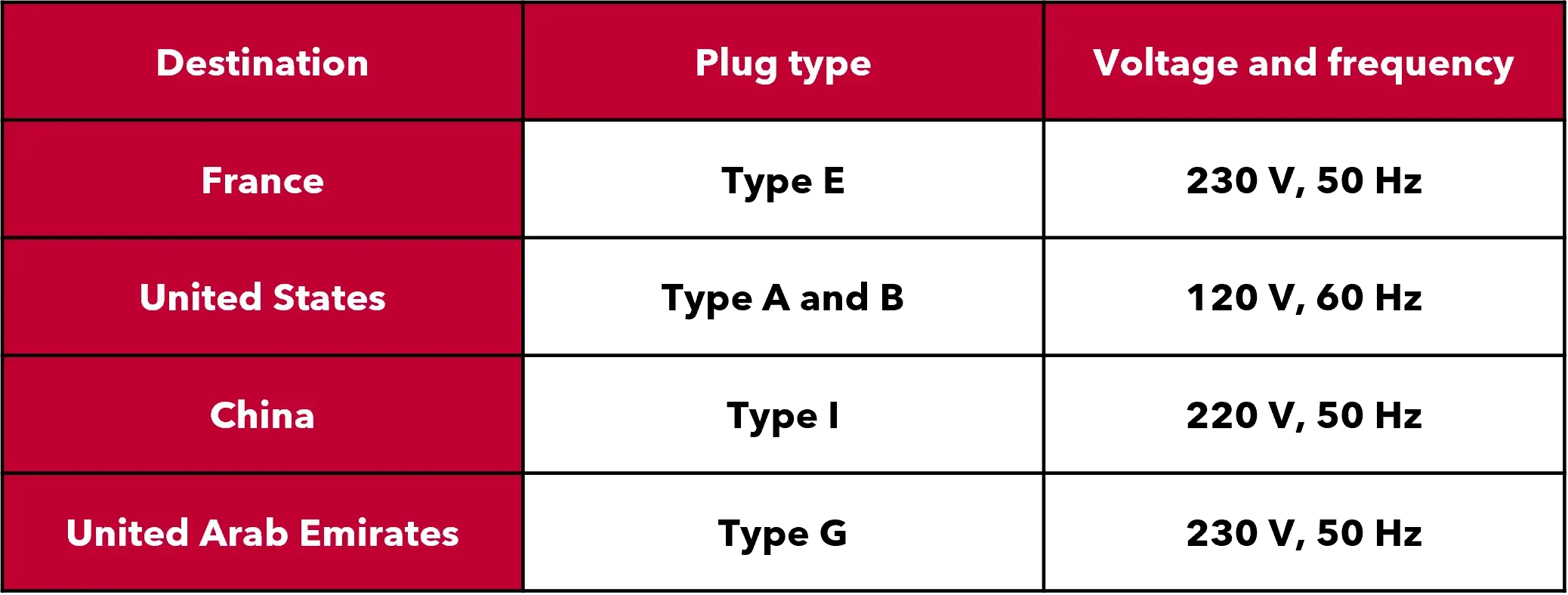
[Source : IEC plug and voltage standards, 2026]
Bring two universal adapters in case one fails, a cabin-certified power bank, your laptop with dual-voltage charger, and an unlocked phone so you can use a local SIM or eSIM. Add the study supplies your programme specifies and leave the rest.
What to bring vs what to buy abroad
The line between the two is mostly about weight, cost and availability.
Worth bringing from home: your documents and certified copies, prescription medication, glasses and a spare pair, the adapters and chargers above, an unlocked phone, and one set of formal clothes. These are either hard to replace quickly or specific to you.
Better bought after you arrive: bulky toiletries, bedding and kitchenware, heavy winter coats bought in the right climate, and most stationery. Buying locally is usually cheaper than paying for excess baggage, and it spreads the cost across the first weeks.
To avoid overpacking, lay everything out and remove anything you have not used in the past month, anything available cheaply at your destination, and any "just in case" item that duplicates something you already have. Leaving space in the bag also gives you room to bring things home.
Travel day: what to keep in your carry-on
Treat the carry-on as the bag that has to survive a lost checked suitcase.
Keep on you, never in the hold: passport, visa, acceptance and enrolment letters, insurance certificate, the address and contact of your accommodation, a printed list of emergency contacts, your medication, and your payment cards plus the cash reserve. A photocopy of your passport, stored separately from the original, speeds up any replacement.
Pack for a long day. A change of clothes, the chargers and power bank, a refillable water bottle, snacks, and any document you might need at the border keep a delayed or rerouted journey manageable. Confirm baggage allowances and transit visa rules for any connecting country before you leave.
Your first week abroad
The first week is administrative. Clearing it quickly is what turns a valid visa into a working daily life.
Set up the basics first: a local phone number or eSIM, a transport pass, and access to the bank account you prepared before departure. These three unlock almost everything else, from booking appointments to paying rent.
Validate your immigration status inside the legal window. In France, this means validating the VLS-TS online through the ANEF platform within three months of arrival; missing it invalidates your right to stay [Source : france-visas.gouv.fr, 2026]. In China, you convert the X visa into a residence permit at the Public Security Bureau within 30 days and register your address at the local police within 24 hours [Source : Chinese exit-entry administration, 2026]. Put the deadline in your calendar before you travel.
Register with your school in person and complete enrolment, bringing the document file you assembled. The school's international student support office handles orientation, the local administrative steps and the questions a checklist cannot anticipate. Once the paperwork is done, settling into daily life, finding your way around campus and meeting other students is the part that decides how the year actually feels. Students on the French campuses, for instance, settle into the Grand Paris campus in Suresnes or one of the other locations with a structured induction.
Extra tips for first-time travellers and exchange students
A few points sit outside the standard list but matter in practice.
If this is your first international trip, do the small things that reduce friction: tell your bank your travel dates, download offline maps and a translation app, learn the basic local phrases for administrative situations, and note the address of your country's embassy or consulate. Keep one full day clear after arrival before any commitment, because jet lag and queues absorb more time than expected.
If you are on an exchange or single semester, your checklist is lighter on immigration but heavier on academics. Confirm the credit transfer in writing before you leave, since a semester is normally worth 15 to 30 ECTS and the receiving institution's grades have to map back to your home transcript [Source : SKEMA Fact Sheet 2025-2026]. Check whether your home health cover, such as an EHIC or GHIC, is enough for a short stay, and whether you need a residence permit at all for a semester. Pack lighter than a full-degree student: you are furnishing nothing and you will be back within months.
FAQ
-
Six blocks: enrolment documents, passport and visa, money and banking, health and insurance, luggage, and the first-week administrative steps. Order them on a timeline, because the visa and any funding deadlines are the items with the least flexibility and the longest lead time.
-
A passport valid for your destination's rule, your student visa or residence permit, the official acceptance letter and enrolment certificate, your health insurance certificate, proof of accommodation, and proof of funds where the consulate requires it. Carry the originals, hold printed copies separately, and keep digital scans in the cloud. For civil documents such as a birth certificate, prepare a certified copy and a sworn translation if the destination asks for one.
-
As soon as your admission is confirmed, because the process is bound by deadlines and consular appointment times vary by season. For France, the long-stay student visa runs through the Campus France "Études en France" procedure, and you should allow several weeks. For the United States, the visa can be issued up to 365 days before the programme start date but you cannot enter more than 30 days before it.
-
One large checked bag, one carry-on and a daypack are enough. Pack for the local climate, bring documents and prescription medication with you, and buy bulky toiletries, bedding and heavy coats after you arrive rather than paying for excess baggage. Check the voltage and plug type for your destination and pack dual-voltage chargers with two universal adapters.
-
Passport, visa, acceptance and enrolment letters, insurance certificate, your accommodation address, emergency contacts, prescription medication, and your payment cards with a small cash reserve. Add a photocopy of your passport stored separately, a change of clothes and your chargers, so a delayed or lost checked bag does not strand you.
-
Anything heavy or generic that is cheaper to buy locally: bulky toiletries, bedding, kitchenware and most stationery. Leave behind duplicate "just in case" items and clothing you have not worn in a month. The exceptions that always travel with you are your documents, prescription medication and the electronics specific to you.
Planning your move abroad
The checklist is a timeline before it is a packing list. The administrative block, passport, visa, proof of funds, health cover and accommodation, is what locks your place into legal reality, and it runs on deadlines set months before departure. The luggage block matters on travel day, but the first week abroad, validating your status, opening daily life and completing enrolment, is where the preparation pays off. Reading the official sources directly for your destination (france-visas.gouv.fr, campusfrance.org, etudiant.gouv.fr, ameli.fr for France; ice.gov and travel.state.gov for the United States) removes most of the operational risk, since fees and procedures are updated regularly.
For students who have validated their academic plan and the financial side, an international school with campuses on several continents shortens part of this list, because mobility, support and enrolment run through one office. The next operational step is to apply online for an admission decision and start the visa sequence with the dates confirmed.