
News
Can you bring your family to France while studying? Visa, residence permit and requirements explained

This guide is written for non-EU students preparing to study at a French campus, including those joining SKEMA in Paris, Lille or Sophia Antipolis. SKEMA's International Office and pre-arrival support for international students can help you settle in, though the school does not handle family immigration formalities on your behalf.
The key points in brief:
- A student visa (VLS-TS) does not let you bring family automatically. Family members apply separately.
- Standard family reunification (regroupement familial) is closed to active students.
- The realistic route is a long-stay visitor visa (VLS-TS "visiteur") for your spouse and children.
- A visitor spouse may live and study in France but cannot work.
- You must prove sufficient resources, suitable housing and private health insurance for the family.
Quick answer: can a student bring family to France?
A student can bring a legally married spouse and minor children, provided the household meets strict conditions on income, housing and insurance. The family does not travel on your permit. Instead, each relative applies for their own long-stay visitor visa, which lets them live in France for the duration of your programme.
The route changes with nationality and length of stay. Non-EU nationals need a visa for any stay over 90 days, so a relative settling with you for an academic year requires a long-stay visa rather than a tourist trip. Students from the EU, the EEA or Switzerland follow a far lighter regime, covered further down.
One distinction matters most: family reunification and the visitor route are not the same thing. The official sources (Service-Public.fr, France-Visas, Campus France) treat them separately, and confusing the two is the single most common mistake applicants make.
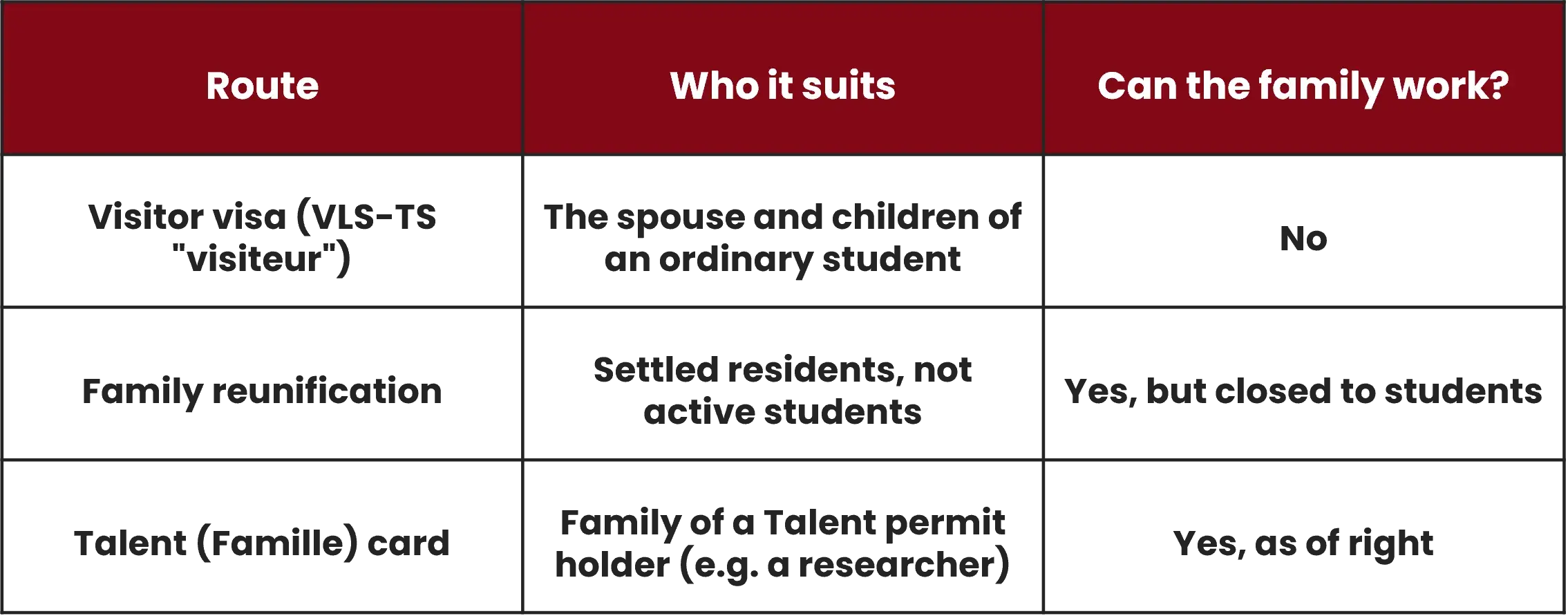
Student visa, family visa or residence permit: the regimes explained
The student VLS-TS is the long-stay visa that doubles as a residence permit for the duration of your studies. It covers you, the student, and nobody else. To bring relatives, you rely on a parallel mechanism rather than on your own permit.
Family reunification (regroupement familial) is the standard procedure for a foreign national who is already settled in France on a stable, non-student permit. It requires at least 18 months of prior residence (12 months for Algerian nationals) on a permit valid for a year or more. Because the student permit is temporary and renewed every year, students cannot start this procedure during their studies.
The visitor route is the long-stay visitor visa (VLS-TS "visiteur") that a student's spouse and children apply for individually, following the Campus France checklist for an international student's family. This is the practical, dedicated route, and the one this guide focuses on.
A fourth case is worth naming so you do not over-rely on it: the "Talent (Famille)" card, which allows a spouse to work. It only applies when the main applicant holds a Talent permit, for example a doctoral researcher rather than an ordinary student.
Who can you bring: spouse, children or other relatives?
The legal scope of the visitor route is narrow.
- A legally married spouse. Both partners must be at least 18, and the marriage must be recognised. Polygamous marriages are excluded.
- Minor children under 18, whether biological or legally adopted.
Several situations fall outside this scope:
- Civil partners and unmarried partners. A PACS partner (or a foreign equivalent) does not automatically qualify. They must show at least a year of documented, continuous cohabitation, and the prefecture assesses each case individually. Unregistered cohabiting partners must secure their own independent visa.
- Parents and grandparents. Ascendants are excluded from the student family framework. A parent who wishes to visit can apply for a visitor visa in their own name, with their own funds and no right to work, but they cannot join you as your dependant.
How nationality changes the rules
If you are an EU, EEA or Swiss national, you and your family enjoy freedom of movement and need no visa. A non-EU spouse of an EU student simply applies, within three months of arrival, for a free residence card marked as a family member of an EU citizen, and that card carries full work rights. The restrictive visitor conditions below apply only to families where the student is a non-EU national.
For older, professionally established candidates, these distinctions shape the whole relocation. If you are weighing a course such as the Global Executive MBA in Paris or a specialised Master of Science taught on a French campus, map the family route before you apply, not after you arrive.
The realistic route: bringing your spouse on a visitor visa
For most students, the visitor visa is the route that actually works. It rests on three conditions, and it carries one firm limitation.
The first condition is money. Your spouse must show stable personal resources of at least the net monthly minimum wage, currently 1,477.93 euros (about 17,735 euros a year), for the whole stay. The funds must be their own and independent of any future work in France, whether savings, investments, a pension or a guarantee from a solvent third party. State family allowances and housing benefit do not count. You, separately, still prove your own student resources, a minimum of around 877,50 euros a month according to Campus France.
The second is insurance. Each relative needs private international cover for the entire stay, at least 30,000 euros per person for medical, hospital, emergency and repatriation costs, until they qualify for the French public scheme.
The third is housing that meets French decency and surface-area standards, set out in the conditions section below.
The limitation concerns work. A visitor spouse signs a handwritten declaration promising not to carry out any professional activity, whether salaried, commercial, self-employed or as an auto-entrepreneur. They may still enrol in studies or training, as long as the course needs no employment contract, which rules out apprenticeships and work-study (alternance). The card lasts a year and is renewed annually, each time on fresh proof of resources.
If your spouse later wants to work, they change status at the prefecture: to a salaried permit (with a job offer and a work permit, subject to the labour-market test), to an entrepreneur permit (with a viable business plan yielding at least the gross annual minimum wage, 22,404.20 euros), or, if you yourself move to Talent status, to a Talent (Famille) card that allows any work without further authorisation.
Is family reunification possible for a student?
Family reunification is the only route that gives relatives a permit allowing them to work straight away, through the "private and family life" card. In practice, a student almost never qualifies, for three reasons.
- Length of residence. You must have lived in France for at least 18 months (12 months for Algerian nationals) on a permit valid for a year or more. For a two-year Master, that point only arrives near the end of the course.
- Stable income. You must show stable resources over the previous twelve months, indexed to the gross monthly minimum wage (1,867.02 euros for a household of two to three people, more for larger families). Social benefits are excluded, which sits badly with capped student working hours.
- Compliant housing. The home must meet surface-area rules by zone (see below), verified by an inspection.
The procedure runs through the OFII, includes a home visit and a prefect's decision, and typically takes 12 to 18 months. For a student, it is rarely a realistic option during the studies themselves.
The Talent route: researchers and doctoral candidates
There is one situation that escapes these constraints entirely. If you hold, or move to, a "Talent" permit, your family benefits from a simplified accompanying-family procedure: your spouse and minor children can file their visas at the same time as you, settle alongside you, and receive a Talent (Famille) card that allows any professional activity without a separate work permit. The Talent permit can run for up to four years.
This matters most to doctoral candidates, where a single distinction changes everything for the family:
- Enrolled for a thesis with no contract, you hold a student visa, and your family falls under the restrictive visitor regime.
- Holding a doctoral research contract and a hosting agreement (convention d'accueil), you qualify for a Talent (Researcher) visa, and your family gains work rights.
If you are already in France on a student permit when your research contract is signed, request a change of status at the prefecture promptly. It unlocks your family's rights at once.
The conditions, route by route
Whichever route applies, four conditions recur. Plan for them early.
- Lawful student status: a valid permit and proof of enrolment at your institution.
- Resources: roughly the net minimum wage for a visitor spouse, the gross minimum wage for family reunification. Bank statements covering the last three to six months are expected, and one-off "courtesy" deposits lead to refusals.
- Housing: minimum surface areas set by zone. As a couple, count on 22 m² in Zone A bis and Zone A (Paris and Suresnes, where SKEMA's
- Grand Paris campus sits), 24 m² in Zone B1 and B2 (which covers the Lille campus and the Sophia Antipolis campus near Nice), and 28 m² in Zone C, plus 10 m² for each additional person.
- Civil status and insurance: marriage and birth certificates legalised or apostilled and then translated by a sworn translator, plus private cover of at least 30,000 euros per person. Inconsistent names across documents are a frequent cause of delay, so check them before you file.
The documents you will need
Exact requirements vary by consulate, nationality and family member, but most files include:
- A valid passport and the completed visa application form for each relative.
- Proof of your enrolment and a copy of your own visa or residence permit.
- A marriage certificate for a spouse, and a birth certificate (and family record book where relevant) for each child.
- Proof of accommodation and recent bank statements evidencing the required resources.
- Proof of private health insurance, and, where needed for a child, a parental authorisation to travel.
Have translations and legalisation or apostille done in good time. Scholarship holders should note that grant benefits, such as funded health cover or housing help arranged through Campus France, generally apply to the laureate alone and not to the family. You will find the relevant aid described on SKEMA's financial support and scholarships page.
How to apply, step by step
- Confirm the right route and assemble the file for each relative.
- File the visa application from your country of residence. Family members can apply at the same time as you or shortly after, up to six months before departure, and you should book the consular or visa-centre appointment at least a month ahead.
- On arrival, validate the visa online through the ANEF portal within three months. Missing the 90-day window makes the stay irregular.
- Once settled, apply online for the children's travel document (the DCEM) through ANEF.
Plan for the waiting times. Consular processing of a family visitor visa generally takes four to eight weeks. Once you are in France, the prefecture can take up to four months to issue or renew a physical card, and an absence of reply after four months counts, in law, as an implicit rejection.
The administrative fees rose on 1 May 2026 (under the 2026 budget law). The current charges, paid by electronic timbres fiscaux, are as follows.
- Student (you): consular visa of 50 euros (for Études en France countries) or 99 euros; permit validation or first card of 150 euros (a 100-euro tax plus a 50-euro stamp); annual renewal of 250 euros.
- Visitor spouse: consular visa of 99 euros; validation or first card of 350 euros (a 300-euro tax plus a 50-euro stamp); annual renewal of 350 euros; a late-application fee of 180 euros.
- Minor child: no residence card is required; the DCEM costs 50 euros and is valid for five years.
These figures change periodically, so confirm them on Service-Public.fr before you pay.
After arrival: schooling, healthcare, housing and childcare
Every child in France aged 3 to 16 has a right and an obligation to attend school, whatever the family's immigration status, and state schooling is free. You register young children at the local town hall (mairie) and secondary-school pupils through the local education authority (rectorat).
Healthcare starts with your own registration. As a student, you sign up free of charge with the French student health scheme through etudiant-etranger.ameli.fr, which reimburses about 70% of standard costs, and your minor children can be added to your account as dependants straight away. A visitor spouse joins the public scheme (PUMa) only after three months of stable residence, and relies on the private 30,000-euro policy in the meantime.
Housing costs and availability differ sharply by campus, so start the search months ahead, and use the school's accommodation guidance for its French campuses. Family-status holders may, in principle, apply to the family allowances fund (CAF) for housing benefit (APL), but the CAF audits resources every year, and the benefit cannot be used to make up a shortfall in the income you are required to prove independently. Recent budget measures have also tightened housing-aid conditions for non-EU students, so check your current entitlement with the CAF rather than assuming it.
For the youngest children, public nursery places (crèches) for under-threes are scarce and competitive. Private micro-crèches, with hourly rates capped at 10 euros, are an alternative, and the CAF's childcare subsidy (the CMG) can cover a large share of the cost depending on your household income, with parents paying at least 15% of each invoice.
Mistakes that lead to refusals
Three errors recur, and all are avoidable.
- Assuming that university admission creates a family right. It does not. A consulate will refuse a visitor visa if the spouse's resources look dependent on the student's.
- Misusing a short Schengen stay to settle. Entering as a tourist and trying to regularise on the spot does not work: without the right long-stay visa, the prefecture refuses the status change, and you risk a removal order and a regularisation fee.
- Weak financial evidence. A bare balance certificate is not enough. Provide three to six months of statements, with no last-minute deposits.
If a relative's application is refused, you can appeal, in French, within the stated deadline. A strong alternative is for your spouse to obtain a status of their own, as a student if they enrol, or as an employee with an endorsed contract, which sidesteps the visitor conditions altogether.
Worked examples
- Bringing your spouse from the start. You file together: your student visa and your spouse's visitor visa. Key documents are the marriage certificate, your enrolment, and your spouse's independent resources. Watch point: those resources must clearly be their own.
- Bringing your children a few months later. Apply for each child's visitor visa, then their DCEM once you are settled. Enrol them at the mairie or rectorat; schooling is free.
- A doctoral candidate with a family. Secure a research contract and hosting agreement to obtain Talent (Researcher) status. Your spouse then receives a Talent (Famille) card and can work.
- A single parent with a dependent child. The child travels on a visitor visa; carry custody or sole-authority documents, as consulates check them closely.
Frequently Asked Questions
-
Not on a visitor visa. A visitor spouse signs a declaration not to work and is barred from any professional activity. To work, they must change status at the prefecture, for example to a salaried permit with a job offer, or to a Talent (Famille) card if you move to Talent status. Until then, they may study but not earn.
-
No. Family reunification requires at least 18 months of prior residence in France on a stable, non-student permit (12 months for Algerian nationals), plus income near the gross minimum wage and compliant housing. A student rarely meets these conditions during their studies, which is why the visitor route is used instead.
-
A visitor spouse must prove independent resources of at least the net monthly minimum wage, 1,477.93 euros (about 17,735 euros a year), separate from your own student minimum of roughly 615 euros per month. State allowances and housing benefit do not count towards the spouse's figure, and the funds must not depend on future work in France.
-
Yes. Schooling is compulsory and free for every child aged 3 to 16, regardless of immigration status. You register young children at the town hall and older pupils through the local education authority. Minor children do not need a residence card, though they need a DCEM to leave and re-enter France without a fresh visa.
-
For the first three months, your spouse and children rely on the private 30,000-euro insurance policy. After three months of stable residence, your spouse can join the public scheme (PUMa). Minor children can be added to your student health account as dependants immediately, once you have registered with the French scheme.
-
Considerably. EU, EEA and Swiss students and their families move freely, with no visa, and a non-EU spouse of an EU student receives a free card with full work rights. The visitor conditions in this guide apply where the student is a non-EU national. Algerian students follow specific rules under the 1968 agreement.
Before you file: a short checklist
- Confirm the right route: visitor visa in almost every case, Talent if you hold a research contract.
- Check the conditions: independent resources, compliant housing, private insurance.
- Prepare the file for each relative, with civil-status documents legalised and translated.
- Budget for the fees and the waiting times, and validate every visa on ANEF within three months.
- Line up your accommodation early, sized to the surface-area rules for your campus.
Settling a family alongside your studies is demanding but entirely feasible with the right route and an early start. Once your plan is clear, you can apply to a SKEMA programme taught in France and prepare your family's move in parallel.
Official sources
The routes, conditions and fees above come from French official sources, which govern any point of detail. France-Visas (france-visas.gouv.fr) covers the long-stay visitor visa (VLS-TS "visiteur"). Service-Public.fr sets out family reunification (regroupement familial), the visitor conditions, the residence-permit fees and the Talent (Famille) card. Campus France (campusfrance.org) publishes the family checklist for an international student. Family reunification is run by the French Office for Immigration and Integration, OFII (ofii.fr), and visa validation and the children's travel document (DCEM) go through the ANEF portal of the Ministry of the Interior. Housing benefit (APL) and the childcare subsidy (CMG) are administered by the CAF (caf.fr), and health cover by l'Assurance Maladie (ameli.fr, including the PUMa scheme). These figures and conditions change periodically, so confirm the value in force on the relevant official source before you file.