
News
Do I need a visa for France? Entry rules by nationality, purpose and length of stay

Quick answer: when do you need a visa for France?
Most travellers fall into one of four situations.
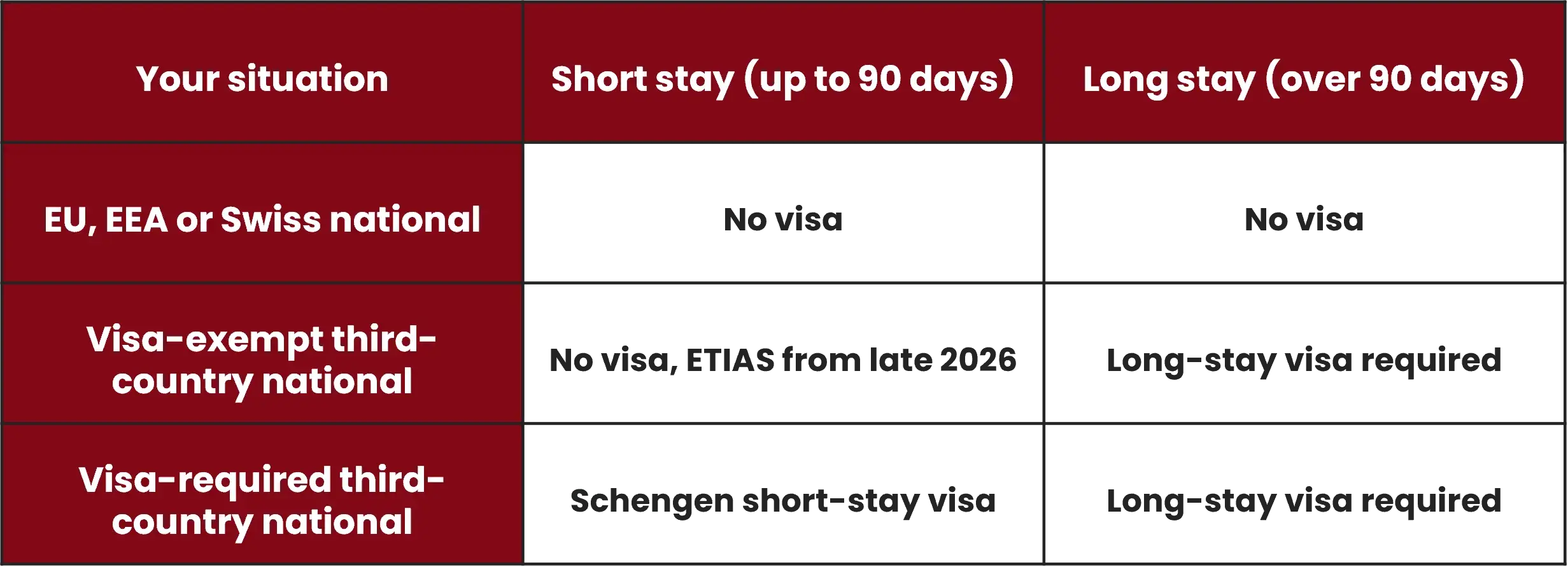
- EU, EEA and Swiss nationals: no visa and no residence permit, regardless of how long you stay or why.
- Visa-exempt third-country nationals (the UK, the US, Canada, Australia and others): no visa for a short stay of up to 90 days in any 180-day period. From late 2026 you will need an ETIAS authorisation, which is not a visa.
- Visa-required third-country nationals: a Schengen short-stay visa for any visit, even a short one.
- Anyone staying more than 90 days, including to study, work or join family: a long-stay visa, whatever your nationality outside the EU, EEA and Switzerland.
The table below summarises the logic. Use it as a first read, then confirm your exact case on France-Visas.
How to tell if you need a visa for France: the four factors
Your visa need is decided by four variables, and changing any one of them can change the answer.
-
Nationality is the starting point. EU, EEA and Swiss citizens move freely and need no visa. For everyone else, the passport you hold determines whether your country appears on the EU's visa-exempt list or its visa-required list. Dual nationals should check which passport gives them the more favourable status before they travel.
-
Where you live can affect where and how you apply, even when it does not change whether you need a visa. A long-term resident of another European country may benefit from specific arrangements, but should still verify France's own entry conditions rather than assume that residence elsewhere is enough.
-
The reason for your trip matters as much as your nationality. Tourism, business meetings, family visits and short courses fall under short-stay rules. Study, salaried work and settling in France require their own long-stay categories, with different documents and conditions.
-
Duration is the decisive threshold. Up to 90 days, visa-exempt nationals travel without a visa. Beyond 90 days, a long-stay visa becomes compulsory for every non-European national, including those who would have been visa-exempt for a short trip.
Border modernisation: EES and ETIAS in 2026
Two new systems now apply at the Schengen border, and neither of them is a visa. They sit alongside the visa rules rather than replacing them.
The Entry/Exit System (EES) is an automated border system that records non-EU travellers entering and leaving the Schengen area. It began a phased rollout on 12 October 2025 and, according to the European Commission, has been fully operational since 10 April 2026. It captures a facial image and fingerprints on first entry and replaces the manual stamping of passports with a digital record. Because biometric enrolment takes place at the border, travellers should allow extra time on their first crossing.
ETIAS is a travel authorisation that visa-exempt nationals will need from the last quarter of 2026 to enter France and the wider Schengen area. It is not a visa. The European Union has confirmed a fee of €20 (with exemptions for applicants under 18 or over 70), validity of up to three years or until the passport expires, and multiple entries within the same 90 days in 180 limit. Visa-exempt nationals, including British and American citizens, will need to hold a valid ETIAS before they board, while visa-required nationals continue to apply for a Schengen visa as before.
Visa-free short stays and the 90/180-day rule
If your nationality is visa-exempt, you can stay in the Schengen area without a visa for up to 90 days within any 180-day period. The 180-day window is a rolling one, counted backwards from each day you are present, which makes it easy to miscount without careful tracking.
A short stay covers tourism, business meetings, academic conferences, university entrance examinations and short courses lasting under three months. It does not allow salaried employment, and it does not allow you to follow a degree programme that runs beyond 90 days.
Because France is part of the Schengen area, time spent in other Schengen countries counts towards the same 90-day total. A fortnight in Spain and three weeks in Italy reduce the days you have left for France within the rolling window. Overstaying the limit can lead to fines, removal and a future entry ban, so the count should be treated as a hard ceiling rather than a guideline.
When you need a Schengen short-stay visa (Type C)
If your nationality is on the visa-required list, you need a Schengen short-stay visa, known as a Type C visa, for any visit of 90 days or less. This applies to tourism, family visits and short business trips alike.
According to France-Visas, the standard fee is €90 for applicants over 12, €45 for children aged 6 to 12, and €35 where a visa facilitation agreement applies, with no charge for children under 6 or for family members of EU citizens. Applicants generally need travel medical insurance covering at least €30,000 for emergency treatment, hospitalisation and repatriation across the Schengen area. A Type C visa authorises a short visit only. It grants neither residence nor the right to work, and it cannot be converted into a study permit once you are in France.
When you need a long-stay visa or residence permit (over 90 days)
Any stay of more than 90 days requires a long-stay visa, whatever your nationality outside the EU, EEA and Switzerland, including the nationalities that are visa-exempt for short trips. Permission to enter and permission to reside are two different things, and a long stay calls for the second.
A long-stay visa is a Type D visa issued for between three months and one year for a defined purpose, such as study, work or joining family. France issues it in two forms. The first is the long-stay visa that serves as a residence permit, the
visa de long séjour valant titre de séjour
(VLS-TS), which removes the need for a separate residence card during the first year but must be validated online shortly after arrival. The second is a long-stay visa that requires you to apply for a residence permit at your local prefecture within the first months of your stay. Students almost always fall under the first form.
Do you need a visa to study in France?
You need a student visa to study in France if you are a non-European national on a course lasting more than 90 days. EU, EEA and Swiss students do not, whatever the length of their programme. France hosts a large international student population, with around 443,500 enrolled in 2024-2025 according to Campus France, and the rules below apply equally to public universities and to private institutions such as SKEMA.
EU, EEA and Swiss students versus non-EU students
Students from the EU, the EEA and Switzerland enter France on a valid passport or national identity card and need neither a visa nor a residence permit. Non-European students enrolling on a course of more than 90 days need a long-stay student visa, obtained before they leave home. This holds true whether they join a degree programme taught in France at a public or a private institution.
UK students after Brexit
British nationals are now third-country nationals for the purposes of French immigration. For a short course of under 90 days they remain visa-exempt, subject to EES registration and, from late 2026, to ETIAS. For a full degree, which by definition runs beyond 90 days, they have needed a long-stay student visa since 1 January 2021. UK applicants also complete the Campus France procedure before applying, a clear change from the pre-Brexit position that warrants early preparation. British citizens who were legally resident in France before 31 December 2020 fall under the EU Withdrawal Agreement instead.
The student long-stay visa and the "Études en France" procedure
Non-European students apply for the long-stay visa that serves as a residence permit for students, the VLS-TS étudiant, which is issued for courses lasting 4 to 12 months. Several elements define the application:
- Proof of funds: you must show access to at least 877,50€ and 10,530€ for a twelve-month year. Bank statements, a sponsor's guarantee, or a scholarship award letter are all accepted, and a scholarship can count as accepted proof of funds.
- Consular fee: the long-stay student visa costs €50 for applicants going through the Campus France procedure and €99 otherwise, according to France-Visas, plus a handling fee capped at €40 where an external provider takes the appointment.
- The "Études en France" procedure: Campus France runs a compulsory pre-consular process for students resident in one of 73 designated countries, including the UK, the US, India, China, Brazil and Morocco. Platform fees vary by country, for example £90 in the UK and $270 in the US. The certificate it produces is then required for the visa application.
- Validation after arrival: once in France, you validate your VLS-TS online on the ANEF platform within three months of arriving. Since 1 May 2026 this validation costs €150, made up of a €100 reduced tax and a €50 stamp duty, payable on the platform. Missing the three-month deadline makes your stay irregular and suspends your right to re-enter the Schengen area.
Students admitted to a programme taught on a French campus fall within this regime. SKEMA provides support for international students before and after they arrive on its French campuses, and teaches courses such as the Master in Management programme there. The full application sequence, from the Campus France file through the France-Visas portal to the consular appointment, is set out on those official portals.
Do I need a visa for France by nationality?
The answer depends first on your nationality, although your country of residence can determine where you apply. The lists of visa-exempt and visa-required countries change, so confirm your own case on France-Visas rather than relying on a fixed list.
-
No visa is required, for any purpose or duration. You may settle, study and work freely, and you acquire permanent residence rights after five years of continuous legal residence.
-
Visa-exempt for short stays of up to 90 days in 180, subject to EES and, from late 2026, ETIAS. A long-stay visa is required for any stay over 90 days, including a full degree.
-
Visa-exempt for short stays under the same 90/180 rule, with the same EES and ETIAS obligations. A long-stay visa is required beyond 90 days, on the same basis as other third-country nationals.
-
A Schengen short-stay visa is needed for any visit, and a long-stay visa for any stay over 90 days. Students from these countries almost always go through the "Études en France" procedure before applying.
Visa, exemption and residence permit: what is the difference?
These four terms are easy to confuse, and the distinctions decide what you can and cannot do.
- A short-stay visa authorises a visit of up to 90 days. It does not allow residence or work.
- A long-stay visa authorises a stay of more than 90 days for a defined purpose, and for students it also serves as the first-year residence permit once validated.
- A residence permit is the document that authorises you to reside in France beyond your visa. It is issued in France and is not the same thing as a visa.
- A visa exemption means you may enter without applying for a visa. It does not remove the conditions of entry, and from late 2026 visa-exempt nationals still need an ETIAS authorisation.
Passport, documents and entry requirements at the French border
A valid travel document and supporting evidence can decide whether you are admitted, even when you do not need a visa. Border officers may ask any traveller to justify the purpose and conditions of their stay.
Your passport should have been issued within the last ten years, contain at least two blank pages, and remain valid for at least three months beyond your planned departure from the Schengen area. Depending on your situation you may also be asked for proof of accommodation, evidence of sufficient funds, a return or onward ticket, and travel medical insurance. Students should carry their enrolment certificate and, where relevant, their Campus France confirmation, together with proof of housing for their first months, which they can secure through SKEMA's guidance on finding student accommodation in France. Keeping certified copies alongside the originals avoids delays at the border.
Do I need a visa for France? Examples by profile
The same nationality can lead to different requirements depending on why and how long you are coming.
- A tourist staying under 90 days needs no visa if their nationality is visa-exempt, an ETIAS from late 2026, and a Schengen visa if their nationality is visa-required.
- An international student staying several months needs a long-stay student visa, whatever their non-European nationality, obtained before departure, whether they study at the Paris campus, the Lille campus or the Sophia Antipolis campus.
- A visitor staying with family or friends follows short-stay rules, often with a formal accommodation certificate from the host.
- Someone moving to France long term needs a long-stay visa matched to their purpose, followed by a residence permit or by online validation of a VLS-TS.
FAQ
-
Not for a short stay of up to 90 days in any 180-day period, although from late 2026 they will need an ETIAS authorisation and are already registered through the EES. For any stay over 90 days, including a full degree, British nationals have needed a long-stay visa since 1 January 2021.
-
No, for short stays of up to 90 days in 180, on the same terms as other visa-exempt nationals, with EES registration now in force and ETIAS required from late 2026. A long-stay visa is required for study or any stay over 90 days.
-
No. Visa-free travel is capped at 90 days in any rolling 180-day period across the whole Schengen area. Any longer stay requires a long-stay visa, whatever your nationality outside the EU, EEA and Switzerland.
-
From the last quarter of 2026, visa-exempt nationals will need an ETIAS authorisation to enter France. It costs €20, is free for applicants under 18 or over 70, and is valid for up to three years. It is a travel authorisation, not a visa, and it does not replace a long-stay visa.
-
EU, EEA and Swiss students do not. Every other nationality needs a long-stay student visa for a course of more than 90 days, obtained before arrival and validated online within three months of reaching France.
-
No. A short-stay or tourist visa does not grant the right to work. Students who hold a valid long-stay student visa may work up to 964 hours a year, about 60% of a full-time year, without a separate work authorisation, according to service-public.fr.
Official sources and a pre-travel checklist
Before departure, run through a short checklist:
- Confirm your visa need on France-Visas for your exact nationality, purpose and duration.
- Secure your visa or, if you are visa-exempt, your ETIAS authorisation once it is required.
- Gather your supporting documents: passport, proof of funds, accommodation and insurance.
- For a student stay, complete the Campus France procedure where it applies, then plan to validate your VLS-TS on the ANEF platform within three months and to pay the €105 student life contribution (CVEC).
- Keep track of your days against the 90/180 limit if you travel on a visa-free basis.
If you are coming to France to study, take the steps in order: confirm your place, complete the visa procedure before you travel, then validate your status within three months of arriving. You can begin by applying to a SKEMA programme in France.
Visa requirements change by nationality and by date, so the official source is the authority on each point. France-Visas (france-visas.gouv.fr), including its "Check your visa need" tool, gives the visa requirement, the Schengen short-stay (Type C) fees and the document list. Service-Public.fr covers the residence rules and the VLS-TS. Campus France (campusfrance.org) runs the Études en France procedure and publishes the country platform fees. The Entry/Exit System (EES) and ETIAS are documented on the European Union's official pages (travel-europe.europa.eu and home-affairs.ec.europa.eu). Confirm the value in force on the relevant official source for your exact nationality, purpose and length of stay before you travel.