
News
France student visa: the complete guide for international students

This guide sets out the French rules in force in 2026, with the euro amounts and timing windows that govern each step, for prospective international students preparing for a degree programme taught in France at SKEMA. Please note that the figures noted in this article are subject to changes according to French authority regulations.
The figures are fixed by regulation and published on official sources. Proof of funds is set at €877.50/month, effective 1 August 2026 [service-public.fr, F2231; CESEDA articles L422-1 to L422-3, Légifrance, 2026]. The consular fee is €50 for applicants going through Études en France and €99 for those who are not [france-visas.gouv.fr/en/etudiant, 2026]. Validating the VLS-TS after arrival costs €50, and the CVEC student contribution is €105 for 2026-2027 [campusfrance.org, 16 July 2025; cvec.etudiant.gouv.fr, 2026]. The calendar is equally strict: an application cannot be filed more than three months before arrival, standard processing runs from 15 days to three weeks, and validation must be completed within three months of entering France. France hosted 443,500 foreign students in 2024-2025, close to 15% of its student population, according to Campus France.
What is a France student visa, and who needs one?
A France student visa is the entry document that authorises a non-European national to reside in France for the purpose of study. Its standard form for higher education is the VLS-TS "étudiant", a long-stay visa that also functions as a residence permit for the first academic year once it is validated online.
Do you need a visa to study in France?
Nationality and the planned length of study determine the answer. Citizens of the European Union, of the European Economic Area (Iceland, Liechtenstein and Norway) and of Switzerland are exempt and may study in France without any visa [service-public.fr, F2231, 2026]. All other nationals, whatever their country of residence, must obtain a student visa before travelling.
EU/EEA/Swiss vs non-EU students
The duration of the programme then sets the category. A stay of 90 days or less falls under a short-stay Schengen visa; a stay above 90 days requires a long-stay visa [france-visas.gouv.fr/en/etudiant, 2026]. Non-EU nationals admitted to a SKEMA campus in France, whether on the Paris campus, the Lille campus or the Sophia Antipolis campus, fall under the long-stay regime for any degree programme lasting more than three months.
France student visa types explained
Three visa categories cover study in France, with different durations and rights.
Eligibility and core requirements
Eligibility rests on documented admission, valid identity and verifiable means.
Admission to a recognised institution. The applicant must hold a formal acceptance letter from an institution recognised by the French state, stating the programme, its start date and its duration. Admission to a SKEMA programme generates this letter and opens the rest of the procedure.
Valid passport and legal status. The passport must be issued within the last ten years, hold at least two blank pages and remain valid for at least three months beyond the planned departure from the Schengen Area [service-public.fr, F16162, 2026].
Sufficient and provable resources. The applicant must show access to the regulatory minimum of €877.50/month, effective 1 August 2026 (see the proof of funds section below).
Accommodation and insurance. Proof of housing for at least the first three months and an international health insurance certificate complete the core file.
Documents required for a France student visa
Consular services require a complete dossier in physical and digital form. A missing item halts the application. The list below groups the standard documents by category; the exact requirements per consulate are published on the France-Visas portal and should be checked for each country.
Identity and travel. A valid passport meeting the issuance and validity standards above, two recent identity photographs to ICAO standards, and a return flight booking or a written declaration of funds sufficient to buy a return ticket.
Forms. The France-Visas long-stay application form, completed online, printed and signed, with its receipt page.
Academic. The official acceptance or enrolment letter from the institution, and, for residents of the connected countries, the Études en France certificate generated by Campus France.
Proof of funds. Bank statements, a scholarship award letter or a guarantor's commitment evidencing €877.50/month, effective 1 August 2026 for the first year.
Accommodation. Proof of residence covering at least the first three months: a lease, a certificate of free accommodation or a confirmed residence booking. SKEMA's housing service helps admitted students secure student accommodation to evidence their housing in a tight rental market, particularly in Paris.
Health insurance. A certificate covering medical, hospitalisation and repatriation costs up to a minimum of €30,000 for the initial period, according to the France-Visas FAQ.
Proof of funds: how much money is required?
International students must prove access to at least €877.50/month, effective 1 August 2026, set by the Code de l'entrée et du séjour des étrangers et du droit d'asile (CESEDA) under articles L422-1 to L422-3 [service-public.fr, F2231; Légifrance, 2026]. The €615 figure is a legal minimum. In high-cost cities such as Paris it does not cover standard rent and daily expenses, so most students need additional funds.
Consular services accept several forms of proof. A recent bank statement showing a stable balance of at least €10,530, or statements from the last three to six months showing consistent savings, satisfies the self-sufficiency route. A guarantor based in France or abroad can provide a signed financial commitment with identity, proof of income and bank certificates. A scholarship certificate stating the monthly amount and duration is accepted, and a SKEMA award documented through the school's scholarships and financial aid options can serve as accepted proof of funds. A student already legally employed in France may submit recent payslips where the income meets the threshold.
Before you apply: admission, Campus France and Études en France
The procedure starts with admission. Once a candidate has been admitted, the next question is whether their country of residence is among the 73 connected to the Études en France procedure. Residents of those countries must go through Campus France before they can reach the consular stage [campusfrance.org, 2026].
Études en France runs in two administrative phases. In the academic stage, the student opens a personal file on the official platform, uploads the admission offer, personal data and transcripts, pays the local Campus France service fee and sits an interview that assesses academic background and language level, which leads to the Études en France certificate. In the consular stage, that certificate unlocks the France-Visas application and the consular appointment. Applicants from countries outside the procedure go directly to France-Visas. In both cases admission comes first, so the operational starting point is to apply for admission to a SKEMA grande école and obtain the acceptance letter that opens the file.
Step-by-step France student visa application process
From admission to arrival, the steps run in a fixed order, split between the student, Campus France and the consulate. Skipping or reversing one delays the rest.
- Confirm the visa category against the programme length: short-stay for 90 days or less, long-stay VLS-TS above 90 days.
- Complete the Études en France procedure through Campus France if the country of residence is connected, and obtain the certificate.
- Create an account on the France-Visas portal and complete the long-stay application form, which generates a unique reference number.
- Upload digital copies of the supporting documents to the portal to speed up the in-person review.
- Book an appointment with the French consulate or its accredited partner (VFS Global, TLScontact).
- Attend in person to submit the original documents, pay the fees and give biometric data.
- Track the application online and collect the passport with the visa sticker.
The student is the responsible party throughout; Campus France handles the academic validation, and the consulate issues the decision.
How to complete the France-Visas online application
The France-Visas form asks for civil status, passport details, the programme and institution, the planned dates and the address in France. Preparing this information in advance reduces errors at the consular desk.
The most common cause of delay is inconsistency between documents: a name spelled differently across the passport, the acceptance letter and the form, mismatched dates, or an institution named differently from the official acceptance letter. The form should match the supporting documents exactly. Once submitted, the application generates a receipt and a reference number that must be printed and kept, as both are required at the appointment and for tracking.
Consulate appointment: biometrics, interview, what to expect
After the digital submission, the student books a slot at the consulate or its external partner. The appointment is in person and short.
At the desk, the student submits the original documents, pays the consular fee and provides biometric data: a live photograph and ten flat fingerprints [france-visas.gouv.fr/en/la-demarche, 2026]. The passport is retained for consular review and returned at collection with the visa sticker.
The interview, where one takes place, covers the coherence of the study plan: why this programme, how it follows from previous studies, how it fits a career path, and how the stay is funded. Bringing both originals and copies of the full dossier, including the acceptance letter, proof of funds and accommodation, avoids a second visit. The tone is administrative, and a consistent file is the main factor in a smooth decision.
France student visa fees and total budget
The total cost combines consular fees, the Campus France service fee, the validation tax and the CVEC. Amounts vary by country and by service centre, so the table below should be read as the 2026 baseline.
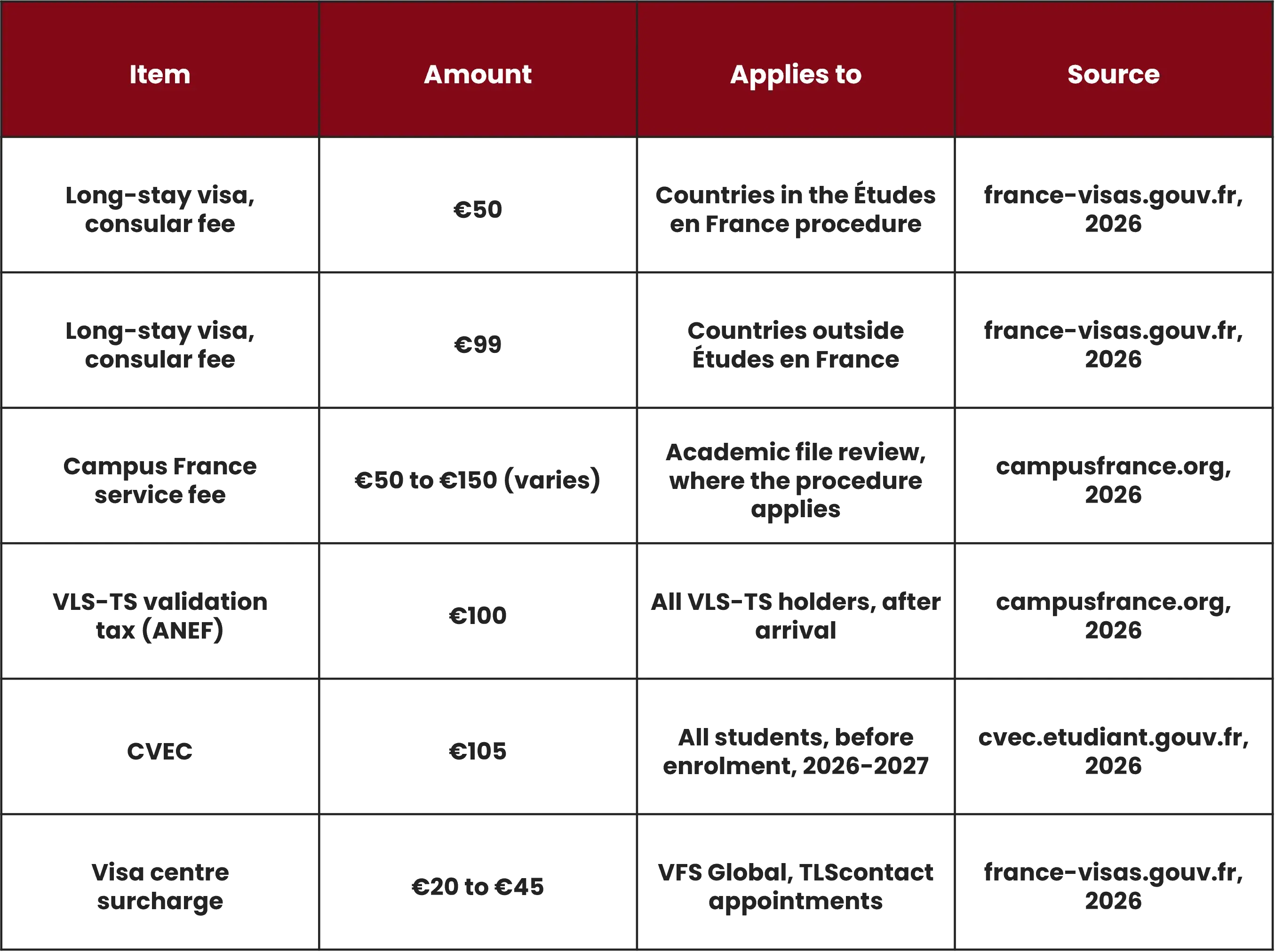
The Campus France fee is set by each local office and is reduced or waived in several countries (among them Algeria, China, Côte d'Ivoire, Colombia and Vietnam), so it should be confirmed locally. Registration fees at public universities do not apply to SKEMA: as a private grande école, it charges its own tuition, paid directly to the school.
Processing time and when to start
Standard processing runs from 15 days to three weeks, and lengthens during the June to August peak [france-visas.gouv.fr, 2026]. An application cannot be filed more than three months before the planned arrival, and consular services recommend booking the appointment at least one month before departure to absorb seasonal demand.
The practical consequence is to start early and in order: secure admission, complete Études en France where required, book the consular appointment as soon as the file allows, and leave a margin for processing before the programme start date.
After arrival in France: validate your VLS-TS
A VLS-TS still has to be validated online within three months of arrival, otherwise its holder falls out of a regular situation. The process is run by the Directorate General for Foreigners in France (DGEF) through the ANEF portal (administration-etrangers-en-france.interieur.gouv.fr), which replaced the former OFII procedure [campusfrance.org, 16 July 2025].
Validation requires an email address, the data on the physical visa sticker, the exact date of entry, the address in France and payment of a €150 tax, settled by card or with an electronic timbre fiscal. The portal then issues a confirmation PDF (the attestation de validation de VLS-TS) that serves as proof of legal residence. Validation is distinct from renewal: it activates the first-year permit, while renewal applies later for continuing study.
Missing the three-month deadline places the student in an irregular situation (séjour irrégulier), with the loss of housing benefits and, in practice, the inability to re-enter the Schengen Area after leaving France. The first administrative steps on arrival also include opening a bank account and registering with the French health system. Affiliation with l'Assurance Maladie is free and compulsory and is done at etudiant-etranger.ameli.fr after academic enrolment [ameli.fr, 19 January 2026]. The state scheme reimburses roughly 70% of standard outpatient costs, so a complementary policy (mutuelle) covers the rest. SKEMA's support for international students before and after arrival covers these formalities, and admitted students can register for student health cover through the school's services.
Can you work in France on a student visa?
A VLS-TS holder may work up to 964 hours per year, equal to 60% of the legal annual working time, without a separate work permit, and the employer is exempt from requesting prior authorisation [campusfrance.org; service-public.fr, F35796, 2026]. Study remains the primary purpose of the stay, and poor attendance or academic failure can lead the prefecture to refuse a renewal.
Renewal and life after your studies
A VLS-TS covers the first year. Continuing study and staying to work in France each follow their own track.
-
Students who continue their studies after the first validated year can apply for a multi-year student residence permit (carte de séjour pluriannuelle étudiant), valid for the remaining length of the programme up to four years [service-public.fr, F35799, 2026]. The request is filed online through the ANEF portal between four and two months before the current permit expires, with proof of continuous enrolment, transcripts, the last diploma obtained in France, proof of address and proof of resources at the €877,50 monthly threshold. The fee is €150 (€100 tax plus a €50 stamp).
-
Graduates of an eligible French degree can apply for the RECE card (recherche d'emploi ou création d'entreprise) to stay in France and look for work or start a business [service-public.fr, F17319, 2026]. It is valid for one year and is not renewable. During that year the holder can work full-time without a separate permit, provided the job relates to the field of study and pays a gross salary above €2,800 per month.
Eligible degrees include a professional licence, a Mastère Spécialisé, a Master of Science certified by the Conférence des Grandes Écoles (CGE) and any master's-equivalent degree. This brings the SKEMA Master in Management (Grande École) programme and an MSc certified by the Conférence des Grandes Écoles within the scope, which matters for students who plan to enter the French labour market after graduation. Algerian nationals are excluded from the RECE card and fall under a separate bilateral framework, while graduates from some countries with migration agreements may apply for an APS (autorisation provisoire de séjour) instead.
Common reasons for refusal and how to avoid delays
Consular reviews are strict, and refusals concentrate in a small set of recurring motifs codified under the unified Schengen rules. Falsified travel documents are the most serious and can carry a multi-year entry ban. Insufficient or unverifiable proof of funds, the absence of a valid acceptance letter and an incoherent study plan that suggests a non-academic intention are the most frequent documentary motifs. Incomplete or unverifiable accommodation, an adverse migratory history such as a prior overstay, and a threat to public order complete the list.
Most of these are avoidable with a clean file. A clear motivation letter linking the programme to the academic background and career plan addresses the intention test. Bank statements should show stable, traceable balances, and a guarantor's documents should match the sponsorship letter exactly. Confirmed housing for at least the first three months removes the most common cause of a held application.
What to do if your France student visa is refused
A refusal comes with a stated motif, which sets the response. Reading the motif first identifies whether the file was incomplete (a fixable documentary gap) or refused on substance (intention, funds, public order).
From there, two routes exist: a fresh application correcting the identified weakness, or an administrative appeal against the decision. Appeals follow short statutory deadlines, so the decision letter and its dates should be kept and acted on quickly.
Frequently asked questions
-
Non-EU, non-EEA and non-Swiss nationals need a student visa for any study in France. Citizens of the EU, the EEA (Iceland, Liechtenstein, Norway) and Switzerland are exempt. The category depends on length: a short-stay Schengen visa for 90 days or less, a long-stay VLS-TS above 90 days.
-
At least €877,50 per month for the first twelve months, a minimum of €10,530, set by the CESEDA. Proof can take the form of bank statements, a guarantor's financial commitment or a scholarship award letter.
-
No. The Études en France procedure through Campus France is compulsory only for residents of 73 connected countries. Applicants from other countries apply directly through the France-Visas portal and the consulate.
-
The VLS-TS is a specific type of long-stay visa for stays above 90 days. Its particularity is its dual function: it serves as the entry visa and, once validated online within three months of arrival, as the residence permit for the first academic year.
-
Yes, a validated VLS-TS allows travel across the Schengen Area. Students may also travel during their first three months in France before validating, but leaving after that three-month mark without having validated bars re-entry into the Schengen Area.
-
Yes, up to 964 hours per year, equal to 60% of the legal annual working time, with no separate work permit required. Study must remain the main purpose of the stay.
-
Validate the VLS-TS online through the ANEF portal within three months, paying the €50 tax. Then open a bank account and register with the French health system at etudiant-etranger.ameli.fr after academic enrolment.
Planning your move to France
The French procedure follows a set order: admission to a recognised institution, the Études en France procedure through Campus France for connected countries, a France-Visas application, a consular appointment with biometrics, and online validation of the VLS-TS within three months of arrival. Checking the official sources directly (service-public.fr, france-visas.gouv.fr, campusfrance.org, ameli.fr) before each step is the safest way to stay current, especially when fees or deadlines change.
For an admitted student, the visa file flows from the acceptance letter onward, and SKEMA's international, financial and housing services support each stage of the move to a French campus.
Official sources
The figures and procedures in this guide come from French government sources, which remain the authority on any point of detail. France-Visas (france-visas.gouv.fr) sets the visa categories, the consular fees and the document list. Service-Public.fr covers the proof-of-funds threshold, the residence-permit rules and the post-study RECE card, with the legal basis in the CESEDA (articles L422-1 to L422-3) on Légifrance (legifrance.gouv.fr). Campus France (campusfrance.org) runs the Études en France procedure and documents the VLS-TS validation, which is completed on the ANEF portal of the Ministry of the Interior (administration-etrangers-en-france.interieur.gouv.fr). The CVEC contribution is set on cvec.etudiant.gouv.fr, and health affiliation is handled by l'Assurance Maladie (etudiant-etranger.ameli.fr). Fees, thresholds and deadlines change by regulation, so confirm the value in force on the relevant official source before you act.