
News
From SKEMA to California: Dimitri Renaudat (SKEMA 2025) brings French expertise to the United States
You joined SKEMA’s Master in Management (PGE) through direct admission. What was your academic journey?
Before joining SKEMA, I earned a bachelor’s degree in Quantitative Management Techniques in Lyon. This multidisciplinary program covered areas including marketing, accounting, finance, statistics, mathematics, management, and contract law. I then joined SKEMA’s Master in Management (PGE) through direct admission, without going through a preparatory program. I started on the Sophia Antipolis campus, then took a gap year during which I completed two internships.
We also work with distributors in Canada and Mexico. Between the two of us, we are helping expand Grands Moulins de Paris across North America.
After that, I spent a semester on the Raleigh campus before returning to Sophia Antipolis to complete my studies through a work-study program. I specialized in Strategic Management and Business Development and completed my studies in July 2025. I had already been very drawn to the United States. I had visited several times, and my time on the Raleigh campus strengthened my desire to come back, work here, and build a life here. Grands Moulins de Paris was looking for a V.I.E. participant to develop its sales in the United States.
Just a few weeks after graduating, you came across a V.I.E. opportunity in the United States...
I had already found a position after completing my work-study program when, in July, I came across a LinkedIn job posting from Grands Moulins de Paris. The company was looking for a V.I.E. participant to develop its sales in the United States. Since I had wanted to come back and work here for a long time, I applied and ultimately started my assignment in October 2025. I was very lucky to come across that posting!
We also work with distributors in Canada and Mexico. Between the two of us, we are helping expand Grands Moulins de Paris across North America.
Your job today involves selling French flour across North America. How does that work in practice?
I’m Sales Manager for Grands Moulins de Paris. My job is to grow sales of our French flours to bakery professionals across North America. It’s a full-fledged sales position: I prospect for new customers, meet with bakers, introduce them to our products, support them during product trials, and also work with our distributors. The territory we cover is huge.
Before I arrived, my colleague was developing the business on his own. Today, there are two of us in sales, and we have divided the United States between us. We also work with distributors in Canada and Mexico. Between the two of us, we are helping expand Grands Moulins de Paris across North America.
The contrast is quite striking when you compare this setup with France, where the company has many more sales representatives covering a much smaller territory.
Does convincing an American baker to switch flour require a particular approach?
Flour is a very tangible product. I can’t simply mail a small sample and wait for feedback. For a baker to consider switching flour, they need to actually be able to work with the product.
I can spend several days, or even a week, in another state visiting customers.
So I travel directly to prospective customers with 25-kilogram bags in the back of my car so they can test the flour themselves. That’s what makes my job so hands-on. I can spend several days, or even a week, in another state visiting customers. I spend a huge amount of time on the road. Some bakers are located quite far from major cities.
And among those bakers, do you meet many French people who have settled in the United States?
Yes, a lot. Many French people have moved to the United States and opened their own bakeries. So my professional life remains closely connected to the French community. The distributor we work with in California is French as well.
It’s quite unusual because I live in the United States, but I work with French people every day and with a product that is deeply associated with French expertise. French people here are eager to work with French products, starting with flour but also butter, much of which comes from Isigny in Normandy.
How do you get bags of French flour all the way to California?
That’s a major part of the equation. The flours are produced in France and then shipped in containers from Le Havre. To reach Los Angeles, the goods travel through the Panama Canal. In total, the journey can take between one month and six weeks.
At the same time, we have several entry points and distributors across North America, including in New York, Miami, and Houston. This entire logistics network is essential when you want to market a French product across such a vast territory.
Doesn’t that distance make French flour much more expensive?
Transportation does account for a significant share of the final price. Between leaving France and reaching a baker in the United States, the price of a bag can triple. Even so, we remain competitive with some premium American flours.
More importantly, there is real demand. French baking has a reputation for quality in the United States, and that perception extends beyond flour. The same applies to other French products used by bakery and pastry professionals. Some Americans are willing to pay a premium for their baguettes. It’s not unusual to see them sold here for $5 each.
Tariffs have added another layer of complexity to these logistical challenges. What impact have they had on your business?
They have become a real issue. At the time of our conversation, I estimated that tariffs amounted to between 10% and 15%. When you add that to ocean freight and the distances the product still has to travel once it arrives in the United States, importing inevitably represents a significant cost.
Despite these challenges, sales have grown significantly in California...
Yes, sales have tripled since I arrived. This growth confirms both the potential of the U.S. market for French flour and the importance of having a sales presence directly in the field.
Being physically present makes a big difference. When you can meet a baker in person, bring them the flour, let them test the product, and build a relationship with them, it changes everything.
You’re based in Los Angeles. What has the experience been like for you?
It’s very different from what I experienced in Raleigh. North Carolina and California are like night and day. I really enjoy it here: California is a very dynamic and economically vibrant state, with a lot of opportunities. It also offers a wide variety of lifestyles and surroundings, which makes it a particularly enjoyable place to live.
My manager and I said to ourselves that we might not be changing the world in the literal sense, but on our own scale, we are helping transform the world of baking by bringing new products
I also really like the pace of my job. I’m constantly on the move. I can spend a week in another state, and I’m never in the same place all the time. You obviously have to enjoy driving, especially in the United States, but I really like that mobility.
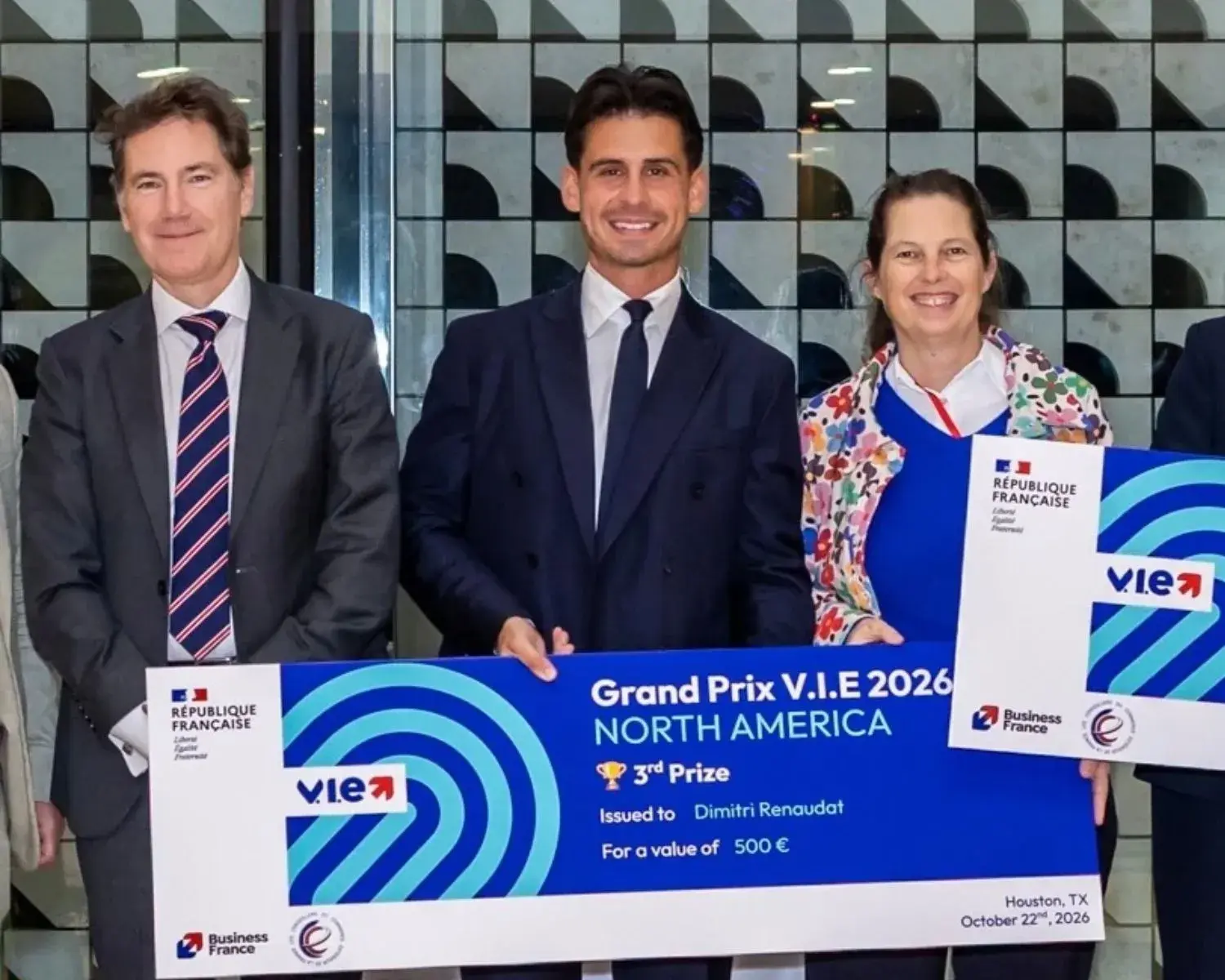
Your work with French flour also earned you recognition at the Grand Prix V.I.E. North America...
To enter the competition, we had to create a two-minute video answering the question: “How is your V.I.E. assignment changing the world of tomorrow in North America?”
My manager and I said to ourselves that we might not be changing the world in the literal sense, but on our own scale, we are helping transform the world of baking by bringing new products and high-quality French flours to the North American market.
So I wanted to create something that genuinely reflected my job, the product, and what selling it involves. I ultimately finished third in the competition and was invited to Houston for the awards ceremony.
Your V.I.E. is coming to an end. Does that mean your American adventure is over?
No! The assignment was originally planned for 18 months, but from the very beginning of the recruitment process, Grands Moulins de Paris was looking for someone who could potentially stay for the long term. The V.I.E. was also an opportunity to see whether things worked well for both sides before moving forward.
Today, both the company and I want to continue working together after my V.I.E. I’m very happy about that, because not every V.I.E. assignment necessarily leads to a job. In my case, I had a genuine position and real sales responsibilities from the outset.
I’m extremely grateful to Grands Moulins de Paris and Savory Gourmet for this experience and for the conditions they provided throughout my V.I.E.