
News
Health insurance for students in Brazil: cover, costs and advice for French students

It pays particular attention to French students, including those heading to SKEMA's Belo Horizonte campus in Minas Gerais: their French Sécurité sociale stops paying once they study abroad for more than six months, the France-Brazil social security agreement does not fill the gap, and the CFE combined with a complementary plan is the route most of them end up taking.
Do you need health insurance to study in Brazil?
In practice, yes. Even though anyone on Brazilian soil can use the public system at no cost, both the consulate that issues your student visa and your host university expect documented private or international cover before you arrive.
What the student visa (VITEM IV) and university enrolment require
The VITEM IV is the temporary student visa required for any course of study longer than 90 days; it does not allow paid employment [gov.br, Ministério das Relações Exteriores, 2026]. The Brazilian consulate issues it on proof of health insurance valid throughout the territory, for the entire duration of the stay, and including medical repatriation. A purely local Brazilian plan does not satisfy this last point, because it does not cover repatriation abroad.
Once in Brazil, you must register with the Polícia Federal within 90 days of entry (the stamp in your passport sets the clock), which produces your migration number (RNM) and residence card (CRNM). Late registration carries a penalty of R$100 per day, capped at R$10,000 (Decree 9.199/2017). Universities, for their part, ask for a health insurance certificate on arrival before they finalise enrolment, so the certificate you used for the visa is checked a second time on campus. SKEMA Belo Horizonte students must provide proof of insurance before applying for their visa, as it is one of the first pre-departure requirements they must complete in order to receive their acceptance letter.
Why relying on the public system alone is rarely enough
Free access is not the same as adequate access. The public system comes with long waits for specialists and imaging and runs almost entirely in Portuguese, with little English on hand, and it produces none of the documentation the consulate and the university ask for. Students therefore keep their right to the SUS but add a private or international layer on top. French students cannot fall back on the Sécurité sociale to bridge the gap either: it stops covering them once they study abroad for more than six months, a point set out in detail further down.
How healthcare works in Brazil: the SUS and private plans
Brazil runs two parallel systems: a universal public service funded by the state, and a private market of subscription health plans regulated by a federal agency. A foreign student can use the first by right and buy into the second by choice.
Can foreign students use the public system (SUS)?
The SUS (Sistema Único de Saúde) is Brazil's universal public health service, free at the point of use and open to anyone present on the territory, including international students on a temporary visa. The right rests on the 1988 Constitution, Federal Law 8.080/1990 and the 2017 Migration Law (13.445/2017); a Ministry of Health technical note of April 2024 confirms that care is provided regardless of documentary status [gov.br, 2024]. Emergencies run through the SAMU ambulance service on 192 and the 24-hour UPA units.
The limits are practical rather than legal. Specialist appointments and scans can involve long queues, consultations are conducted in Portuguese with little English available, and provision varies by region. Belo Horizonte is comparatively well served thanks to the university hospital, but this does not remove the language barrier or the waiting times.
Private health plans (planos de saúde) and the role of the ANS
A plano de saúde is a private Brazilian health plan sold on a monthly subscription, giving faster access to consultations, private hospitals and, in the larger networks, English-speaking doctors. Around a quarter of the population holds one. Outside an approved plan or insurance policy, private providers expect payment upfront, so the plan exists precisely to remove that barrier.
The ANS (Agência Nacional de Saúde Suplementar) is the federal agency that regulates these private plans, sets the rules insurers must follow and protects subscribers. Its Resolution RN 438/2018 is the key text for foreigners: an insurer cannot refuse a plan on the grounds of nationality or the absence of permanent residence, which is what makes a local plan accessible to a student on a temporary visa.
Your cover options as an international student
Four routes exist, and they are not interchangeable: a Brazilian local plan, a dedicated international student policy, and, for French nationals, the CFE or a French study-abroad policy, with the Sécurité sociale playing only a residual role. The table summarises how they compare on the visa requirement and cost; each is detailed below.
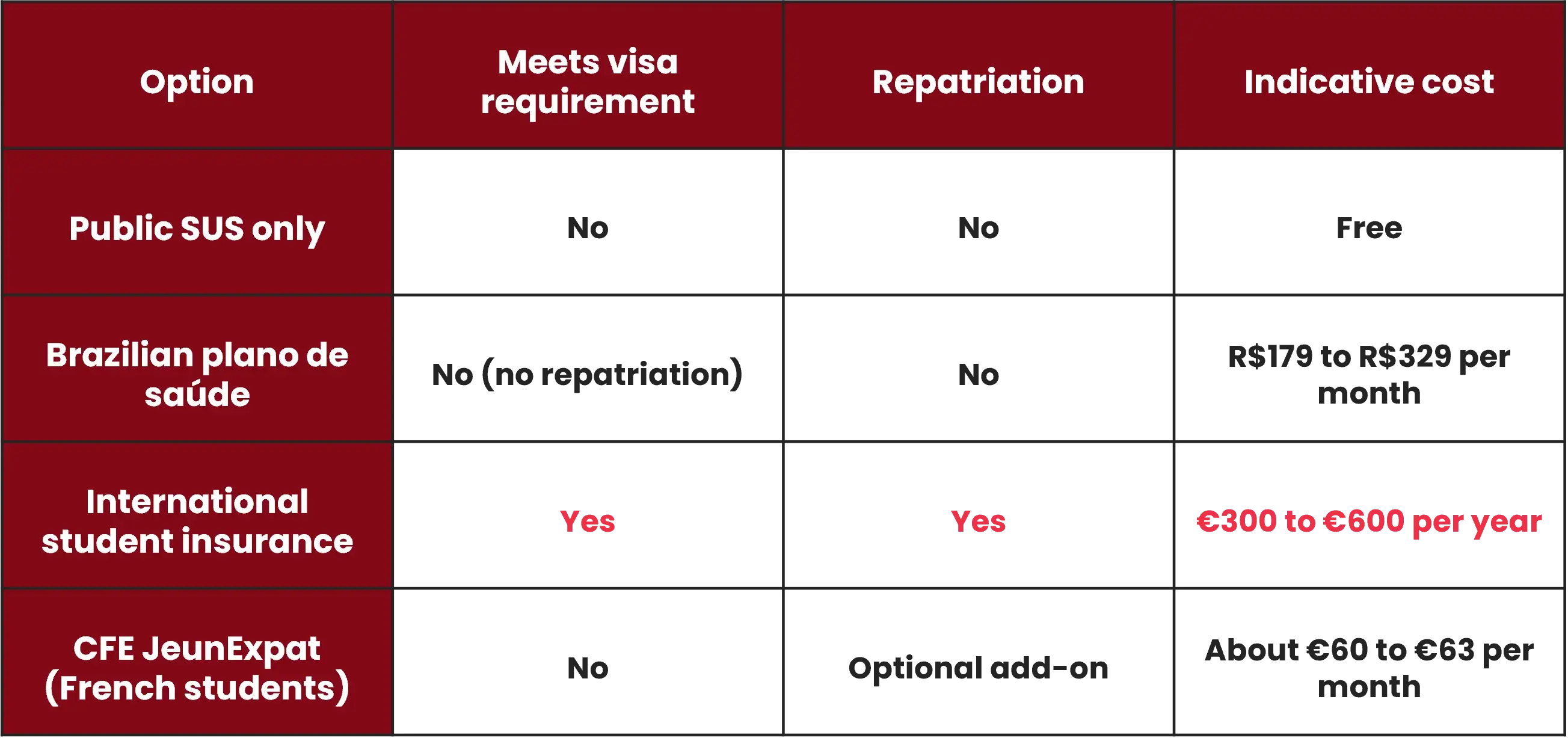
[Sources: gov.br, ANS, cfe.fr, 2026; premiums indicative]
A Brazilian private health plan (plano de saúde)
A foreign student can subscribe to a local plan once they hold a valid CPF (the Brazilian tax number), under ANS rule RN 438/2018. The insurer will ask for a passport, the CPF, proof of address and the Polícia Federal registration protocol. Two caveats matter. Plans apply carências, the Portuguese term for waiting periods before certain treatments are covered, and they do not include international repatriation. As an order of magnitude, the Unimed-BH Unifácil range in Minas Gerais runs from about R$179 to R$279 a month for ages 19 to 23 and R$199 to R$329 for ages 24 to 28 (indicative).
Dedicated international student health insurance
A dedicated international student policy is the option built for this situation and is mandatory to obtain the visa. It typically reimburses close to the full cost of care, carries cover limits of €100,000 to €300,000, and includes medical repatriation, which is what allows it to satisfy the visa requirement on its own. Budget around €300 to €600 for a year (indicative). Read the exclusions before buying: routine check-ups, chronic or pre-existing conditions and non-urgent dental or optical care are frequently left out.
For French students: Assurance Maladie, the CFE and the France-Brazil agreement
This is the part the comparison sites and brokers leave out, and it is where most French students get the rules wrong.
French Assurance Maladie stops after six months outside the EU. A student over 20 who leaves for more than six months outside the EU and EEA is no longer covered by French health insurance for care received abroad [ameli.fr, 2026; cleiss.fr, 2026]. There is no tiers payant (direct billing) in Brazil, and only unforeseen care may be reimbursed afterwards, at the French convention tariff and on a discretionary basis (a possibility, not an entitlement), through a claim filed on your return [cleiss.fr, 2026].
The France-Brazil social security agreement does not cover student healthcare. Signed on 15 December 2011 and in force since 1 September 2014, managed by the Cleiss, it applies to employees, posted workers and pensioners, for retirement pensions, invalidity, and work accidents or occupational diseases [cleiss.fr, 2026]. Its Article 2 excludes voluntary schemes, and it carries no student or healthcare component for academic mobility, so it provides no health cover for a student in Brazil. Relying on it is the single most common mistake.
The Caisse des Français de l'Étranger (CFE) is the voluntary French public scheme that lets nationals abroad keep a link with the French system. Its JeunExpat Santé offer is open to French nationals under 30 with no medical questionnaire, and covers routine care, hospitalisation, diagnostics and maternity, plus care during visits to France of under three months [cfe.fr, 2026]. Joining before departure, or within three months of arrival, gives immediate cover; join later and a three-month waiting period applies. Reimbursement follows French tariffs, and Brazil sits in the CFE's Zone 2, where the scheme refunds roughly half of actual costs (an €80 consultation returns about €21), so a French complementary plan (mutuelle) is needed to approach full cover. Repatriation is not in the base offer and is bought as an option. The JeunExpat Solo scale for April 2026 is €180 a quarter (about €60 a month) under 25 and €189 a quarter (about €63 a month) for ages 25 to 29 [cfe.fr, 2026].
A French study-abroad student policy is the other route French students take, sold by French insurers as a single travel-and-health product. It usually reimburses the full cost of illness and accident care, bundles civil liability and medical repatriation, and can therefore satisfy the visa requirement on its own, but it is not a complete health scheme: routine check-ups, dental, optical and chronic conditions are normally excluded.
How much does it cost?
Budgets fall into three brackets: a Brazilian local plan at roughly R$180 to R$330 a month, an international student policy at €300 to €600 a year, and, for French students, CFE membership at about €60 a month plus any top-up.
Typical premiums by option and length of stay
- Brazilian plano de saúde (Unimed-BH Unifácil, Minas Gerais, indicative): R$179 to R$279 a month at 19 to 23, R$199 to R$329 at 24 to 28.
- International student health insurance: €300 to €600 a year, limits of €100,000 to €300,000, repatriation included (indicative).
- CFE JeunExpat Solo (official April 2026 scale): €180 a quarter (about €60 a month) under 25, €189 a quarter (about €63 a month) at 25 to 29 [cfe.fr, 2026].
What makes a plan more or less expensive
Price moves with age, the length of the stay, the cover limit, and whether repatriation and chronic-condition care are included. To gauge the gap a good policy closes, the indicative out-of-pocket costs of private care in Brazil are worth keeping in view (indicative figures, around 6 BRL to 1 EUR):
- Private GP consultation: R$300 to R$1,200 (about €50 to €200).
- Private hospital, per day: up to R$5,000 (about €800).
- Intensive care, per day: around R$18,000 (about €3,000).
- Private ambulance: about R$1,500 (about €240).
- Medical repatriation to France: €10,000 to €30,000 within South America, around €40,000 by scheduled flight with a medical escort, and €50,000 or more for an air ambulance carrying critical-care equipment.
A single intensive-care episode, or one repatriation, can exceed several years of premiums, which is the practical case for proper cover.
What a student plan should cover
Beyond price, a student policy should be read against five benefits, because the gaps between products sit in the detail rather than the headline limit.
-
Check that the policy covers emergency treatment, hospitalisation, outpatient consultations and medical repatriation. A cover limit of at least €100,000 per illness or accident is a sensible floor for a stay in Brazil.
-
These are the benefits most often missing. Outpatient mental health support, routine dental and optical care, and treatment for chronic or pre-existing conditions are frequently excluded or capped in international student policies, and they sit behind waiting periods in Brazilian plans. A student who already manages a long-term condition should confirm in writing that it is covered before paying.
-
Brazilian plans apply carências before certain treatments become available, and international policies routinely exclude routine check-ups and non-urgent care. Read the exclusions line by line, note any per-item caps, and confirm the start date of cover lines up with your arrival rather than your enrolment.
Choosing the right option for your situation
The right cover depends on how long you stay and on your nationality more than on price.
-
For a single exchange semester, an international student policy is usually the cleanest choice: it produces a visa-ready certificate in one document and runs for the length of the term without a Brazilian CPF or a Polícia Federal protocol to set up first. A French student on a one-semester exchange often takes a French study-abroad policy instead, keeping CFE membership only to preserve continuity with the French system on return.
-
For a full degree or a stay of several years, a Brazilian plano de saúde can work out cheaper over time and gives day-to-day access to private networks in Brazil and Belo Horizonte, provided repatriation cover is added separately. Many long-stay students may hold a local plan for routine care and a slim top-up alongside it. For French and international students, an international insurance plan is often required by the host institution and remains a visa requirement for VITEM IV applicants.
-
Interns and language students on a course longer than 90 days still need the VITEM IV and the same insurance proof, so the certificate question does not go away on a short programme. Students bringing a partner or children should confirm that dependants are named on the policy and meet the same repatriation requirement, since family members are not covered by default.
Using your cover in Brazil
Day to day, access depends on whether you hold a local plan or an international policy. A local plan books you into a private network directly; an international policy more often means paying and claiming back, so keep every receipt.
Appointments, emergencies and hospitals (including Belo Horizonte)
In an emergency, the public route is the SAMU ambulance on 192 and the 24-hour UPA units, available to everyone regardless of cover. For planned care, a Brazilian plan routes you through its own network of clinics and private hospitals, which in Belo Horizonte includes well-equipped university and private facilities. Without a plan, private providers expect payment before treatment, so confirm in advance whether your insurer settles directly or reimburses you afterwards.
Direct billing vs reimbursement, and claims
Brazilian plans and a few international insurers with local agreements bill the provider directly; most international and French policies work by reimbursement, where you pay first and claim back on the French or insurer tariff. Keep itemised invoices, prescriptions and proof of payment, and note any deadline for submitting a claim. French students reclaiming through the CFE should remember that the refund is calculated on the Zone 2 tariff, not the Brazilian bill.
Before you leave: documents and checklist
Settle the paperwork before departure, because the insurance certificate is checked twice, once for the visa and once at enrolment, and the Polícia Federal deadline starts the day you land.
- Proof of health insurance valid across Brazil, for the full stay, with medical repatriation, for the consulate and the university.
- Passport, VITEM IV visa and the entry stamp that starts the 90-day registration clock.
- Polícia Federal registration within 90 days, to obtain the RNM number and CRNM card (administrative fees around R$100 for registration and R$200 for the card, to confirm on the official gov.br schedule).
- Your CPF if you intend to subscribe to a Brazilian plano de saúde locally.
- For French students, proof of CFE membership or a French study-abroad policy, plus any repatriation option.
- Yellow fever vaccination, recommended at least ten days before travel rather than a strict entry requirement, depending on your itinerary [France Diplomatie, 2026].
Wider pre-arrival and orientation support is gathered on SKEMA's international students hub, which is useful for the documents and timelines that sit alongside the health paperwork.
Studying in Brazil with SKEMA
SKEMA's Brazilian presence is its Belo Horizonte campus in Minas Gerais, which puts students in one of the country's better-served cities for university and private hospitals. The health rules above apply in full to students on this campus, where the SUS is available by right but is not, on its own, the cover the visa and university expect.
On campus, SKEMA's student health and wellbeing services (SKEMA KARE) provide internal support and guidance. Students who have settled their cover before they apply to a programme with a Brazil destination arrive with the certificate, the visa file and the Polícia Federal deadline already accounted for.
FAQ
-
Yes, in the public system. The SUS is free at the point of use and open to anyone on Brazilian soil, including international students on a temporary visa [gov.br, 2026]. It cannot, though, produce the insurance certificate the visa and university require, so students still need private or international cover.
-
Rarely. The SUS covers treatment but comes with long waits for specialists, a near-total reliance on Portuguese, and no repatriation. Most students add a Brazilian plan or an international policy for faster access and to satisfy the consulate and the university’s requirements.
-
No, not after six months. A student over 20 leaving for more than six months outside the EU and EEA is no longer covered by French health insurance for care abroad, and the France-Brazil social security agreement does not cover student healthcare [ameli.fr, 2026; cleiss.fr, 2026]. The usual route is CFE membership plus a complementary plan.
-
No. The CFE JeunExpat offer covers care, but its base does not include the medical repatriation the Brazilian consulate requires [cfe.fr, 2026]. French students take a French study-abroad policy so the certificate meets the visa rule, then keep the CFE for continuity with the French system and for care during stays back in France.
-
Not by default. Dental, optical and outpatient mental health care are common exclusions in international student policies and sit behind waiting periods in Brazilian plans. Check each benefit individually and confirm it in writing before paying.
-
The one that names the condition as covered. Chronic and pre-existing conditions are frequently excluded from international student policies and subject to carências in Brazilian plans, so request written confirmation that your condition is included, and compare the cover limit against the indicative private-care costs above before deciding.