News
Insurance for French students in the USA: requirements, costs and how to choose your plan
This guide sets out the federal rules in force in 2026, real Student Health Insurance Plan (SHIP) prices for 2025-2026 and the criteria to compare plans, including for students targeting the SKEMA Raleigh campus on NC State's Centennial Campus.
At a glance: which insurance is right for French students in the USA?
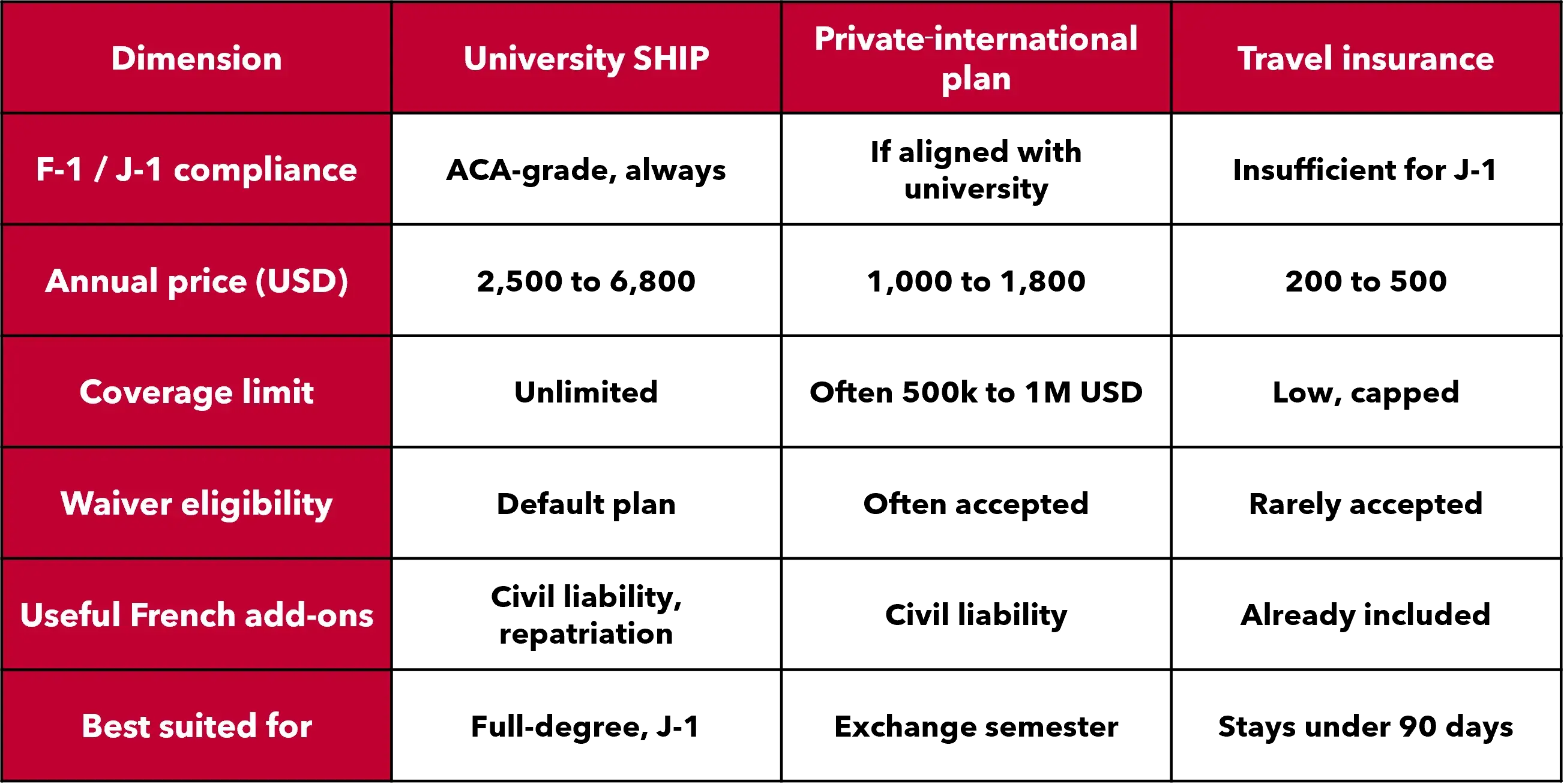
The answer depends on your visa, your host university's waiver policy and the length of your stay. Where waivers are accepted, compare a private US-based international plan against the SHIP. Where the university operates a no-waiver policy, the SHIP is compulsory and only a French complementary plan adds value (civil liability, repatriation, luggage). J-1 holders also meet the federal minima of 22 CFR § 62.14.
[Sources: bluecrossnc.com, isoa.org, chapkadirect.com, 2025-2026]
Why French students cannot rely on French cover in the USA
Healthcare in the USA is private and expensive
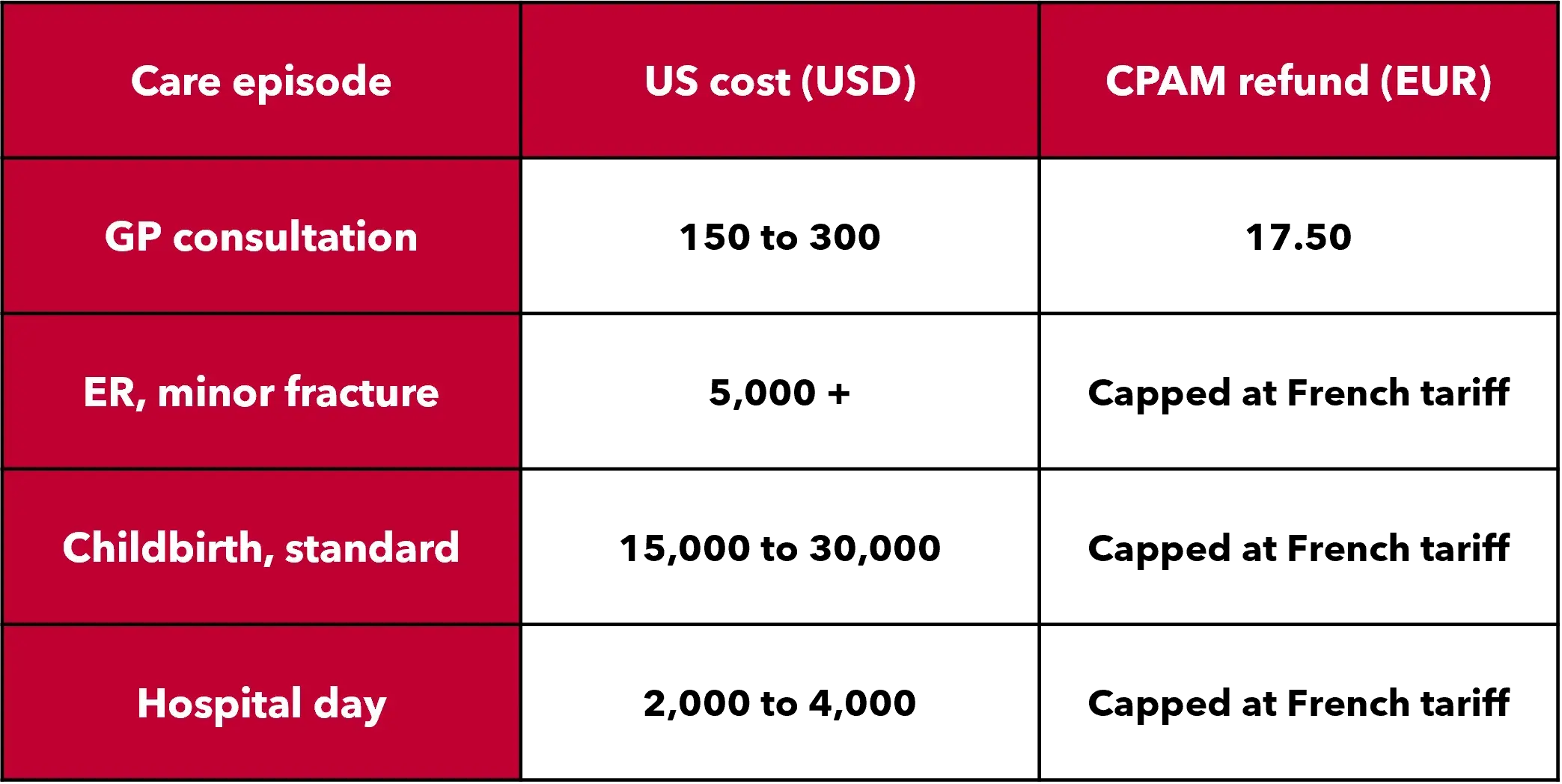
A GP consultation costs 150 to 300 USD, an emergency room visit for a minor fracture exceeds 5,000 USD and a standard childbirth without insurance ranges from 15,000 to 30,000 USD [Sources: ameli.fr, internationalstudentinsurance.com, 2026].
What French Sécurité sociale and the EHIC do not cover
The CEAM / EHIC is valid only in the European Economic Area, Switzerland and the United Kingdom [cleiss.fr, 2026]. The only redress for US care is a discretionary CPAM reimbursement on return via form Cerfa 12267*04, calculated on French tariff grids: a 150-300 USD US GP consultation yields approximately 17.50 EUR (70% of the French 25 EUR reference rate) [ameli.fr, 2026]. Mutuelles étudiantes (Heyme, LMDE, SMENO) do not pay US providers.
Keeping French rights via CFE
The Caisse des Français de l'Étranger (CFE) is the public body that lets French nationals abroad keep continuity with the French social security system, at a student rate of approximately 30 EUR per month [cfe.fr, 2026]. It does not cover US care but preserves your rights between terms.
Typical out-of-pocket costs without insurance
Aim for plans with limits of at least 500,000 EUR per accident or illness.
F-1 vs J-1: the US visa rules
-
The F-1 visa is the academic student visa for international students enrolled full-time in a SEVP-certified institution. There is no federal floor: the standard is delegated entirely to each university [mpowerfinancing.com; amerigoeducation.com, 2026]. The same private plan can satisfy one institution and be rejected by another, so checking the host university's criteria comes before any quote comparison. Wider mobility resources sit on SKEMA's international students hub and in the dedicated guide to the F-1 and J-1 student visas for the USA.
-
The J-1 visa is the exchange visitor visa, used by exchange semesters, short-term scholars and dual-degree participants. J-1 holders and their J-2 dependents are bound by 22 CFR § 62.14 [j1visa.state.gov; ecfr.gov, 2026]:
- Sickness and accident: at least 100,000 USD per accident or illness
- Medical evacuation: at least 50,000 USD
- Repatriation of remains: at least 25,000 USD
- Deductible cap: at most 500 USD
- Coinsurance: at most 25%
- Pre-existing conditions: reasonable waiting period
- Underwriter: A.M. Best A-, S&P A-, Weiss B+, Fitch A-, Moody's A3, or government-backed, or CMS-eligible
Non-compliance triggers SEVIS termination and mandatory departure. J-2 dependents must meet the same minima.
Affordable Care Act (ACA) and state-level mandates
The federal Individual Shared Responsibility Payment is 0 USD since 2019 [isoa.org, 2026]. F-1 students are non-resident aliens for the first five calendar years, J-1 for two, and exempt from the federal ACA mandate during that window. Five states retain a local mandate with active penalties: California, Massachusetts, New Jersey, Rhode Island and the District of Columbia [ftb.ca.gov; mahealthconnector.org, 2026]. Massachusetts defines tax residency differently from the IRS; a private plan failing the state's Minimum Creditable Coverage (MCC) exposes the student to a penalty.
University waivers: where the decision is made
How a hard waiver works
A hard waiver is the dominant US model: the university auto-enrols every international student in its SHIP, bills the premium on the tuition account and accepts opt-out only on proof of an alternative plan meeting every criterion (deductible ≤ 500 USD, year-long coverage, US-based English claims, unlimited maximums on major medical, mental health benefits) [amerigoeducation.com; bluecrossnc.com, 2026]. After the deadline, the SHIP is irreversibly billed.
"No waiver" universities
A minority of universities impose their SHIP whatever the alternative cover (University of Florida via ISO [isoa.org, 2026]). NC State currently runs a hard waiver, Fall 2025-2026 deadline 10 September 2025 [studentservices.ncsu.edu, 2025]; re-check yearly, as the wider UNC System has been revisiting its rules. SKEMA Raleigh students are not concerned by this no waiver policy.
Hard waiver in practice: the NC State case
NC State runs Student Blue, administered by Blue Cross NC. For 2025-2026 [bluecrossnc.com NCSU 25-26 brochure; studentservices.ncsu.edu]:
- Value Plan: 1,226.80 USD per semester (undergraduate), 1,396.54 USD (graduate)
- Premium Plan: 1,583.50 USD per semester (undergraduate), 1,802.92 USD (graduate), i.e. 3,605.84 USD per year
- Deductible: 0 USD at the Student Health Center, 500 USD in-network on Premium
- Out-of-pocket max, Premium in-network: 4,000 USD
- Fall waiver deadline: 10 September 2025
Students enrolled in the BBA in International Business taught at Raleigh or on exchange tracks on the same campus are not concerned by the SHIP. SKEMA students will need to show proof of insurance meeting SKEMA Raleigh’s minimum requirements.
Common reasons waivers are refused
Seven recurring causes [amerigoeducation.com, 2026]: deductible > 500 USD, incomplete year-long coverage, no US-based claims, capped major medical maximums, exclusion of mental health, exclusion of organised sports, non-US-licensed underwriter.
Documents to keep ready for the waiver process
Certificate of insurance, benefits summary, Proof of Coverage letter in English with effective dates, front-and-back copies of the insurance card. Prepare these in PDF before the portal opens.
The four main insurance options for French students in the USA
-
ACA-grade major medical plans underwritten by Aetna Student Health, UnitedHealthcare StudentResources or Blue Cross Blue Shield. Unlimited maximums, 100% preventive care in-network, zero waiting period on pre-existing conditions, 0 USD deductible at the campus Student Health Center [isoa.org, 2026]. 2,500-4,000 USD per year at public universities, 4,000-6,800 USD+ at selective private ones.
-
ISO, PSI and International Student Insurance (ISI) design plans to clear university waiver criteria. ISO plans start around 90 USD per month, up to 70% cheaper than typical SHIPs [isoa.org, 2026]. ACcess runs through US PPO networks (Aetna PPO, First Health). Deductibles are higher (often 500 USD+); sports, mental health and pre-existing exclusions must be checked line by line.
-
- April Expat StudenT: ~57 EUR per month, 100% hospitalisation up to 1,000,000 EUR per year (COVID-19 included), medical repatriation, psychological support, civil liability [april-international.com, 2026].
- April MyStudies Cover: ~40 EUR per month, accident cover up to 250,000 EUR and repatriation.
- Chapka Cap Student (Zone 3, includes USA): ~63 EUR per month, full medical and hospitalisation with no deductible on sudden illness, round-trip travel for a relative if the student is hospitalised, civil liability up to 4,500,000 EUR [chapkadirect.com, 2026].
These plans are generally not ACA-compliant, lack a US PPO network and use French-language claims. They work as a complementary layer (civil liability, repatriation, baggage, trip interruption), rarely as the primary plan in strict-waiver universities.
-
Low limits, broad exclusions, unfit for a full academic year. Possible below 90 days outside the J-1 framework if the host institution does not impose its own SHIP. No waiver value.
How to compare plans
Aim for coverage limits of 500,000 USD per accident or illness, ideally with an unlimited annual cap. The J-1 100,000 USD floor is per accident or illness, not a shared annual cap.
On the cost mechanics: a deductible is what you pay before the insurer contributes, a copay is a flat fee per visit, coinsurance is your share after the deductible, the out-of-pocket maximum is the annual ceiling on your share. Above a 500 USD deductible, most universities refuse the waiver.
Outpatient mental health cover with low copay matters (Columbia: 0 USD for the first ten visits [health.columbia.edu, 2026]) and is a frequent exclusion in private international plans. NCAA varsity, club sports and intramurals must be explicitly included; SHIPs cover them by default, private plans often charge an option.
On the provider network side: an HMO is restricted with PCP referrals, a PPO is the student-friendly format with in- and out-of-network access, an EPO is in-network only, no referral. Modern SHIPs and ISO plans use a PPO backbone. A 24/7 francophone hotline and mobile app, native to French-sourced plans and absent from SHIPs, matters for parents staying in France. Read the host university's Student Health Insurance Plan Comparison Sheet before any purchase.
How much does insurance cost for French students in the USA?
For 2025-2026:
- Public-university SHIPs: 2,500 to 4,000 USD per year
- Selective private SHIPs: 4,000 to 6,800 USD or more per year
- Private US-based international plans: 1,000 to 1,800 USD per year
- French expat student plans: 480 to 760 EUR per year
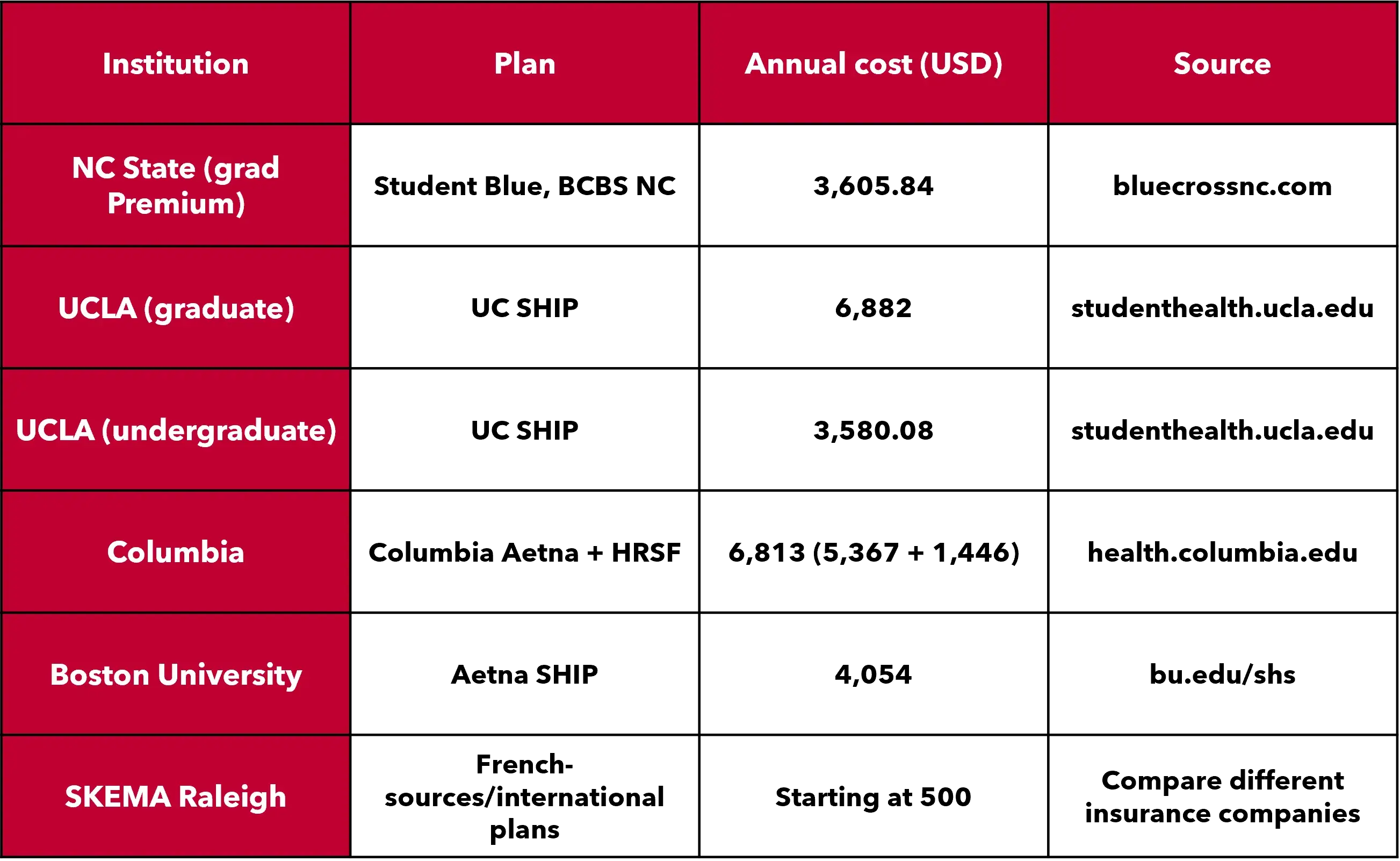
Price moves with age, state (NY, MA, CA top the range), pre-existing conditions, deductible, sports option, programme length and academic level (graduate plans run 30 to 50% above undergraduate). Hidden costs: out-of-network copays, drugs outside the formulary, dental and vision sold separately (BU Aetna Dental PPO: 478 USD per year [bu.edu, 2026]) and non-waivable institutional fees (Columbia HRSF: 1,446 USD per year [health.columbia.edu, 2026]).
Best plan by profile
Exchange students on a single semester usually combine a private international plan compliant with the host's criteria with a French complementary plan for civil liability, repatriation and luggage. Full-degree students on a Bachelor, MSc or MBA are better served by the SHIP, for continuity of access at the campus Student Health Center, unless the budget is tight; those enrolled in the Global MBA's international triple degree or in other multi-campus programmes with a US mobility track typically plan a full-year SHIP cycle into the budget. SKEMA Raleigh students are free to choose a French-sourced or international plan meeting SKEMA’s minimum requirements. Interns and trainees on J-1 are bound by 22 CFR § 62.14, and the underwriter rating (A.M. Best A- or above) should be verified before submission to the DS-2019 sponsor. Student athletes need cover for intercollegiate or club sports explicitly included. For short summer or language programmes below 90 days outside the J-1 framework, travel insurance can suffice if the host institution allows it.
What a good plan must cover
Beyond the decision criteria, four points deserve explicit verification in the policy. Civil liability (Responsabilité Civile) is absent from every US SHIP [internationalstudentinsurance.com, 2026] and must be added through a French complementary plan (Chapka Cap Student goes up to 4,500,000 EUR), covering rented accommodation and third-party injury during an internship. Medical evacuation and repatriation of remains hit the J-1 thresholds of 50,000 USD and 25,000 USD; they are often optional in private US plans for F-1 holders and included by default in April Expat Student and Chapka Cap Student. Maternity coverage is the cleanest break between products: SHIPs cover pregnancy immediately under ACA rules, while private international and French expat plans apply a 12-month waiting period or exclude maternity entirely, so a pregnant student or one planning a pregnancy should enrol in the SHIP. Exclusions to read line by line include pre-existing conditions (variable), extreme sports, alcohol-related injuries, intentional self-harm and varsity or club sports (often excluded from private plans).
Common mistakes to avoid
Choosing the cheapest plan and missing one waiver criterion is the leading cause of refusal, with the SHIP then billed in full on top. A travel insurance policy taken for a full academic year carries limits too low for the J-1 floor and exclusions too broad for the F-1 institutional check. Skipping the French-side complementary cover leaves civil liability, repatriation, trip interruption and lost luggage uncovered. Treating a no-waiver shift as a remote scenario delays a budgeting decision that belongs at the application stage.
Practical timeline and arrival checklist
Waiver portals open 45 to 60 days before term start [health.columbia.edu, 2026]. Fall portals unlock in early July; NC State closes on 10 September 2025. No SSN or ITIN is required to purchase insurance or file a waiver [amerigoeducation.com, 2026]; insurers identify the student through the Student ID or the SEVIS ID. SKEMA Raleigh students are not concerned by the waiver procedures.
Critical arrival documents: insurance card (physical or digital), immunisation record translated into English (MMR, Meningococcal, Hepatitis B, Tdap, Varicella), and active prescriptions in International Nonproprietary Names (INN) (e.g. Paracetamol rather than Doliprane), since US pharmacists do not recognise French brand names. Printed waiver approval if applicable. On-campus wellbeing through SKEMA KARE student health and wellbeing services complements but does not replace this paperwork.
FAQ
-
No. The CEAM / EHIC is valid only in the European Economic Area, Switzerland and the United Kingdom [cleiss.fr, 2026]. US care needs a separate US-compliant plan.
-
Generally no. French plans (April Expat Student, Chapka Cap Student) are not ACA-compliant and lack a US PPO network. Strict-waiver universities reject them as the primary plan, but they remain useful as a complementary layer.
SKEMA Raleigh students are not subject to NC State’s health insurance plan or its waiver policy.
-
22 CFR § 62.14: 100,000 USD per accident or illness, 50,000 USD evacuation, 25,000 USD repatriation, deductible ≤ 500 USD, coinsurance ≤ 25%, underwriter rated A.M. Best A- or equivalent. Non-compliance triggers SEVIS termination [j1visa.state.gov, 2026].
-
No. F-1 and J-1 students do not need an SSN or ITIN. Identification runs through the Student ID, the SEVIS ID or an insurer member number.
-
No. Under HIPAA, US providers cannot share diagnoses, records or bills with parents without the student's explicit written consent, even when parents pay the premium.
-
US pharmacists cannot fill foreign prescriptions. Schedule a US consultation, ideally at the campus Student Health Center, with documents in International Nonproprietary Names (INN) rather than brand names.
-
2025-2026: 2,500-4,000 USD per year at public SHIPs, 4,000-6,800 USD+ at selective private SHIPs, 1,000-1,800 USD for private US international plans, 480-760 EUR for French expat plans. NC State Student Blue, graduate Premium: 3,605.84 USD per year [bluecrossnc.com, 2025-2026].
-
Not in practice. A discretionary CPAM reimbursement via Cerfa 12267*04 is calculated on French tariffs: a 150-300 USD US GP visit yields ~17.50 EUR [ameli.fr, 2026]. CFE membership at ~30 EUR per month preserves your French rights but does not cover US care.
A two-step decision
The choice resolves in two steps. First, confirm your host university's policy: hard waiver, no waiver or no SHIP imposed. Then compare plans on coverage limits, deductible, mental health, sports, civil liability and US-based claims. Students who have validated this sequence can apply to a SKEMA programme with a US destination with the SHIP or waiver budget already built in.