
News
Can you work in France with a student visa? Rules, hours, jobs and next steps

Quick answer: can you work on a student visa in France?
A student residence document in France carries an ancillary right to work. For non-EU students that right is capped at 964 hours over a rolling 12-month period, which is roughly 20 hours a week on average. No prior work permit is needed within that limit, but the employer must file a short declaration before you start. Algerian students follow a separate regime (822 hours 50 minutes a year, with a work permit required).
The annual work limits depend on nationality: non-EU students, 964 hours a year; Algerian students, 822 hours 50 minutes a year; EU, EEA and Swiss students, no limit. The rest of this guide explains how those figures apply in practice.
This guide is written for international students living, or about to live, in France on a French campus. SKEMA runs three campuses in France, in Paris-Grand Paris (Suresnes), Lille and Sophia Antipolis, and the rules below apply to students enrolled there.
Who is allowed to work while studying in France
Your right to work depends on your nationality and on the exact document you hold.
Students from the European Union, the European Economic Area or Switzerland benefit from free movement of labour. They face no work permit and no annual hours limit, and they may also register as self-employed.
Non-EU (third-country) students need a valid residence status to access the labour market. A VLS-TS étudiant is a long-stay visa that doubles as a residence permit for the first year, and it grants the right to work automatically once validated. A student residence card (carte de séjour étudiant) works the same way. Neither requires a separate work permit for standard part-time employment within the 964-hour limit (service-public.fr, F2713).
Not every visa opens this door. A short-stay Schengen visa, a temporary long-stay visa (VLS-T) and the étudiant-concours visa do not grant the right to work. Only a validated VLS-TS or a student card does.
One restriction applies to everyone outside the EU and EEA: a student permit allows salaried work only. Registering as an auto-entrepreneur, or working as an independent contractor, is not permitted under student status. Any paid activity must run through an employment contract.
If you are still choosing where to study, the right to work attaches to a degree programme taught in France, not to a campus abroad, so the campus you enrol on determines which rules you follow.
How many hours can a student work in France?
French law allows non-EU students to work a maximum of 964 hours per year. That figure is exactly 60% of the standard legal working year in France, which is 1,607 hours for a full-time post (Campus France, 2026).
The cap is an annual envelope, not a weekly ceiling. The 964 hours average out to about 20 hours a week across a full year, but you may spread them unevenly. You can work full-time, up to 35 hours a week, during the summer and university breaks, then stop almost entirely during exam periods, provided the running total stays under 964 hours by the end of the reference period (service-public.fr, F2713).
The 12-month reference period starts on the day your residence permit is issued or your VLS-TS is validated. A permit validated on 1 September 2025 carries a 964-hour allowance that runs until 31 August 2026, then resets on renewal. Shorter programmes are calculated pro rata: a one-semester exchange of six months gives 482 hours, and a three-month course gives 241 hours.
The Franco-Algerian Agreement of 27 December 1968 governs Algerian students separately. They are limited to 50% of the legal working year, which works out to 822 hours and 50 minutes a year, and they must hold a work permit before starting (immigration.interieur.gouv.fr, 2025).
Can you work full time on a student visa in France?
Not as a steady arrangement. A student visa is granted for study, so permanent full-time employment is not the route it is designed for. You can work full-time in short bursts, typically during the summer or other breaks, but only until you reach your annual allowance. A non-EU student who works 35 hours a week will use up the 964-hour limit in around 27 weeks, so a full year of full-time work is not possible without changing status. Occasional full-time work during breaks and continuous full-time employment are treated differently, and only the first is compatible with student status.
Do you need a separate work permit or authorisation?
For most students, no. The Provisional Work Authorisation (APT) was abolished for students within the annual limit back in 2007, by decree of 11 May 2007, and the student visa or card now serves as the work permit in its own right under Article R5221-2 of the Labour Code.
The employer still has a duty. Before you start, your employer must file a nominative declaration of employment with the prefecture that issued your permit, at least two working days before the contract begins, with a copy of your validated visa or card attached. If the prefecture does not object within 48 hours, the declaration stands.
Two situations call for more. If a contract would take you over the 964-hour cap, the employer has to apply for a temporary work authorisation through the ANEF platform before you work any hour beyond the limit. And, as noted, Algerian students need a work permit (APT) for any paid work from the first hour, and they cannot start on a receipt of application; they must wait for the physical residence certificate to be issued.
What types of work can you do as an international student in France?
Four formats cover almost all student work, and they are treated differently by law.
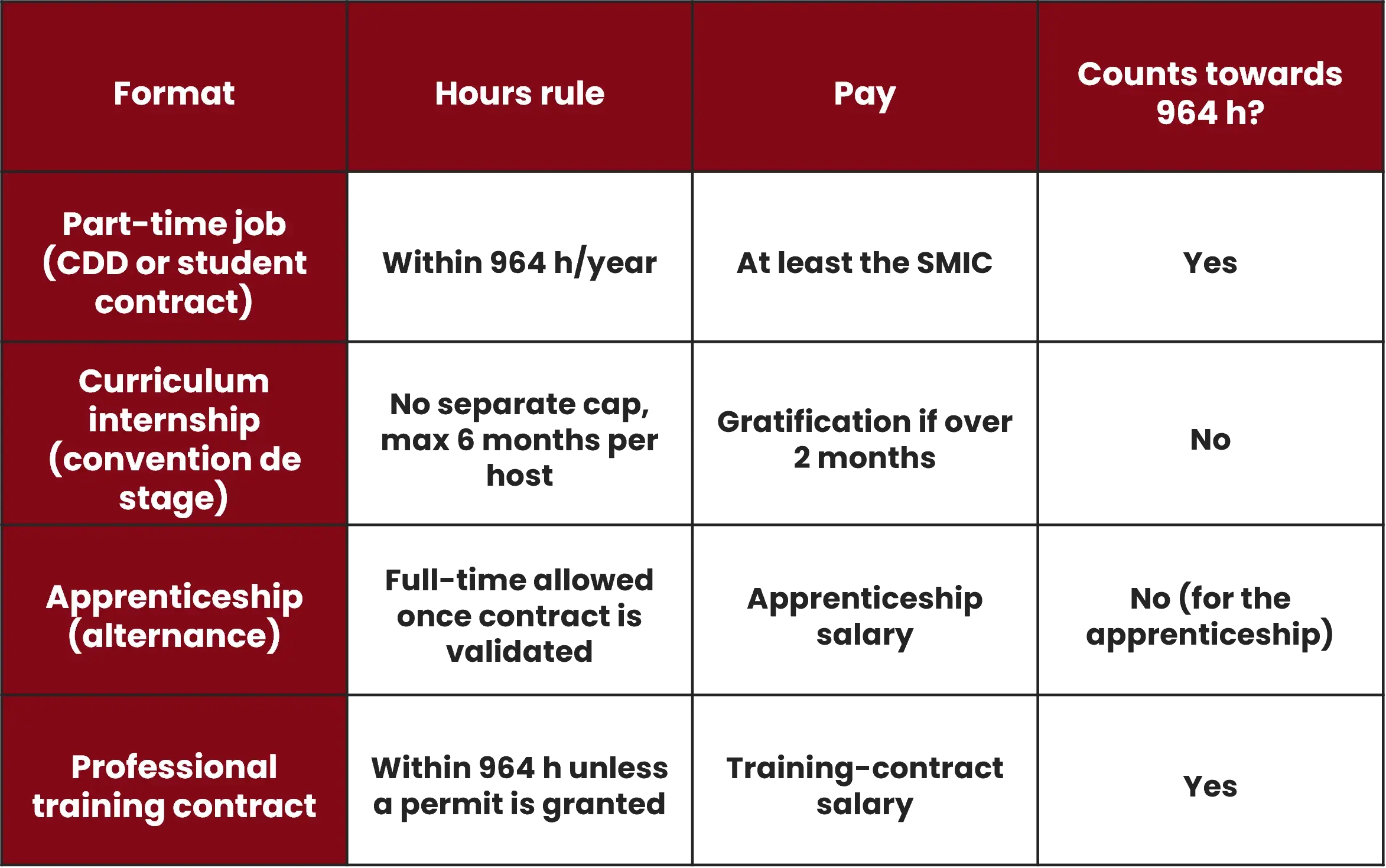
The sections below take each in turn.
-
Part-time jobs are the most common option: retail, hospitality, tutoring, childcare, events, delivery and on-campus roles. A suitable student job has to fit around your timetable and keep you within the 964 hours.
Most students build the job around the academic calendar, lighter hours during teaching and exams, heavier hours over the summer. Plan the year as a budget of hours rather than a fixed weekly figure, and keep a running count, because the responsibility for staying under the cap sits with you.
SKEMA's support for international students, covering orientation and settling in, is a useful starting point for finding campus roles and local opportunities once you arrive.
-
Internships are regulated separately from ordinary salaried employment, and the difference matters for your hours.
A formal internship requires a tripartite internship agreement, the convention de stage, signed before it starts by five parties: the student, the host organisation, the school, the supervising teacher and the workplace tutor. As the educational institution, SKEMA co-signs the agreement, which sets out the tasks, the dates, the weekly hours and the pay.
If the internship runs longer than two months, that is more than 44 days at seven hours a day, the host must pay a minimum allowance, the gratification. For 2026 the minimum is 4.50 euros per hour of actual presence, indexed at 15% of the social security hourly ceiling, which gives roughly 661.50 euros a month for a full-time placement (service-public.fr, 2026). A single internship with one host is capped at six months, or 924 hours of presence, per academic year.
The key point: hours spent on a curriculum internship do not count towards your 964-hour limit. You can complete the internship built into your degree and still keep your full annual allowance for a separate part-time job (Campus France, 2026).
-
Work-study, known in France as alternance, follows a separate set of rules that can work to a master-level student's advantage.
Under an apprenticeship contract (contrat d'apprentissage), once the contract is validated by the relevant skills operator (OPCO) or labour authority (DREETS), you may work full-time beyond the 964-hour limit with no separate permit. Non-EU students usually have to complete a first year of study in France before signing one. There is an exception for master-level programmes: a student on a programme such as SKEMA's Master in Management (Grande École) can sign an apprenticeship from the first year, with training fees covered by the OPCO and a salary on top.
A professional training contract (contrat de professionnalisation) is stricter. The employer must request a separate work permit if combined study and work exceed your 964-hour threshold, and the contract can only be signed after a first year of study in France. The age limit is under 26.
How much can a student earn in France?
Every salaried worker in France, students included, is guaranteed the minimum wage, the SMIC. The rate changed twice in 2026, so date any figure you quote.
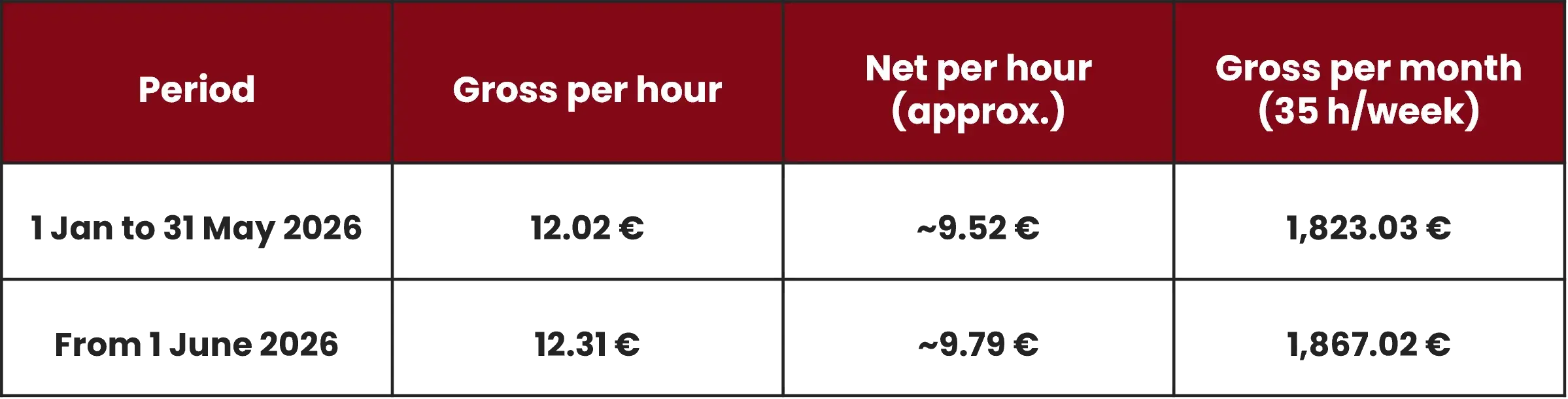
The net rate is the gross figure minus employee social security contributions, which run at about 20% in the private sector. Hours worked beyond the 35th in a week count as overtime and attract a premium of 10% to 25% (travail-emploi.gouv.fr, 2026).
A worked example helps. At the rate in force from June 2026, the 964-hour cap spread evenly is about 80 hours a month, which comes to roughly 990 euros gross a month, or around 11,870 euros gross over the year before tax treatment.
Earnings rarely cover everything, so it is worth pairing a student job with the scholarships and financial support you may be eligible for, and weighing your income against the cost of your student accommodation, which is usually the largest line in a student budget.
Tax, social security and employee rights
Your net pay is lower than your gross pay because of mandatory contributions collected by URSSAF, which fund healthcare, workplace-accident cover and pensions. In return you hold the same core rights as any employee: the minimum wage, paid leave, a written contract and a payslip for every period worked. Keep your payslips, they are the evidence the prefecture relies on at renewal, and the basis for any tax return.
French tax law is generous to young workers. For income earned in 2025, a student aged 25 or under on 1 January is exempt from income tax on a student job up to three times the monthly SMIC, capped at 5,405 euros (economie.gouv.fr, 2026). Internship allowances are exempt up to the annual SMIC, capped at 21,622 euros (impots.gouv.fr, 2026). Health cover for international students is handled through the French social security system, and SKEMA's student health services help you register and find support once you are enrolled.
What documents does an employer need from a student in France?
Before you sign a contract, expect to provide:
- a valid passport
- your validated VLS-TS or student residence card
- a certificate of enrolment (certificat de scolarité)
- your French social security number, once issued
On their side, the employer must check that your title grants the right to work and file the nominative declaration with the prefecture at least two working days before you start. For an internship or an alternance contract, add the convention de stage or the apprenticeship contract, and, where the hours exceed the cap, the work authorisation.
How to find a student job in France
International students usually look in three places. On-campus roles, in administration, tutoring or student life, are advertised through the institution. The CROUS student-services network runs Jobaviz, a public platform listing jobs designed to fit a student timetable. And the private sector, retail, hospitality, childcare and private tutoring, hires steadily, especially in active student cities such as Paris, Lille and the Sophia Antipolis technology hub.
Language is a factor. English-only roles exist, native-English tutoring, childcare and some student-support posts, but a basic to intermediate command of French widens the pool considerably in retail and services.
Common mistakes that can put your student status at risk
Several common mistakes carry serious consequences for your status.
Exceeding the 964-hour limit is the most serious. The authorities cross-check hours through URSSAF declarations, and going over the cap can lead to the withdrawal or non-renewal of your residence permit, and in severe cases an obligation to leave French territory (OQTF). Employers who hire a student beyond the legal limit without the right authorisation commit an offence that, under the Labour Code, can carry heavy fines and, for repeat cases, a prison sentence.
Working without the right documents, or before your VLS-TS is validated, is the second trap. The third is missing deadlines, both the validation window after you arrive and the renewal of your permit.
Validating your visa: the step that activates your right to work
Your right to work does not switch on until your visa is validated. Within three months of arriving in France, a VLS-TS holder must validate the visa online through the ANEF portal and pay a 50-euro residence tax (Campus France, 2025). The system issues a validation certificate, which you keep with your passport. Algerian students follow a different path: a physical medical visit with the OFII to obtain their residence certificate.
Miss the three-month deadline and your stay becomes irregular, which suspends your right to work along with your access to French health insurance and housing benefits. Validation should be among your first administrative steps after arriving.
Can you stay and work in France after graduation?
International graduates have defined legal pathways to stay and work in France after their studies.
The main one is the RECE residence permit (Recherche d'Emploi ou Création d'Entreprise, job search or business creation). It lasts one year, is non-renewable, and lets you work full-time with no hours limit and no employer permit during that year. To qualify, you apply within 12 months of obtaining your diploma, and the degree must be at least master-level, which covers SKEMA's Master in Management and MSc programmes, or a professional licence. File the application at your prefecture, in practice around two months before your student permit expires (service-public.fr, F17319).
Once you have a job, you change status to a professional residence card. The salary thresholds in force in 2026 are:
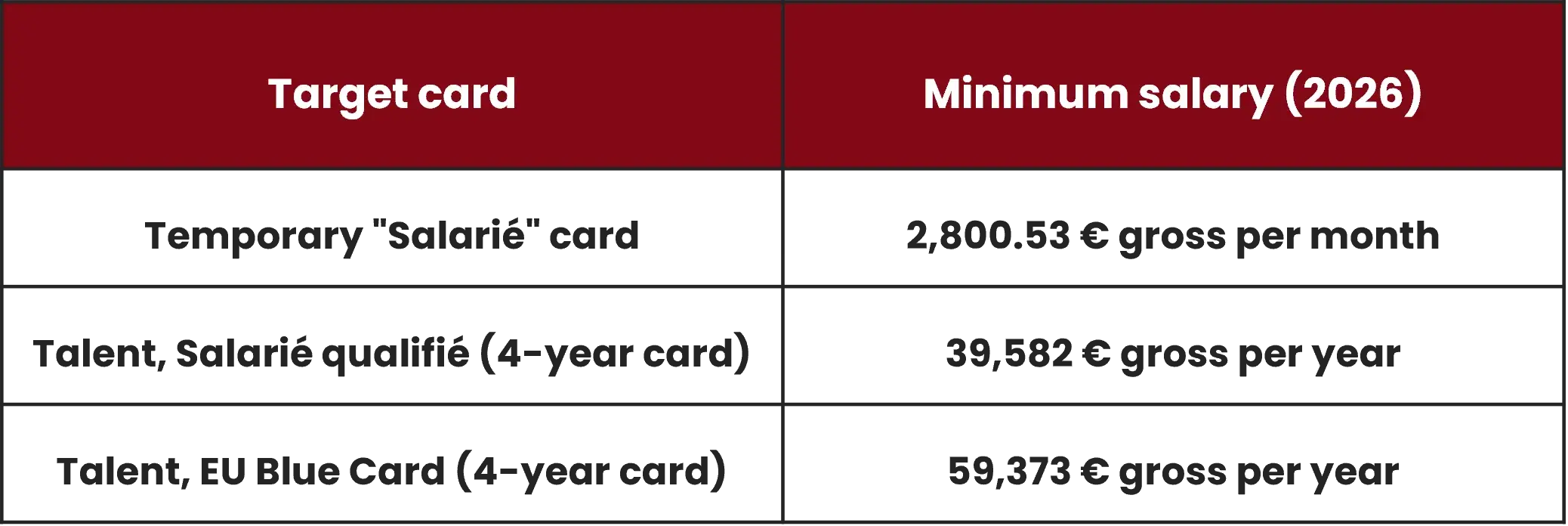
Median salaries for business-school graduates often clear the temporary "Salarié" threshold, which is set at 1.5 times the monthly SMIC, so the change of status is realistic for many graduates. Planning matters here: start the paperwork months ahead, because the change of status is filed before your current permit runs out. Algerian graduates are excluded from the RECE scheme but can apply for a provisional residence authorisation (APS) under the 1968 agreement. If you are weighing up where this pathway begins, it starts when you apply to a SKEMA programme taught in France.
FAQ: working on a student visa in France
-
Yes. Non-EU students with a validated VLS-TS or a student residence card may work up to 964 hours a year without a separate work permit. EU, EEA and Swiss students have no limit. The student's status must remain primarily about study.
-
There is no weekly limit as such. The cap is annual, 964 hours over a rolling 12 months, which averages about 20 hours a week. You may work up to 35 hours a week during breaks as long as the yearly total stays under 964 hours.
-
Yes, within the annual cap. You can work up to 35 hours a week during university breaks, but those hours count towards your 964-hour allowance, so sustained full-time work across the whole year is not possible on a student permit.
-
No, in the standard case. The student visa or card serves as the work permit within the 964-hour limit. A permit is needed only to exceed the cap, or for Algerian students, who require one from the first hour.
-
Yes. A curriculum internship runs under a convention de stage co-signed by your school. Internships longer than two months must pay a minimum gratification, 4.50 euros an hour in 2026, and the hours do not count towards your 964-hour work limit.
-
At the SMIC in force from June 2026, 12.31 euros gross an hour, the 964-hour annual cap spread evenly comes to about 80 hours a month, roughly 990 euros gross. Net pay is about 20% lower after social contributions.
-
Yes. Master-level graduates, including SKEMA's Master in Management and MSc programmes, can apply for the one-year RECE permit to look for work, then change status to a salaried residence card once employed.
Final checklist before you start working in France
- Validate your VLS-TS on the ANEF portal within three months of arrival, and pay the 150-euro tax.
- Confirm your status: 964 hours a year for non-EU students, 822 hours 50 minutes for Algerian nationals, no limit for EU, EEA and Swiss students.
- Make sure your employer files the nominative declaration at least two working days before you start.
- Keep every payslip, and track your hours against the annual cap.
- Use curriculum internships and apprenticeships, which sit outside or beyond the 964-hour limit, to gain experience without spending your allowance.
- Plan your after-graduation status (RECE, then a salaried card) several months before your student permit expires.
Official sources
The hours, pay rates and after-study rules above come from French official sources, which govern any point of detail. Service-Public.fr sets out the right to work, the 964-hour cap (file F2713) and the post-study RECE card (file F17319). Campus France (campusfrance.org) confirms the annual cap and the visa-validation step. The Ministry of the Interior (immigration.interieur.gouv.fr) and the ANEF platform cover the Algerian regime and the authorisation required above the cap, with the work-permit exemption set in the Code du travail (article R5221-2) and the Franco-Algerian Agreement of 27 December 1968, both on Légifrance (legifrance.gouv.fr). The SMIC, overtime and work-study rules are published by the Ministry of Labour (travail-emploi.gouv.fr), and the income-tax and social-contribution figures by the public finance services (economie.gouv.fr, impots.gouv.fr) and URSSAF (urssaf.fr). The SMIC and the tax thresholds changed during 2026, so confirm the value in force on the relevant official source before you act.