
News
How to study in China: a step-by-step guide for international students

Mainland China hosted 380,000 international students from 191 countries during the 2024-2025 academic year [Ministry of Education of the People's Republic of China, Department of International Cooperation and Exchanges, statistical release 2026-04-13, moe.gov.cn]. Asia supplied 61.1% of that cohort, Africa 16.2%, Europe 15.6%, and the Americas and Oceania the remaining 7.1%. Degree-seekers numbered 205,000, with 35% enrolled at postgraduate level and Engineering accounting for 27.8% of all degree enrolments. Self-funded students made up 92% of the total; the Chinese Government Scholarship covered the remaining 8%. The same release confirms a structural shift for 2026/2027: a new standardised admissions test, the China Scholastic Competency Assessment (CSCA), becomes mandatory for every undergraduate applicant, scholarship-funded or self-funded.
Several European business schools, including SKEMA Business School's Suzhou campus in Jiangsu province, operate full degree programmes alongside Chinese universities, providing an alternative route for candidates who want a recognised European credential and an academic experience anchored in China.
Quick answer: how to study in China in six steps
International students follow a six-step sequence shared between the host university, the Chinese embassy in the country of residence, and the local Public Security Bureau on arrival in China.
- Step 1. Shortlist a Chinese university and a programme (Chinese-taught or English-taught)
- Step 2. Verify the admissions and language requirements: HSK level for Chinese-taught tracks, IELTS or TOEFL for English-taught tracks, transcripts, references and study plan.
- Step 3. Prepare the application file (passport, notarised diplomas, study plan, recommendation letters, Foreigner Physical Examination Form).
- Step 4. Submit the application before the deadline.
- Step 5. Once the admission notice and the JW201 or JW202 form arrive, apply for the X1 visa at the Chinese Visa Application Service Center (CVASC) with jurisdiction over your place of residence.
- Step 6. Register at the host university, complete the medical check at the Health and Quarantine Bureau, and convert the X1 visa into a Residence Permit for Study at the local Public Security Bureau within 30 days of entry into China.
Why study in China in 2026
China's higher education sector combines scale, competitive rankings and a clear regulatory framework designed to attract international talent. The 380,000 international students recorded by the Ministry of Education in 2024-2025 mark a recovery to pre-pandemic mobility levels, with postgraduate enrolments and Engineering programmes driving the rebound [moe.gov.cn, 2026-04-13].
The C9 League, often presented as China's equivalent of the Ivy League, posts the following positions across the three major global rankings:
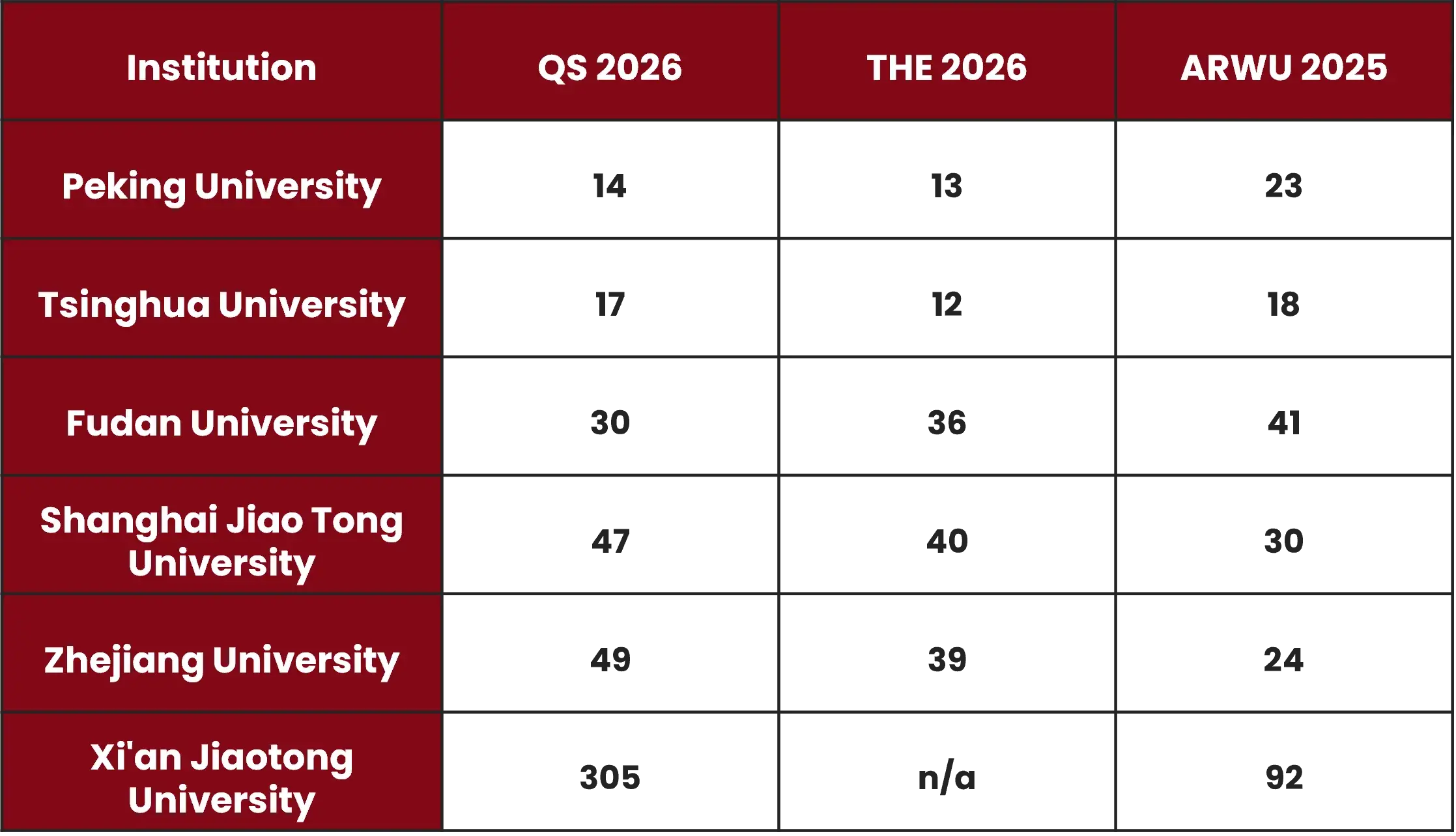
Sources: QS World University Rankings 2026 (published 19 June 2025, topuniversities.com); Times Higher Education World University Rankings 2026 (published 8 October 2025, timeshighereducation.com); Academic Ranking of World Universities, Shanghai Ranking 2025 (published 15 August 2025, shanghairanking.com).
Tsinghua University posted a perfect industry collaboration score (100/100) and a research quality score of 93.9 under Times Higher Education criteria. In computer science, Tsinghua and Shanghai Jiao Tong University tied for first place worldwide in CSRankings publications.
For UK, EU and Commonwealth students, the career proposition rests on two pillars. The first is direct exposure to a graduate market that recruits foreign talent into technology, green energy, supply chain finance and luxury management. The second is the increasing relevance of Mandarin and of working familiarity with Chinese regulatory environments for European multinationals operating under "China+1" supply chain strategies.
Can foreigners study in China? Eligibility basics
Foreign nationals can enrol at any Chinese university authorised by the Ministry of Education to recruit international students, subject to three baseline requirements: a valid passport, a previous diploma at the corresponding academic level, and proof of language proficiency in the language of instruction.
- Bachelor's programmes require a recognised secondary school diploma (UK A levels, French baccalauréat, equivalent foreign qualification) and, from 2026/2027, the new CSCA score.
- Master's programmes require a recognised bachelor's degree in a related field, transcripts and a research-oriented study plan.
- Doctoral programmes require a recognised master's degree, a detailed research proposal and the formal endorsement of a supervisor at the host institution.
Most universities require candidates to be aged between 18 and 30 at the start of the academic year for undergraduate intake, with the ceiling raised to 35 for master's and 40 for doctoral applicants. Scholarship-specific schemes apply tighter age limits (CSC undergraduate: 25 maximum; CSC master's: 35 maximum; CSC doctoral: 40 maximum).
Choose the right Chinese university
The choice of institution should weigh four criteria: the academic reputation of the university in the field, the cost of living in the host city, the share of programmes taught in English, and the recognition of the diploma in the candidate's home country.
Public universities dominate the international student market. The "Double First-Class" initiative, launched by the Ministry of Education in 2017, designates approximately 140 universities and 460 disciplinary programmes as national priorities. The C9 League sits inside that perimeter, alongside flagship institutions such as Nanjing University, the University of Science and Technology of China (USTC), Harbin Institute of Technology and Xi'an Jiaotong University (XJTU).
City choice has a measurable financial impact. Beijing, Shanghai and Shenzhen run as tier-1 megacities, with rents, transport and meals at the upper end of the national grid. Provincial centres such as Suzhou, Xi'an, Nanjing and Hangzhou cut the monthly student budget by 25% to 35% while remaining within 30 to 90 minutes of a tier-1 hub by high-speed rail. Suzhou specifically sits 25 minutes from Shanghai by train and concentrates a dense international academic and corporate ecosystem inside the Suzhou Industrial Park.
For UK applicants, academic recognition is handled by UK ENIC (Ecctis), which issues Statements of Comparability mapping Chinese bachelor's, master's and doctoral qualifications onto the UK qualifications framework [enic.org.uk]. For French and EU applicants, the equivalent service is ENIC-NARIC France, which charges a €20 filing fee and a €100 evaluation fee on admissibility [service-public.gouv.fr]. Mainland China is a signatory of the Asia-Pacific Regional Convention on the Recognition of Qualifications in Higher Education, which underpins those mutual recognition arrangements. Double-degree programmes registered under the French RNCP, such as the SKEMA Master in Management (RNCP n°41054), provide direct EHEA-wide recognition without a separate comparability procedure.
Pick the right programme
International candidates choose between four academic formats, with very different durations, costs and admission criteria.
-
Full Chinese degree programmes run for four to five years at bachelor's level, two to three years at master's level, and three to five years at doctoral level. The diploma is issued by the Chinese host university, registered with the Ministry of Education, and recognised internationally through the standard ENIC-NARIC procedure.
-
Joint and dual-degree programmes the joint MSc in Entrepreneurship and Innovation (Big Data and Artificial Intelligence Management) operated by SKEMA and Xi'an Jiaotong University was distinguished by the Sino-French Innovation and Cooperation Award of the China-France Chamber of Commerce in late 2024, and graduates collect an MSc issued by SKEMA together with a study certificate from XJTU.
-
Exchange semesters are bilateral, organised between a partner university in the candidate's home country and a Chinese host, and require neither a separate admission file nor a degree-level application. They run one or two semesters and use the X2 visa for stays under 180 days.
-
Short formats include summer schools (two to four weeks at C9 universities, mixing introductory coursework and cultural programmes), winter schools, and Chinese-language years aimed at HSK certification. Confucius Institute Scholarships cover the language-focused track.
Study in China in English or in Chinese?
The language of instruction shapes admission requirements, daily life on campus and post-graduation labour-market positioning. Both routes lead to nationally recognised degrees, but the operational implications differ.
English-medium instruction (EMI) programmes are taught entirely in English by Chinese and international faculty. They cover the most internationally exposed fields (business, management, finance, AI, international relations) and account for the majority of joint and dual-degree formats. Admission requires IELTS 6.0 or higher, or TOEFL 80 or higher, alongside academic transcripts.
Chinese-medium programmes require certified HSK proficiency, give access to a much wider catalogue of disciplines (humanities, law, medicine, traditional Chinese studies, large segments of STEM) and substantially raise the candidate's employability in domestic Chinese roles. Daily life on campus also changes: administrative procedures, off-campus housing contracts and most internships run in Mandarin.
Many candidates begin with a one-year Chinese Language Foundation programme (HSK preparation) before progressing to a Chinese-medium bachelor's or master's degree, particularly in fields such as Chinese medicine, law and Chinese studies where no equivalent EMI track exists.
Language requirements: HSK, IELTS, TOEFL
Language proficiency is documented through standardised tests recognised by the Chinese Ministry of Education and individual host universities.
The new CSCA standardised test (mandatory from 2026/2027)
The China Scholastic Competency Assessment (CSCA) is a new standardised admissions test required of every international undergraduate applicant to a Chinese university from the 2026/2027 academic year onwards, scholarship-funded or self-funded. It is organised by the China Scholarship Council (CSC) and run on a dedicated digital platform [csca.cn, joint specifications published November 2025].
The test combines three modules:
- Specialised Chinese (mandatory): adapted to the academic track chosen by the applicant.
- Mathematics (mandatory): 60 minutes, 48 single-answer multiple-choice questions.
- Physics or Chemistry (mandatory for STEM majors): one module out of the two, depending on the host university's specifications.
The CSCA runs five testing windows per year: January, March, April, June and December. Candidates take the test on a desktop computer using a dedicated software environment. The technical requirements are explicit: 64-bit Windows 7 SP1 or higher, 4GB of RAM minimum, and an internet connection of at least 20 Mbps. macOS is not supported, a practical detail that UK and EU candidates should anticipate when planning the test logistics.
Each university sets its own qualifying threshold per module and per field of study, and the score is mandatory at the application stage. Candidates planning a September 2027 intake should target the December 2026 or January 2027 windows to secure a result before the main application deadlines.
How to apply to a Chinese university, step by step
Applications can be filed through one of two channels: directly with the university's international office, or via a centralised platform such as CUCAS (China's University and College Admission System) or China Admissions, which process documents across multiple host institutions in exchange for a service fee.
The application file is standardised across institutions and includes:
- A valid passport with at least six months of remaining validity and two blank pages.
- Notarised and translated diplomas and academic transcripts.
- Language proficiency certificates (HSK and/or IELTS/TOEFL).
- A study plan or research proposal: minimum 500 words at undergraduate level, 800 to 1,500 words at postgraduate level.
- Two recommendation letters signed by professors or associate professors.
- The Foreigner Physical Examination Form, completed by a licensed physician, mandatory for any stay exceeding six months.
- A certificate of non-criminal record, officially translated and legalised.
- The CSCA score (undergraduate applicants from 2026/2027 onwards).
Application fees vary by institution and route, typically between CNY 400 and CNY 800 per university. Interviews are common at postgraduate level and at top-tier institutions, usually conducted by video conference. Decisions are notified between four and twelve weeks after submission for self-funded applications and between two and four months for CSC-funded applications, which include an inter-institutional review.
When to apply: timeline and deadlines
The Chinese academic year runs from September to July, with a smaller intake in March. Application windows align with that calendar, and missing a window pushes the start date back by one semester.
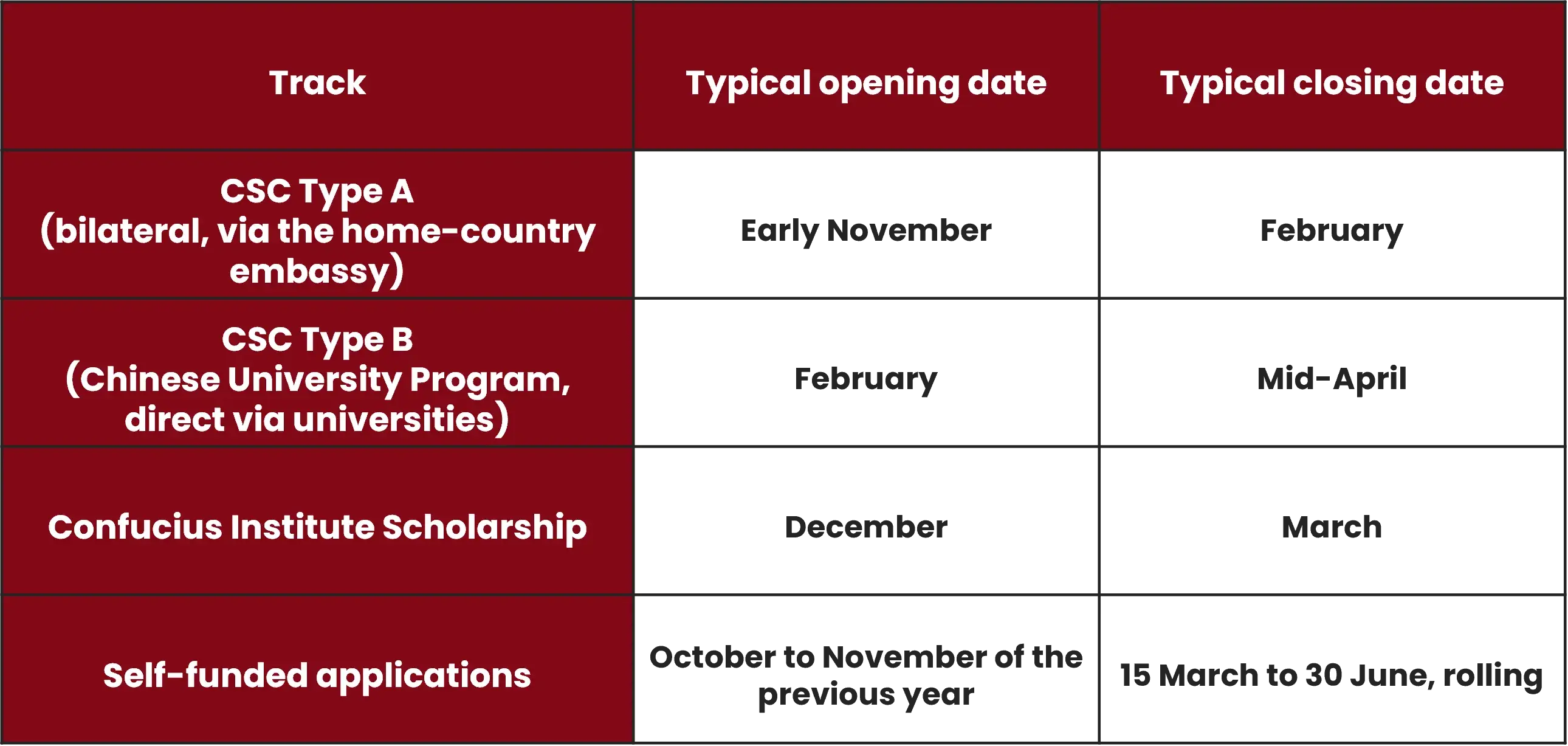
[Sources: cucas.cn 2026, csc.edu.cn 2026].
A defensible schedule for a September 2027 intake is therefore: CSCA registration and sitting between December 2026 and April 2027 (undergraduate applicants); CSC Type A submission between November 2026 and February 2027; CSC Type B and self-funded applications between February and June 2027; X1 visa filed at the CVASC between July and August 2027 once the admission notice and the JW201 or JW202 form are received.
Scholarships to study in China
Chinese authorities operate one of the largest international scholarship systems in the world, with two national schemes at its core.
Chinese Government Scholarship (CSC)
The CSC, administered by the China Scholarship Council, is the flagship scheme. It is split into three application paths for the 2025-2026 cycle:
Full CSC packages cover tuition, on-campus dormitory accommodation, comprehensive medical insurance (CNY 800 per year), and a monthly stipend of CNY 3,500 for doctoral candidates, CNY 3,000 for master's, and CNY 2,500 for bachelor's [csc.edu.cn, 2026].
Confucius Institute Scholarship (CIS)
Funded by the Chinese International Education Foundation, the CIS targets students of Chinese language, linguistics and literature. It covers tuition, shared on-campus housing, medical insurance and a monthly allowance: CNY 3,000 for MTCSOL (Master's in Teaching Chinese to Speakers of Other Languages) and CNY 2,500 for BTCSOL (Bachelor's) and short-term language students. An additional CNY 700 per month applies if off-campus living is approved.
CSC funding covers approximately 8% of the international student population. The remaining 92% are self-funded, and these figures should set realistic expectations for candidates without a pre-existing bilateral channel through their home-country embassy.
Living costs
Monthly living costs vary substantially between tier-1 megacities (Beijing, Shanghai) and provincial centres (Suzhou, Xi'an, Nanjing).
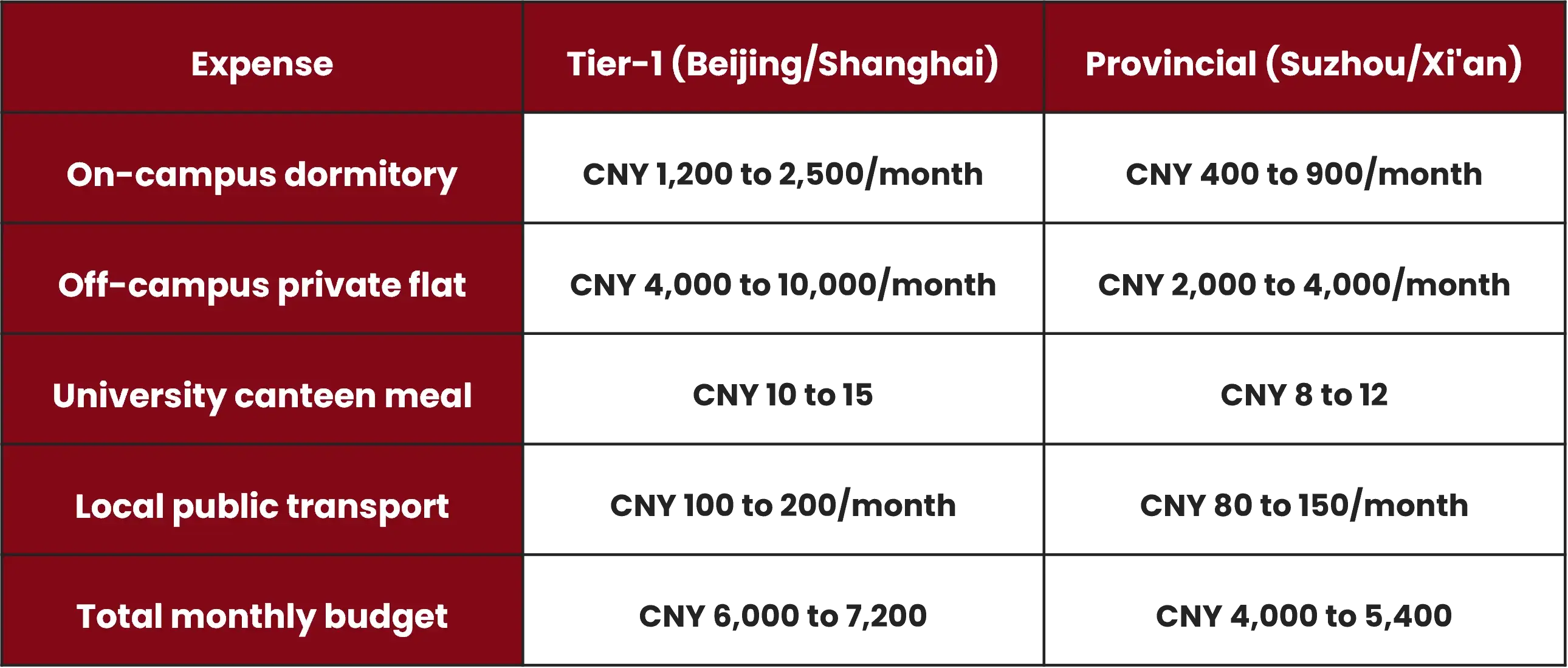
Suzhou is explicitly classified as a provincial centre in this grid, with monthly costs around 30% below the Shanghai equivalent and a 25-minute high-speed rail connection to central Shanghai.
Comprehensive medical insurance is mandatory throughout the studies under Ministry of Education regulations. Universities arrange collective enrolment in the "Comprehensive Insurance and Protection Scheme for Foreigners Staying in China", typically underwritten by Ping An or PICC, at CNY 800 per academic year (CNY 400 per semester). The plan covers in-patient treatment up to CNY 400,000 per year, outpatient and emergency care up to CNY 20,000 (with a CNY 650 cumulative deductible and 85% reimbursement), and accidental death or disability up to CNY 100,000. Dental, optical and mental health coverage are excluded and usually require a private top-up policy in the CNY 2,000 to 5,000 per year range.
For day-to-day life, a local SIM card from China Mobile, China Unicom or China Telecom costs CNY 50 to 150 per month. A local bank account (ICBC, Bank of China, China Construction Bank) is needed to link WeChat Pay and Alipay, the two payment platforms used in virtually all retail transactions. Cash and foreign credit cards are now rarely accepted outside international hotels and a small number of tier-1 retailers.
Student visa X1 / X2 and residence permit
The Chinese student visa is split into two categories defined by the duration of stay.
The Ministry of Education issues two distinct application forms that determine the financial proof required for the visa:
- JW201 is issued to recipients of a Chinese Government Scholarship, and acts as proof that tuition and living expenses are covered by the state.
- JW202 is issued to self-funded students and to recipients of university-specific or provincial scholarships. Candidates must produce personal or parental bank statements showing liquid funds of approximately £5,000 to £7,000 for the first year of study.
Original signed copies of both forms must be presented at the embassy application and again at the in-country residence permit conversion.
UK-based candidates file at the Chinese Visa Application Service Center (CVASC), with offices in London, Manchester, Edinburgh and Belfast [visaforchina.cn]. In-person biometric submission is mandatory for applicants aged 14 to 69. Regular processing takes four working days; express processing is three working days. The combined consular and service charge for a single-entry standard application sits at approximately £151 for UK citizens.
Important warning: tourist visa exemptions do not extend to study purposes. Entering China under a tourist status with the intention of studying is strictly prohibited and exposes the candidate to immediate fines, deportation and a multi-year ban on re-entry [visaforchina.cn, 2026].
Life on campus in China
On-campus dormitories remain the default option for international students. They are cheaper, simpler administratively, and handle police accommodation registration automatically. Off-campus rentals provide more privacy and longer-term flexibility, but the tenant must report to the local police station within 24 hours of moving in to complete a Temporary Accommodation Registration Form.
Academic culture at Chinese universities emphasises structured coursework, regular formative assessment and high expectations on attendance. Class sizes vary widely between domestic Chinese-taught programmes (often 60 to 120 students per lecture) and international EMI programmes (typically 25 to 50). Faculty interaction outside the classroom tends to be formal, and students are usually expected to engage through institutional channels rather than informal contact.
Internet access requires anticipation. A number of widely used Western search engines, messaging applications and news platforms are not accessible from mainland networks. International students typically install a Virtual Private Network (VPN) on their personal devices before entering the country, and many universities provide a separate institutional connection for academic research purposes.
After graduating: working in China and beyond
Foreign graduates of Chinese universities can apply for a Z visa (Work) to take up employment in mainland China. The application is initiated by the employer, which must hold an authorisation to hire foreign staff and obtain a "Notification Letter of Foreigner's Work Permit" from the Bureau of Foreign Experts. The Z visa is converted to a Residence Permit for Work without leaving the country.
Three regulatory reforms introduced in 2025-2026 have substantially lowered the barrier for recent graduates [Ministry of Human Resources and Social Security, revised guidelines published March 2026, gov.cn]:
- The "Green Channel" for master's graduates exempts international master's graduates (or above) of a Chinese university with an average score of at least 80/100 (Grade B+) from the historical two-year prior work experience requirement.
- The Free Trade Zone (FTZ) exemption allows bachelor's graduates to work immediately upon graduation if the employer is registered in a designated FTZ such as Shanghai (Pudong), Shenzhen (Qianhai) or Hainan.
- The STEM K-Visa pilot enables top-tier STEM graduates from world-ranked universities to remain in selected municipalities to seek high-tech employment without holding an immediate offer at the point of graduation.
For Class B work permits (Professional Talent), a points-based index sets the bar at 60 points minimum. Points are awarded against several criteria: 10 points for the 18 to 25 age bracket, 15 points for a master's degree, 5 points for HSK Level 5 or 6, and 5 points for graduation from a top-tier Chinese institution. The structure is calibrated to let qualified young graduates clear the threshold without substantial prior experience.
Internships during the studies are tightly regulated. X1 holders are not permitted paid employment, but can undertake part-time off-campus internships only with an official "Internship Annotation" issued on the Residence Permit by the host university and the local PSB Entry-Exit Administration. Internships without that annotation expose the student to fines and deportation. The S visa, sometimes mentioned in older guidance for student internships, in fact covers family members accompanying foreign professionals working in China and is not a route for academic internships.
A structured exit into the European or global labour market is one of the most common post-graduation paths for international students. Programmes designed for that trajectory, such as the SKEMA MSc International Business with a Doing Business in China specialisation, align the academic calendar with internships in Suzhou or Shanghai and post-graduate placements in European and Asian operations.
Common mistakes to avoid
A small number of recurring mistakes account for most application delays and visa refusals.
- Filing without notarised translations of diplomas and transcripts. Original-language documents are not accepted at the application stage, and the notary chain has to be completed before the deadline.
- Underestimating the CSCA timeline for September 2027 intakes. The test runs in fixed windows, and a missed sitting pushes the entire application back by one semester.
- Confusing CSC Type A and Type B deadlines. Type A closes two to three months earlier than Type B and is filed through the embassy, not the university.
- Entering China on a tourist visa with the intention of studying. The X1 visa is mandatory for any stay above 180 days, and the tourist channel is not convertible in-country.
- Missing the 30-day residence permit conversion at the local PSB after arrival, which leads to fines and, in repeated cases, deportation.
- Choosing a city without checking budget alignment. A Beijing or Shanghai dormitory costs between two and three times the equivalent in Suzhou or Xi'an, and that gap drives most of the difference between a comfortable and a tight monthly budget.
FAQ
-
Yes. A majority of master's programmes at C9 League and Double First-Class universities are taught entirely in English, with admission requirements set at IELTS 6.0 or TOEFL 80. Selected bachelor's tracks (notably MBBS Medicine and international business programmes) also run in English. Chinese-medium programmes remain the rule in law, traditional Chinese medicine and most humanities.
-
Monthly living costs sit at CNY 6,000 to CNY 7,200 in tier-1 megacities (Beijing, Shanghai) and CNY 4,000 to CNY 5,400 in provincial centres (Suzhou, Xi'an, Nanjing). Comprehensive mandatory health insurance adds CNY 800 per year.
-
Yes. UK ENIC (Ecctis) issues Statements of Comparability mapping Chinese bachelor's, master's and doctoral qualifications onto the UK framework. ENIC-NARIC France issues certificates of comparability (€20 filing + €100 evaluation). Mainland China is a signatory of the Asia-Pacific Regional Convention on the Recognition of Qualifications in Higher Education, which provides the underlying treaty framework.
-
It depends on the language of instruction. English-medium programmes require no HSK certification. Chinese-medium programmes require HSK Level 3 or higher at undergraduate level, and HSK Level 4 or 5 at postgraduate level. Candidates without the required HSK can enrol in a one-year Chinese Language Foundation programme or a Confucius Institute Scholarship before progressing to the degree.
-
Yes. The Chinese Government Scholarship covers tuition, on-campus accommodation, comprehensive insurance and a monthly stipend of CNY 2,500 (bachelor's) to CNY 3,500 (doctoral). The CSC funds around 8% of the international student population, so candidates should plan a fallback self-funded route.
-
Direct application through the host university's international office is the standard route, with no intermediary fees. Centralised platforms such as CUCAS and China Admissions process documents across multiple universities for a service fee, which can save time for candidates submitting to four or five institutions in parallel.
-
Paid employment is not permitted on an X1 visa. Part-time off-campus internships are allowed only if the host university and the local Public Security Bureau issue an "Internship Annotation" on the Residence Permit. Working without that annotation triggers fines and possible deportation. Post-graduation, the Z visa and the 2025-2026 Green Channel reforms set the framework for full-time employment.
Planning your study path in China
The path from a shortlist of Chinese universities to a Residence Permit for Study in mainland China is procedural rather than discretionary: an admission file built around the host university and, from 2026/2027, the CSCA score; an X1 visa filed at the CVASC with the JW201 or JW202 form; a 30-day window after arrival to convert the X1 into a Residence Permit at the local Public Security Bureau. Reading the primary sources directly (moe.gov.cn, csc.edu.cn, visaforchina.cn) before each step keeps the file aligned with the most recent regulatory updates, particularly during the CSCA rollout and the post-graduation Z visa reform cycle.
For candidates who want to combine a Chinese academic experience with a recognised European credential, joint and dual-degree programmes shorten the recognition process and open structured pathways into the European graduate market. The next operational step is to compare options on the SKEMA Business School portfolio of international programmes and to submit a formal application through the SKEMA admissions portal once the academic track and the campus rotation have been confirmed.