
News
Mission Possible: back in Saint-Nazaire, ten SKEMA students recount their Atlantic crossing by sail
Pioneers, quite simply. Nineteen days later, after a stopover in Saint-Pierre and Miquelon and nearly 4,500 nautical miles aboard the Neoliner Origin, the ten SKEMA Business School students involved in the long-term Mission POSSIBLE project returned to dry land in Saint-Nazaire, Loire-Atlantique.
Accompanied by Bertrand Groslambert, Professor of Finance at SKEMA’s Sophia Antipolis campus, the students were returning from their exchange semester on the Raleigh campus in North Carolina. Their journey home was anything but ordinary. Conceived as a full-scale experiment, it set out to question the role of air travel in international, and student, mobility, while exploring lower-carbon alternatives.
An idea born several years ago
The project began with an intuition developed by Bertrand Groslambert in 2021: to turn a simple return journey from an academic exchange into a field of study. When the idea was presented to Alice Guilhon, Dean and Executive President of SKEMA Business School, it soon received strong support.
It then took shape through the involvement of SKEMA’s teams, Sailcoop, NEOLINE and several partners, including the Riché Foundation, HEYME insurance and the SKEMA Alumni community. “Without you, there would have been no project. With you, this project became an incredible success,” Bertrand Groslambert wrote in a message to the students after their arrival.
A floating laboratory on the Atlantic
Aboard the Neoliner Origin, the students discovered the daily reality of maritime transport, shared life with the crew and observed the performance of a vessel designed to reduce greenhouse gas emissions through wind-assisted propulsion. For Louise-Marie Croizet, a Global BBA student, the experience gave her a direct insight into the changes under way in the shipping industry. “Understanding how the maritime sector can reinvent itself. The Neoliner Origin is a perfect example,” she wrote in her account of the journey.
The most symbolic moment of the crossing was no doubt when the engines were turned off and the wind took over. In his logbook, Baptiste Lavenir Aleonard, an M1 student in the Master in Management (PGE), put it this way: “We turned off the engines because wind propulsion was enough. It was a striking moment because, from that point on, the crossing made full sense.”
“My phone swallowed 5GB of internet in two days”
On some days, the ship moved under sail, using only the fuel needed to power the onboard equipment. It was a concrete demonstration of the potential of wind-assisted propulsion for the maritime transport of tomorrow.
An ode to slow time and disconnection
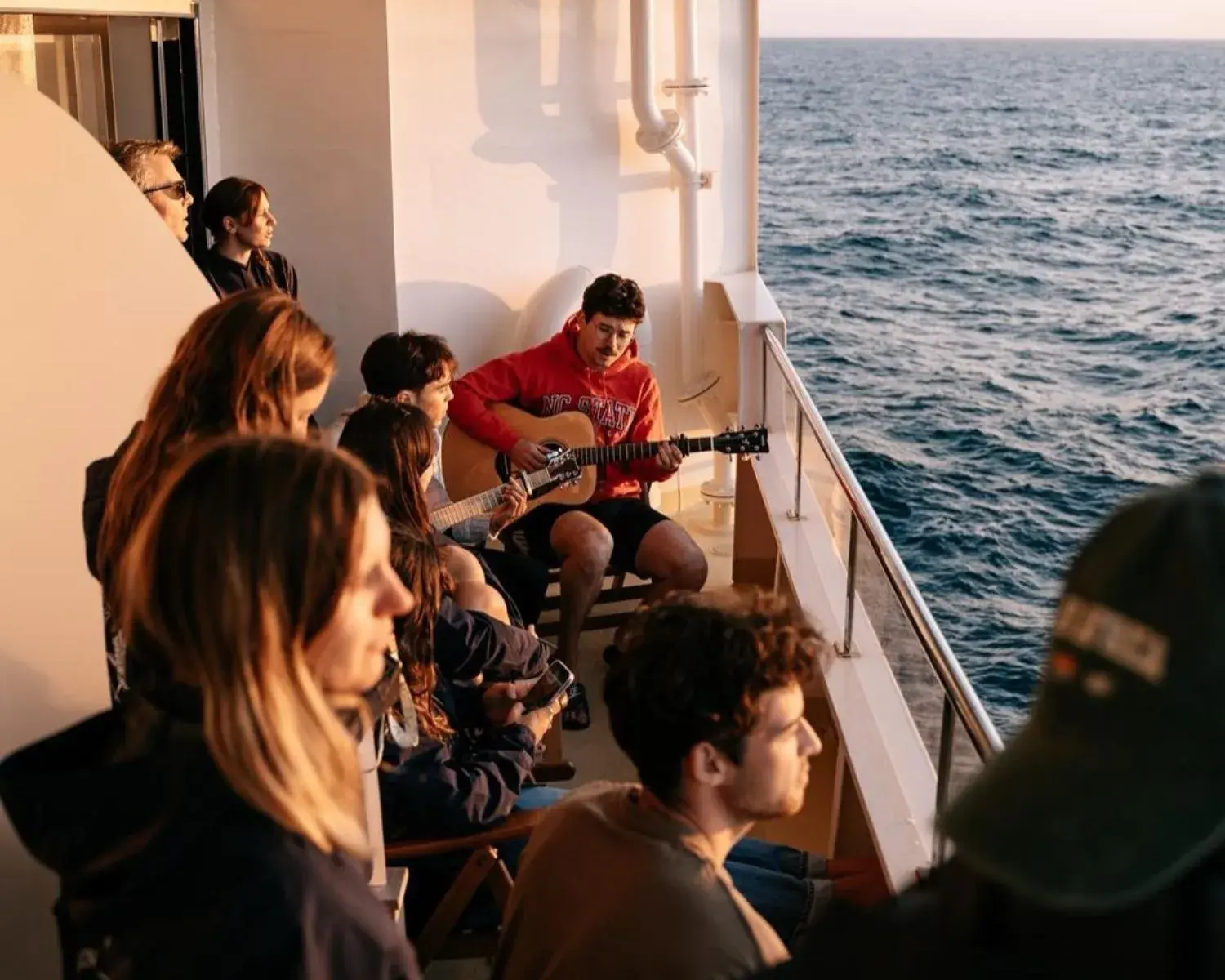
Mission POSSIBLE cannot be told without speaking about the relationship with time imposed by the ocean. For almost three weeks, notifications gave way to conversations, reading, board games, sightings of dolphins and whales, and long evenings spent watching the stars from the deck.
“On the boat, time stopped,” Baptiste Lavenir Aleonard wrote in his logbook. “I am 100% in the present.”
Disconnection was not always a matter of choice. “My phone swallowed 5GB of internet in two days,” he joked. Yet this break from everyday life became one of the main lessons of the journey. For many of the students, the crossing offered a chance to rediscover a rare luxury: taking time.
“Seeing nothing but ocean as far as the eye can see, coming across dolphins and a whale in the middle of the Atlantic, sharing those moments with wonderful people. Some images never fade,” Baptiste summed up.
A collective adventure, surrounded by grandeur
Over the course of the crossing, the students describe the emergence of a close-knit group. “There are no small groups, only one big group. We are all kind to one another,” Baptiste Lavenir Aleonard noted.
The days revolved around shared meals with the crew, games of Catan and Dixit, quizzes, improvised sports sessions on deck, against the magnificent backdrop of the ocean, conversations until nightfall, and sightings of dolphins and whales.
After several days surrounded by the ocean, the stopover in Saint-Pierre and Miquelon became one of the highlights of the adventure. The students phoned their families, explored the archipelago on an 11-kilometre hike and enjoyed a few hours on land before heading back out to sea.
“That was when we realised we were really there,” Lilou Lafont wrote in her logbook. The arrival of French customs officials and the Saint-Pierre and Miquelon stamp in their passports gave the stopover a particular flavour.
As the days passed, the ship became far more than a means of transport. A place to live. A floating classroom. Almost a second home. “The Neoliner Origin will always have a place in our hearts,” Lilou wrote a few days before arrival.
A low-carbon experience
Beyond the human adventure, Mission POSSIBLE was also an environmental experiment. According to estimates based on onboard data and discussions with the crew, the Baltimore-Saint-Nazaire crossing generated around 5kg of CO₂ equivalent per passenger.
By comparison, a transatlantic flight from New York to Paris represents around one tonne of CO₂ equivalent per passenger, almost 200 times more. On this crossing, the Neoliner Origin consumed around 60% less fuel than a conventional cargo ship. When calculated for passenger transport, emissions are estimated at around 0.8 grams of CO₂ equivalent per kilometre per person, compared with nearly 200 grams for air travel.
What next?
The arrival in Saint-Nazaire marks the end of the crossing, but not the end of the project. A photo exhibition, podcasts, testimonials, feedback sessions and productions created during the journey will, in the coming months, share the lessons of this adventure.
For Bertrand Groslambert, the experience showed that a return journey could be transformed into a pedagogical, human and scientific project. For the students, the memory will no doubt be simpler.
Dolphins at the bow. A whale seen offshore. A cabin built in the passenger lounge. Sunsets over the Atlantic. Nineteen days outside time.
The ten participants in the adventure were Louise-Marie Croizet, Baptiste Lavenir Aleonard, Chloé Bétant, Enza Reffuveille, Keo Rollin, Thomas Dosset, Aldric Lamodière, Éloïse Vuillemin, Jules Rousseau and Lilou Lafont.