
News
How to recruit at a university careers fair
Why career fairs are worth the day again
On Handshake, the largest early-career platform in the United States, the average number of applications per job rose 26% in a year while the number of jobs posted fell by more than 16% (Handshake, 2026 Workforce Outlook, platform data to August 2025). At the same time, 44% of employers say they have detected AI-generated applications, and another 35% do not know whether they have (National Association of Colleges and Employers, Job Outlook 2026 Spring Update, 159 respondents). Since candidates can now submit polished applications with minimal effort, applications no longer differentiate them effectively.
The market has not shrunk so much as gone quiet on both sides. American employers expect to hire 5.6% more from the Class of 2026, having projected a 2.4% cut in the autumn, and almost all of that gain sits with organizations of more than 5,000 employees, which are up 8.7% (NACE, Job Outlook 2026 Spring Update). More applications chasing fewer postings, with employers hiring cautiously, puts the pressure on the quality of the sort rather than on its speed.
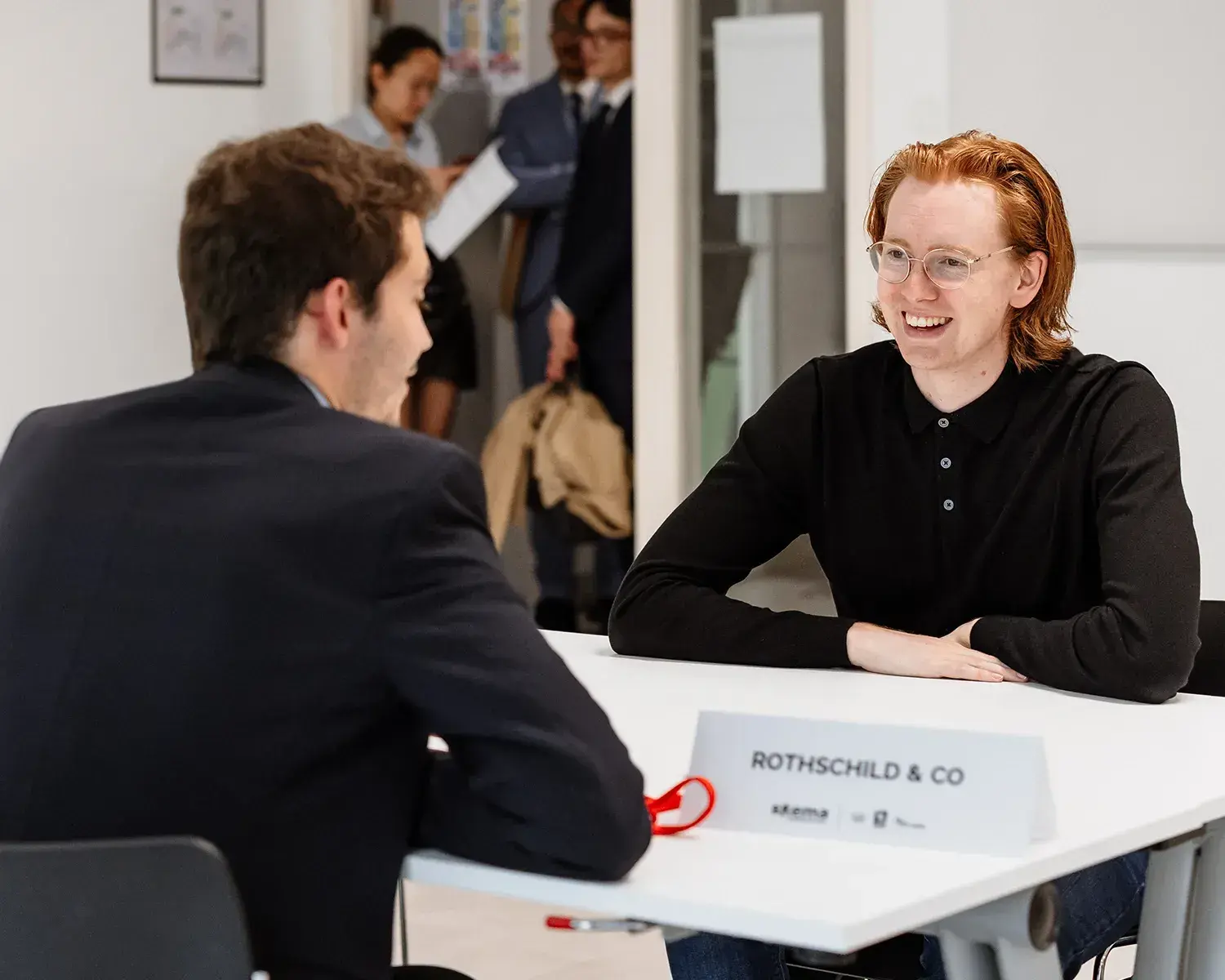
That is what makes a fair worth a day again. It is the one channel where you meet the person before the paperwork, and where the qualities an application can no longer evidence are open to direct observation. Most employers still plan the day around visibility, which is why most stands are staffed to be looked at rather than to assess anyone.
Set your objective before you book the stand
Decide what success looks like in numbers before you commit the day: how many students to meet, how many interviews to schedule, which roles to fill, which degree disciplines to target, and which year of study.
That last one is the most commonly missed. A careers fair is not a single audience. Penultimate-year students are your placement and internship pipeline. Final-year students are your graduate scheme. Arriving without having decided which of the two you came for is how a team spends a day talking to people it cannot hire.
Internships are not a consolation prize. They are the strongest signal you can buy. Across successive editions of its Job Outlook survey, NACE finds internship experience to be the single most influential factor when employers choose between two otherwise equally qualified candidates, with an internship served at the hiring organization itself ranking above one served elsewhere in the industry. The retention data says the same thing later: more than three-quarters of new hires who interned with the employer are still there after a year and more than half after five, against fewer than half at one year and around a third at five years for hires with no internship behind them (NACE, 2026 Internship & Co-op Report, 284 organizations). The fair fills that pipeline. Each year, more than 9,000 SKEMA students undertake an internship or apprenticeship lasting between two and 24 months, and companies can reach SKEMA's early-career talent through campus events, job postings and partnerships.
Choose the right fair, and work with the careers service
Not every fair deserves your day. Audience, disciplines, size, format, timing and the density of competitors on the floor all change what you get out of it.
The careers service is the part of the process employers use least well. It organizes the event, which means it knows what you are walking into. Ask it, before you book: the expected number of students, the disciplines and years of study represented, how the event will be promoted, the stand logistics, the visibility options, and whether meetings can be arranged in advance.
The framing matters more than the list. A school is not a stand rental business. An employer who arrives with a precise brief, three vacancies, two disciplines, and a target year of study, gets a different conversation from one who books a table and hopes. The request shapes what the organizer can offer.
Where the need is specific, a sector event beats a general fair. SKEMA runs Career Fairs and Sector Days across its campuses; the latter focus on a single industry, including Finance Day, Audit & Consulting Day, and Luxury Day.
What to bring, and what nobody reads
Bring what supports a conversation, and what captures a contact you can act on afterward.
- Something that shows the actual work: a real project, a real team, a first-year task list. Students ask what the job involves before they ask what the company stands for.
- A way to capture contacts that survives the day, such as a QR code pointing to a short form, with only the fields you will genuinely use.
- Whatever you are permitted to say about pay, agreed upon before you arrive.
- People who can answer questions matter more than any material you print.
The corporate brochure goes unread. Branded merchandise reliably draws a queue of people who want the merchandise.
On capture, the useful test is whether you can act on a contact a week later. A name and an email address with no note on what was discussed will not survive the return to the office.
Who should represent the company at the stand?
Send people who did the job recently.
A graduate who joined 18 months ago can describe the first year in specifics: the work, the team, the progression, the parts that were harder than expected. That is what makes an employer promise verifiable. An HR team can describe the process but not the job, and students notice the difference within a minute.
They will also ask about money. Salary has returned to the top of this cohort's professional priorities, cited by 74% of respondents to the SKEMA x EY Talent Barometer 2026, conducted by Ipsos BVA among 1,609 students and recent graduates in France. American graduating seniors put it slightly differently but not lower: a high starting salary sits in their top five attributes in an employer, alongside career growth, benefits, job security, and friendly colleagues (NACE, 2026 Student Survey, more than 1,860 graduating seniors). For the Class of 2026, employers project an average starting salary of $68,873 for a business degree, up 5.5% on the previous class (NACE, Winter 2026 Salary Survey, 150 employers). Deflecting the question is read as an answer, and usually as a poor one.
Brief the team before the day: the roles open, the disciplines targeted, what may be said about pay, what happens next, and who owns the follow-up.
How to run the conversation
Open with something other than "so, what do you know about us?" It tests preparation rather than ability, and it pushes the student straight into a rehearsed answer.
Ask instead about something they have done: a project they finished, or a problem that did not work out. Then push on the detail. What did they choose, why, and what would they do differently? The aim is to hear a student account for their own work, which a generated application can't provide. It is also what employers say they are looking for. When asked what they want to see on a resume, 59% of employers want specific skills backed by examples, compared with 16% who want a list of specific skills and 2% who want a list of general ones (NACE, Job Outlook 2026 Spring Update, 161 respondents). The example is the part a form cannot carry and a conversation can.
The later stages no longer protect you either. Only 20% of employers use any tool to detect AI assistance across the application, testing, and interview stages, and 64% use none at all (NACE, 2026). A conversation across a stand is one of the few unmediated signals left in the process, which is an argument for using the twenty minutes deliberately rather than filling them with small talk.
Qualify as you go. Agree a light scoring grid before the day, three or four criteria, marked immediately by whoever held the conversation rather than reconstructed that evening. Nobody recalls the fourteenth conversation accurately by the sixtieth.
Turn the day into hires: interviews and follow-up
Decide in advance whether you interview on site or afterward. On-site works for high-volume, well-defined roles, where a short structured conversation is genuinely decisive. For a graduate scheme that ends in an assessment center, use the fair to shortlist and book the next step while the student is still standing in front of you.
Then move quickly. A junior candidate reads silence as rejection, and the strong ones are talking to other stands the same afternoon. Send something within days that refers to what was actually discussed. A generic mailshot to everyone who scanned the QR code undoes the day's work.
The standard you hold yourself to is the hard part. A fair is judged on hires, not on CVs collected, and a day that produced 80 contacts and no interviews was an awareness campaign at the price of a recruitment one.
Measure it properly
Track the sequence rather than the crowd:
- Qualified contacts, meaning those who met your criteria, not everyone who scanned
- Interviews scheduled
- Attendance rate at those interviews
- Offers made
- Hires
- Internship and placement conversions into permanent roles
For each, set a baseline from your last event, a target, an owner, and a review date. A single event tells you very little. Three comparable events tell you which fairs to keep.
Choose the benchmark carefully. No published American figure isolates what a single campus event costs or returns. What is published is the scale of the function around it: a median early-careers recruiting budget of about $114,000 a year, an average of 27 days between a student's first interview and an offer, and 9 days for the student to answer (NACE, 2024 Recruiting Compensation Report and 2025 Recruiting Benchmarks Report). The comparison worth making is against what sorting your open application flow costs you, in hours, for the same number of viable candidates.
Where to start
A day at a fair is one of the few points in the year where you can watch a candidate think before a document has spoken for them. That is worth planning properly, and worth choosing the right event for. SKEMA runs Career Fairs and Sector Days across its campuses throughout the year, and companies can take part in our recruitment events by sending their participation preferences. SKEMA's corporate partnership options set out broader arrangements for recruitment, employer branding, and involvement in teaching. To discuss which events match your roles, contact the corporate relations team.
Frequently asked questions
-
Set numerical objectives before booking: students to meet, interviews to schedule, roles, disciplines, and year of study. Ask the careers service what to expect. Send colleagues who have done the job recently, not only recruiters. Ask candidates to account for work they have actually done, score each conversation on the spot, and follow up within days. Judge the event on hires, not on contacts collected.
-
Bring people who can describe the job, something that shows real work, whatever you are allowed to say about pay, and a contact capture method with fields you will use. Corporate brochures go unread. Branded merchandise generates traffic, not candidates. The useful test for anything you pack is whether it helps a conversation or helps you act on one afterward.
-
Ask about a piece of work they have actually done, then push on the details: what they chose, why, and what they would change. Questions like these surface judgment and self-awareness, and they produce the thing employers say they want on a resume and rarely get, which is a specific skill backed by a specific example. Avoid the opening that only tests whether they researched you the night before.
-
Show the work rather than the brand. Students stop where they can find out what the job actually involves, what the first year looks like, and what it pays. A recent graduate at the stand does more for footfall than any display, because passers-by can hear a real answer being given. Being explicit about the roles you are recruiting for filters traffic towards the people you can hire.
-
It depends on the role. For high-volume, well-defined positions, a short structured conversation on the day can be decisive and worth doing immediately. For a graduate scheme with a full assessment process, use the fair to shortlist and book the next step while the student is with you. What does not work is leaving the decision undecided until the day itself.
-
Track qualified contacts, interviews scheduled, attendance at those interviews, offers, hires, and internship conversions into permanent roles, each with a baseline, a target, and an owner. Compare across at least three events before drawing conclusions. Measure against the cost of sorting your open application flow for the same number of viable candidates, not the cost of the stand.
Sources
United States employer figures are drawn from the National Association of Colleges and Employers: Job Outlook 2026 Spring Update, conducted from 12 February to 17 March 2026 among 185 respondents, of whom 142 were NACE employer members; the 2026 Internship & Co-op Report, conducted from 15 October 2025 to 4 January 2026 among 284 organisations; the Winter 2026 Salary Survey, conducted from 8 October to 30 November 2025 among 150 employers; the 2026 Student Survey, conducted from 12 March to 15 May 2026 among more than 17,000 students at 258 institutions, with results reported for graduating seniors; the 2025 Recruiting Benchmarks Report, conducted from 21 April to 23 May 2025; and the 2024 Recruiting Compensation Report. Platform figures are drawn from Handshake, 2026 Workforce Outlook, based on job posting activity to August 2025 and on July 2025 surveys of 2,440 Class of 2026 students and 1,042 entry-level hiring managers. Young talent figures are drawn from the Ipsos BVA 2026 Talent Barometer for SKEMA Business School and EY, conducted among 1,609 students and recent graduates with less than three years of professional experience, surveyed online between 3 and 22 February 2026.